

 Login
Login


By Michelle Rabin, Ph.D.
I spent my professional career as a clinical psychologist treating adults and studying human behavior. Over decades of observing people — their motivations, fears, loyalties and blind spots, you begin to see patterns.
I’ve seen the good, the bad and the ugly of what human beings are capable of. Certain aspects of human nature become predictable. You learn how difficult it is for people to question beliefs when those beliefs are tied to their identity, their career and their social standing.
What I’m here to report is that there are a few things that are pretty obvious to just about anyone who has an opportunity to really see what is right smack in front of them.
You don’t need an advanced degree to understand it. You don’t need countless research articles to prove it. On some level, we all simply know that it’s true once the evidence becomes available.
… You don’t need to be a psychologist to know this.
This brings me to an uncomfortable but important issue: what happens when entire professional communities build their careers on assumptions that later become controversial or questioned? How do human beings react when the very foundation of their life’s work is challenged and brought into question?
… You don’t need to be a psychologist to know this.
Imagine a young person who wants to help people and chooses a career in medicine or public health. They attend good schools, train at respected institutions and are taught that organizations like the National Institutes of Health, the Centers for Disease Control and Prevention (CDC) and U.S. Food and Drug Administration (FDA) represent the gold standard of science and public health.
They are taught that vaccines are among the greatest achievements in medical history, that the science is settled and that modern vaccination policy is both safe and necessary.
These are not unreasonable beliefs. They are, in fact, the foundation of modern public health. But now imagine what happens when those beliefs are questioned and shown to be incorrect — not by random people on the internet, but by credentialed scientists, physicians and researchers.
Imagine lawsuits, data disputes, policy reversals and public controversy. Imagine being told that the institutions you trusted may have been influenced by pharmaceutical companies, politics or bureaucracy.
Imagine now that one was capable of actually getting independent, conflict-of-interest-free evidence to scientifically validate these beliefs? How do you suspect such a person would go about pursuing the truth?
Let’s walk our way through a likely scenario. If I were a scientist or researcher and I had devoted my career to the study of vaccines and their subsequent development, I think we can all agree that I would strongly believe in the safety and efficacy of vaccines.
Enter vaccine hesitancy. This issue had exploded during COVID-19, and today we see it rear its ugly head regarding the childhood vaccine schedule. So how would you expect me to respond to the increasing problem of vaccine hesitancy, which, at its root, contributes to considerable concerns about its impact on public health?
Would you expect me to continue to say that this is proven science and close the book on efforts to scientifically validate the safety of these vaccines? Would the best path forward be to attempt to cast aspersions on those who believe otherwise? Remarkably, that had been a fairly successful path until COVID-19 hit the streets.
Recently, Pfizer actually had to cancel their research trial on COVID-19 booster shots because they were unable to get enough subjects who were willing to get their 8th booster. Let’s keep in mind that our public health agencies continue to recommend annual boosters for everyone, including our children.
From my vantage point, as an expert in human behavior, I can tell you that if someone really believed in the safety of the childhood vaccination schedule, they would be the first in line demanding that the necessary research be done to finally put this controversy to rest.
The anticipated results could effectively eliminate vaccine hesitancy if their beliefs were finally corroborated through scientific research. Imagine that.
… You don’t need to be a psychologist to know this.
Now, let’s view this concern through the lens of COVID-19, which further supports this dynamic.
Our public health officials, in a reported attempt to prevent vaccine hesitancy, chose to engage in censorship to prevent well-respected scientists, researchers and physicians from around the world from publicly voicing their differing opinions on the matter of experimental mRNA injections.
These public health officials, in fact, chose to violate their constitutional rights of free speech in order to ensure that vaccine hesitancy would not compromise our success against COVID-19.
Had they had confidence in the safety and efficacy of the experimental vaccines, the easiest solution would have been to release the clinical trial data to independent researchers, well-respected scientists and physicians around the world and have them confirm the accuracy and validity of the clinical trials.
What actually happened, however, was that our FDA, our federal public health agency, which has been tasked to protect the health of all Americans, went to federal court to attempt to prevent the release of the clinical trial documents for 50 years.
Now, I ask you, what possible positive intention could they have had to intentionally attempt to suppress this research? The only possible reason is that they were afraid of the consequences that such exploration and review would reveal.
… You don’t need to be a psychologist to know this.
Perhaps the final untruth being perpetuated by mainstream medicine is that it’s “unethical” to conduct clinical trials on the safety of vaccines in the childhood schedule with a control group that isn’t vaccinated, because you would deprive the child in the control group of a critically important vaccine.
That’s their excuse for not allowing a pure saline placebo in any of the childhood vaccine trials that are currently part of the official childhood vaccine schedule.
Today, there are tens of thousands, if not more, pregnant women who’ve made the challenging decision not to vaccinate their children. They could represent a huge control group and such clinical trials could easily and ethically move forward.
Why do you suppose no one has suggested this obvious option? I describe the moms as making a challenging decision because in some states, refusing vaccines would prevent their children from entering public school.
That might require the family to relocate or pay out of pocket for private school or homeschool their children, so indeed it is a very challenging decision.
… You don’t need to be a psychologist to know this.
The only remaining question is, have we finally learned this lesson? There have been multiple independent research projects from different countries around the world comparing vaccinated vs unvaccinated children. Yes, in many of those studies, the number of participants was small.
An effective statistical analysis, a meta-analysis, could positively analyse and validate the conclusions of multiple smaller studies, however. Keep in mind, there was, however, one very critical distinguishing result in both the smallest and largest clinical trials, whether in America or internationally.
The same conclusions were reached by ALL of the vax vs unvaxed research trials. The unvaccinated children were significantly healthier, in just about every category, than the vaccinated — levels of magnitude healthier in fact.
In an attempt to finally prove the benefits of vaccines, Dr. Marcus Zeros, a highly respected researcher from Henry Ford Health, ran the largest research study of its kind, comparing the vaccinated and unvaccinated children. The hospital administration refused to publish the results.
“Impact of Childhood Vaccination on Short and Long-Term Chronic Health Outcomes in Children: A Birth Cohort Study.” Their excuse to avoid publication was due to “serious flaws in data and methodology.”
Del Bigtree, however, secretly filmed a meeting with the researcher who confirmed that the study was well done and that the conclusions were very important for the American people to hear.
Ultimately, he concluded that he was not a strong enough person to live with the consequences of going public with his findings. He strongly believed that he would lose his job and then be unemployable. He was not prepared to retire.
Truth is, I agree with him. He is 100% correct in his conclusions. He would be barred from his ability to continue to do national-level research. The movie chronicling the history of this study, however, went on to win the award for Best Film at the Malibu Film Festival in 2025. Yet most people have never even heard of it.
It’s called “An Inconvenient Study,” and it’s still available for free as it always has been. Now there’s yet another captured industry. Welcome to mainstream media.
So what can be done about these crimes against our children and every human being in America and around the world? Shall we pretend that we’re confused, unsure what to believe or who to believe? I say believe the evidence. I say trust your instincts. Believe what you must now know to be true.
… You don’t need to be a psychologist to know this.
From a behavioral standpoint, the solution to declining public trust is actually very simple: more data, more transparency, more independent review and more open debate.
If a medical intervention is truly safe and effective, it should withstand scrutiny from independent researchers anywhere in the world. In fact, such scrutiny should be welcomed, because it would strengthen public confidence.
… You don’t need to be a psychologist to know this.
Instead, we have seen growing polarization. On one side, people are told to “trust the science.”
On the other side, people are told that the system is corrupt. The result is that trust in public health institutions has fallen dramatically. This may be one of the most damaging long-term consequences of the pandemic — not the virus itself, but the collapse of trust. And trust, once lost, is very difficult to rebuild.
This is not just about vaccines. It is about institutional credibility. It is about whether large organizations — government agencies, pharmaceutical companies, medical associations and media organizations — are willing to be transparent, admit uncertainty and allow debate.
Science has never advanced through censorship or appeals to authority. It advances through questioning, testing, criticism and replication.
… You don’t need to be a psychologist to know this.
I watched the last “No Kings” marches around the country. What do you suspect would happen if similar numbers of people took to the streets and demanded answers to the cause of the horrific chronic disease epidemic that has made our children the sickest children in the industrialized world?
Regarding vaccines, the U.S. is an outlier among wealthy nations. We require our children to receive over 72 vaccines, beginning within 24 hours of their birth through the age of 18, in order to attend public school. We’re told this isn’t a mandate, however.
Let’s be honest here as well. If it looks like a mandate and sounds like a mandate and behaves like a mandate, I think we can all agree that it’s a mandate.
… You don’t need to be a psychologist to see what happens when people feel they are being managed rather than informed. They stop listening. They stop trusting. And eventually, they stop complying.
If public health leaders truly want to reduce vaccine hesitancy and restore trust, the path forward is not through mandates, censorship or public shaming. The path forward is radical transparency: release data, allow independent analysis, fund long-term studies and welcome debate rather than fearing it.
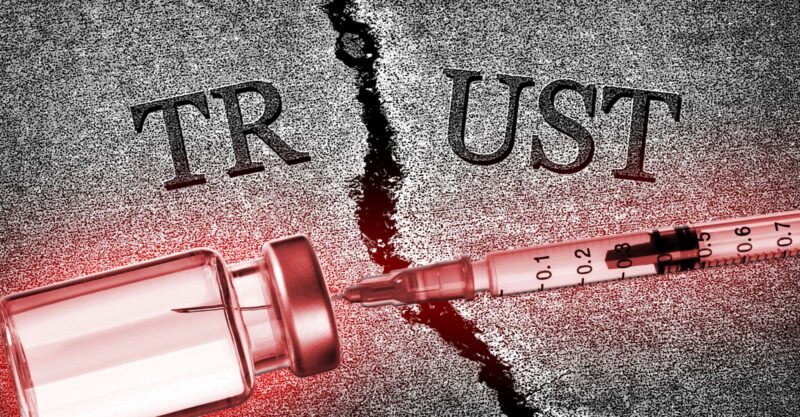
Because in the end, public health depends on one thing above all else: trust.
And trust is not created by authority. It is earned through honesty.
Originally published by TrialSite News.
Michelle Rabin, Ph.D., is a retired clinical psychologist, feminist and medical freedom advocate.
