Login
Login
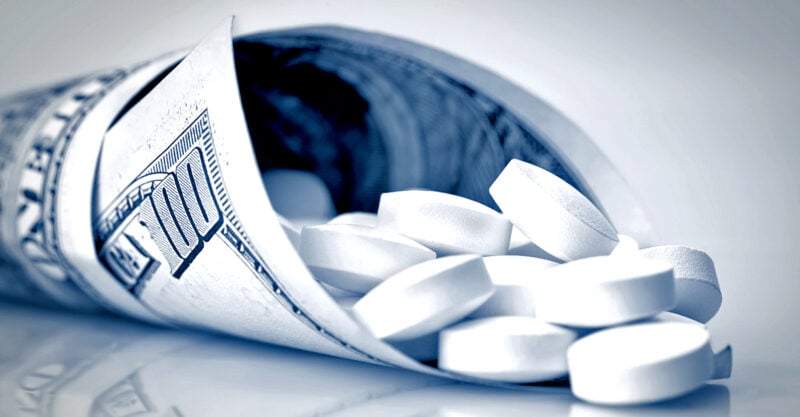


The U.S. pharmaceutical industry exercised its virtually unlimited pricing power to hike costs for patients again this month as Senate Democrats made progress toward a limited deal to regulate out-of-control prescription drug prices, which are forcing millions of people to ration their medication or go without it entirely.
A new analysis released Tuesday by Patients for Affordable Drugs estimates that pharmaceutical companies in the U.S. have raised drug prices 1,186 times so far this year, further padding their bottom lines while intensifying the already overwhelming cost burden for patients.
Patients for Affordable Drugs found that between June 24 and July 5, pharmaceutical companies increased prices for 133 products. Pfizer, for instance, hiked the cost of its leukemia medication Besponsa again this month, bringing its per-vial price tag to $21,056.
“This is Pfizer’s fourth hike on the cancer drug during the COVID-19 pandemic — even as the company enjoys record-shattering profits from its vaccine,” the analysis notes.
The patient group also spotlighted Amgen’s price hikes for its autoimmune disease drug Enbrel. The California-based firm’s price increases for the medication have exceeded even the record-high U.S. inflation rate.
Amgen’s two price hikes for Enbrel this year alone are particularly brazen given that the company has faced recent congressional scrutiny over its business practices.
“Americans are struggling with record inflation and the continued challenges of a pandemic,” David Mitchell, the founder of Patients for Affordable Drugs, said in a statement.
“Yet Big Pharma continues to raise drug prices with no regard for the health and financial well-being of Americans.”
Mitchell, a patient with incurable blood cancer whose drugs come with an annual list price of more than $900,000, argued that the pharmaceutical industry’s “latest price hikes demonstrate again why the Senate must stand up for the American people and pass the comprehensive drug pricing reforms in the reconciliation package.”
“These reforms are overwhelmingly supported by Republicans, Democrats, and independents alike, and the votes are there to pass the package immediately,” said Mitchell.
“We must put an end to drug corporations’ unfettered ability to dictate prices at the expense of patients.”
Earlier this month, Senate Democrats unveiled 190 pages of legislative text containing their plan to require Medicare to negotiate the prices of a small subset of prescription drugs directly with pharmaceutical companies.
The proposal also includes other measures to limit costs, such as a $2,000-a-year cap on out-of-pocket prescription drug payments for Medicare Part D enrollees.
But as The American Prospect’s David Dayen noted earlier this month in a detailed look at the plan — which has predictably drawn opposition from the pharmaceutical industry — the legislation’s scope is highly restricted.
“In earlier versions of the bill, the negotiated prices would have been accessible to all insurance payers,” Dayen observed.
“But in this bill, the prices are only available to Medicare recipients. Part B (for drugs given at hospitals) and Part D (the Medicare prescription drug benefit) drugs that Medicare spends high amounts on are eligible.”
“The drugs eligible for negotiation also have to be at least 7 to 11 years beyond their approval stage, meaning that there’s still an exclusivity buffer where newer drugs can charge whatever they want,” he continued.
“Since no drug can get a negotiated price at launch, this is likely to lead to higher launch prices.”
Launch prices are already in the stratosphere: Research published last month showed that nearly half of all new brand-name prescription drugs launched in the U.S. in 2020 and 2021 had an initial price tag of $150,000 or more per year.
Ashley Suder, a patient in Morgantown, West Virginia who takes GSK’s Benlysta to manage her lupus, said that she’s had to spend “her entire paycheck” on her medications.
That experience is all-too-common in the U.S., where patients spend far more on prescription drugs than their counterparts in other rich countries.
Accounting for the latest price hikes, Benlysta now carries a monthly price tag of $4,282.
“Without this drug, my immune system attacks my healthy tissue, resulting in painful inflammation that damages my skin, joints, blood vessels, and brain,” Suder said.
“With the price increasing again, I worry about how I’ll make ends meet while still affording my drugs.”
Originally published by Common Dreams.