Login
Login
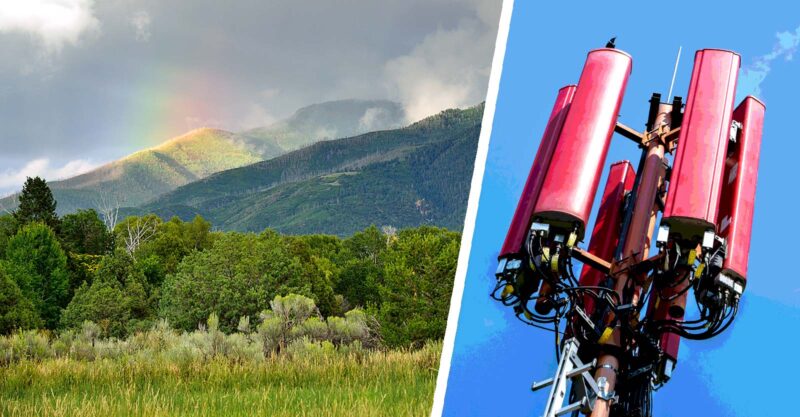


Residents of San Cristóbal, New Mexico, a historic valley in Taos County, successfully blocked a 195-foot cell tower from being built in their community after teaming up with a telecommunications attorney featured in The Defender.
San Cristóbal residents contacted attorney Robert Berg on Sept. 19, after reading a Sept. 18 article in The Defender. The article featured Berg’s work representing communities that opposed cell towers or wireless antennas near homes and schools.
Berg agreed to represent the residents in person and praised their teamwork. “It’s a remarkable group of people — and a remarkable valley,” he said.
On Oct. 14, the Taos County Board of Commissioners voted 3-2 to overturn the Planning Commission’s July approval of a special use permit for Skyway Towers, a Tampa-based company that builds cell towers on speculation.
“Our community was united in opposition to this tower because we know that better alternatives exist,” Mandy Sackett, a San Cristóbal resident, told The Defender. “It’s heartening that the county commissioners took our voices seriously.”
The San Cristóbal residents’ victory comes as the Federal Communications Commission (FCC) — the agency that oversees wireless infrastructure — is proposing new rules that would hand the wireless industry sweeping control over where cell towers are built, according to an Oct. 17 Children’s Health Defense (CHD) action alert.
If adopted, the rules would eliminate public hearings for conditional and special use permits and automatically approve new tower applications after 150 days.
Residents stepped up opposition after tower was approved in July
Tucked at the base of the Sangre de Cristo Mountains, San Cristóbal is home to just over 100 households and is celebrated for its wilderness views.
Sackett said the proposed tower would have loomed over the area’s juniper and piñon trees, becoming “a huge detriment” to the community’s character, historic sites, tourism economy and property values — “all while not being needed or wanted.”
Residents within 1,000 feet of the proposed tower were notified just 10 days before the Planning Commission’s hearing and had to quickly mobilize, Sackett said. Once the commission approved the permit, the residents stepped up their efforts to oppose the tower.
More than two dozen residents signed a letter on Sept. 4 appealing the permit decision. They argued that the proposed tower would break several county land-use rules, cause “significant and irreparable harm” to local businesses and raise wildfire risks in an already fire-prone valley.
The letter also said the project ignored the New Mexico Game and Fish Department’s written warnings about the tower’s potential harm to migratory birds and wild game — and failed to consider how it could negatively affect local wildlife overall.
Sackett noted that the tower would have been a particular eyesore at the historic Taos Goji Retreat & Cabins, which New Mexico is currently reviewing for official historic site status.
Taos Goji, formerly the San Cristobal Trading Post, has long been a gathering place for artists, activists and thinkers, including Georgia O’Keeffe, César Chávez, Pete Seeger and J. Robert Oppenheimer, she said.
Sackett said the appeal letter also included results from a resident survey showing that most households already had adequate cell service — and that the area already had full 911 coverage.
Defender article highlights how developers mislead residents
In the September Defender article, Berg explained how developers often mislead residents and local officials by claiming new or taller towers are needed to fill coverage gaps — even when official FCC maps show the area already has solid service.
That appeared to be the case in San Cristóbal, Berg said. The FCC National Broadband Map showed the area already had 100% coverage through AT&T.
“A lot of people read that article, and now they have some ammunition to go into these hearings,” Berg said, referring to the data from the National Broadband Map, which wireless companies themselves provide to the FCC. The data usually show higher coverage rates than what cell tower developers claim at local land-use board meetings.
After speaking with San Cristóbal residents and agreeing to assist in their appeal, Berg contacted Kent Chamberlin, Ph.D., past chair and professor emeritus of Electrical and Computer Engineering at the University of New Hampshire. Chamberlin also agreed to assist in person.
Chamberlin is a science adviser and former president of the Environmental Health Trust, a nonprofit focused on research and education about the effects of wireless radiation. He also acts as a special expert for the International Commission on the Biological Effects of Electromagnetic Fields.
The residents teamed up with Berg and Chamberlin to prepare for the Oct. 14 hearing. Berg helped about 25 residents prepare their witness testimony explaining why the commission should revoke the tower’s permit approval.
On Oct. 3, Chamberlin submitted an expert report on behalf of the residents that showed San Cristóbal already had good cellphone coverage. “I was able to debunk the report from the industry supposedly showing gaps in coverage,” he said.
Berg said Skyway Towers hadn’t properly investigated less intrusive alternative sites, as required by Taos County Land Use Regulations and federal case law.
For example, the company claimed T-Mobile needed the new tower to boost its coverage. However, T-Mobile could have simply leased antenna space on a nearby tower operated by SBA Towers Inc.
The SBA tower primarily serves AT&T and Verizon customers, but Berg and Chamberlin found space near the top where T-Mobile could install its antennas. By using that space, T-Mobile could likely achieve the near-100% coverage that AT&T already provides its customers from the same tower.
Sackett said the proposed tower would also have violated the county’s land-use regulation requiring free-standing towers to be at least 5 miles apart, since another recently approved tower stood just 3.5 miles away.
On Oct. 3, Berg sent a letter to the Taos County Board of County Commissioners outlining why they should overturn the approval decision.
Before the hearing, Berg flew a drone over the proposed tower site, capturing photos that showed how the tower would visually intrude on Taos Goji and the surrounding area.
Sackett, standing next to Berg during the flight, gave factual testimony about how the tower would dominate the view from Taos Goji.
Berg couldn’t testify about the visual data because state legal ethics rules prevent him from acting as both a lawyer and a material fact witness during the same quasi-judicial hearing.
Skyway Tower’s attorney, Ryan Shaffer, who did not bring any fact witnesses to the hearing, tried to act as both attorney and fact witness during the hearing.
Berg objected to this. “That violates the New Mexico Code of Professional Responsibility, as well as every other code of professional responsibility,” he said.
Despite Berg’s objection, the commissioners allowed Shaffer to proceed.
Berg said Skyway Towers is likely to sue to get its San Cristóbal tower built, but won’t have a leg to stand on in court. “They clearly didn’t do what they were supposed to do,” he said.


This article was funded by critical thinkers like you.
The Defender is 100% reader-supported. No corporate sponsors. No paywalls. Our writers and editors rely on you to fund stories like this that mainstream media won’t write.
Engineer’s advice: ‘Start early and stay strong’ in opposing new cell towers
Chamberlin said it can feel like a “David versus Goliath” battle when a small community like San Cristóbal fights a wireless developer’s plan to build a cell tower.
“Goliath doesn’t always win, but it takes a highly organized effort to successfully fight a tower. Without a strong community consensus and some financial support, it is nearly impossible to fight a tower,” he said.
He advised other communities facing similar situations to “build a community effort around stopping the tower. Start early and stay strong.”
CHD’s Stop 5G initiative supports communities seeking to block new towers from being built in their neighborhoods.
Related articles in The Defender- Cell Tower Developers ‘Lying’ About Coverage Gaps to Push New Towers, Lawyer Says
- Telecom Wants to Take Over Home Internet Market — It Could Double Kids’ Exposure to Radiation
- Sitka Residents Block Cell Tower Project With Help From CHD’s Stop 5G Initiative
- Critics Blame ‘Agency Capture’ as FCC Seeks to End Environmental Safety Reviews for Cell Tower Projects