Login


Highlights:
- Trial halted over severe illness: Moderna shut down its clinical trial for two experimental infant RSV vaccines in July 2024, after vaccinated babies developed severe RSV at significantly higher rates than those in the placebo group.
- New U.K. regulatory data: Newly obtained records from U.K. regulators revealed 13 reports of Suspected Unexpected Serious Adverse Drug Reactions (SUSARs) — which require hospitalization or involve life-threatening outcomes — among trial participants. The reactions were not classified as severe RSV.
- Continued reports of severe RSV and delayed reporting deadlines: Despite halting the study in 2024 and continuing to log hospitalizations from severe RSV in European databases throughout 2025, Moderna has not publicly released updated safety findings. The drugmaker extended the trial’s official completion date to December 2029, delaying its deadline to report final outcomes.
- Skewed preclinical animal data: Independent researchers reexamining Moderna’s preclinical cotton rat study found evidence of lung inflammation — a warning sign for vaccine-associated enhanced respiratory disease (VAERD) — arguing that Moderna’s unusual scoring and median-reporting methodology obscured severe outlier reactions and downplayed safety signals.
- FDA oversight questions: The FDA approved the infant trial in 2023 without consulting independent advisers, raising scrutiny over its initial risk assessment given the decades-long history of severe safety failures in pediatric RSV vaccine development.
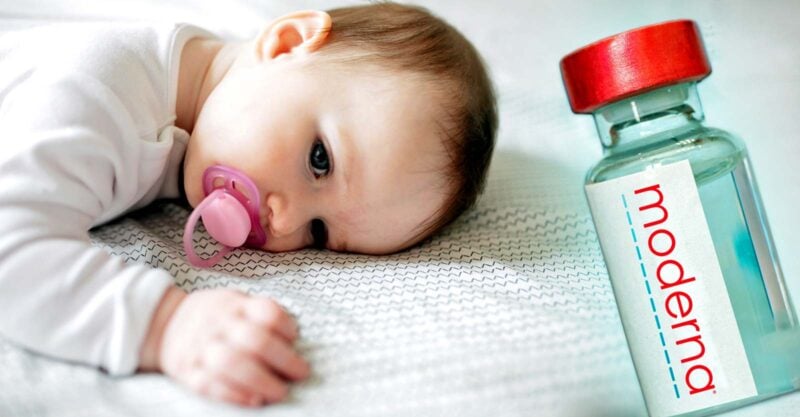
In July 2024, Moderna paused a clinical trial of two experimental mRNA RSV vaccines for infants 5-8 months old after data showed babies who received the shots developed severe cases of RSV at a significantly higher rate than babies who didn’t get the vaccine.
The U.S. Food and Drug Administration (FDA), which approved the trial based on animal study data Moderna submitted to the agency, shut down the trial in December 2024.
Two researchers who recently reexamined the animal study said the study revealed that the vaccinated rats, when later exposed to RSV, developed lung inflammation.
Lung inflammation is a symptom of vaccine-associated enhanced respiratory disease (VAERD) — a condition that occurs when someone who received a vaccine develops more severe respiratory symptoms or lung damage after being infected with the real (wild-type) virus than someone who was not vaccinated.
The researchers who reexamined the study — Dr. Peter Selley, a physician, and Children’s Health Defense Senior Research Scientist Karl Jablonowski — suggested that Moderna downplayed the evidence of any safety signals in the animal study.
Now, data obtained just last week from the Medicines & Healthcare products Regulatory Agency (MHRA), the U.K.’s equivalent of the FDA, raises even more questions about the Moderna trial.
The U.K. data confirm that ongoing monitoring of trial participants resulted in 13 reports of Suspected Unexpected Serious Adverse Drug Reactions (SUSARs) — serious vaccine injuries that U.K. regulators say are not even related to VAERD.
SUSARS are reactions or injuries likely linked to a drug that weren’t anticipated to be a possible outcome and that result in serious outcomes — such as death, prolonged hospitalization, disability or a life-threatening condition. They are rarer than serious adverse events.
“SUSARs by definition result in hospitalization,” Selley said. “If they were common, there would be no healthy volunteers for clinical trials,” Selley said
Calling the latest data “worrying,” Selley told The Defender, “It is remarkable that MHRA states that none of the 13 SUSARs were due to Enhanced Respiratory Disease. Perhaps they are classifying it differently. Moderna should come clean as to what these SUSARs are.”

Moderna extends trial end date to 2029, delaying deadline to report injuries
Moderna’s single trial — the Rhyme Trial — tested two vaccines: a respiratory syncytial virus (RSV) vaccine — already licensed for some adults as mRESVIA — and a combined RSV/human metapneumovirus (hMPV) vaccine. Both the RSV and hMPV viruses can cause serious respiratory illness.
In December 2024, the FDA published a briefing document revealing that rather than protect babies, the RSV and RSV/hMPV vaccines used in the Moderna trial had likely caused higher rates of severe RSV.
According to Moderna’s early reporting on the trial, 5 of 40 healthy infants between 5 and 7 months old who received one of the two RSV vaccines developed severe RSV illness, compared with only 1 of 20 infants who received the placebo.
However, documents obtained from the U.K.’s MHRA through a freedom of information request indicate that Moderna’s early report didn’t include vaccinated babies who became seriously ill post-trial, when exposed to the RSV virus.
Records posted to the European Union’s clinical trials database also indicate that in 2025, Moderna was still reporting additional cases of severe RSV-related disease and hospitalizations, as the drugmaker continued to monitor the babies who had received the vaccines.
It’s unclear if Moderna shared those reports with the FDA.
Moderna told the FDA vaccine advisory committee it would share trial data with the public as the data became available — but the company has not publicly released the updated findings.
Moderna recently extended the trial’s scheduled completion date by more than three years, to Dec. 30, 2029 — even though the drugmaker halted the trial in 2024. Extending the trial’s end date gives the company several more years before it is required to report the final outcomes.
The Defender submitted a Freedom of Information Act request to the FDA in May 2026 for communications between Moderna and the FDA about safety issues related to the RSV and RSV/hMPV trial, but the FDA has not responded.
Scientists from Moderna did not respond to a request for comment.
Why did FDA approve the trial?
Moderna paused its RSV/RSV-hMPV trial in July 2024 after the number of severe RSV cases reached a pre-specified safety limit. The FDA then placed a formal hold on the trial, citing two reasons:
- Human participants would be exposed to “an unreasonable and significant risk of illness or injury.”
- The IND — the application for a new drug to the FDA — did not contain sufficient information to assess the risks to participants in the proposed study.
The FDA announcement raised a key question: If Moderna’s application lacked enough data to assess risk to the babies involved in the study, why did the FDA allow the clinical trial to proceed in the first place — especially given the history of bad outcomes and failed RSV vaccine trials?
In the early 1960s, Pfizer’s RSV vaccine made with an inactivated RSV virus led to two toddler deaths. In the same trial, 80% of vaccine recipients required hospitalization for severe RSV, or VAERD. In 1967, the trial was halted, and clinical RSV vaccine research stalled until recently.
In recent years, drugmakers tried again to develop RSV vaccines for infants and children — and again failed.
In June 2023, GSK shut down its trial for an RSV vaccine for pregnant women because the risk of preterm birth was 37% higher in the vaccine group.
Pfizer’s similar vaccine for pregnant women was approved, despite data showing more preterm births in the vaccine group — both in clinical trials and in post-marketing studies.
In October 2024, Sanofi halted its trial of an RSV vaccine for children, reportedly due to lack of efficacy. However, documents show that a baby died during the trial, which led to the shutdown. Sanofi said the death wasn’t caused by the vaccine.
Monoclonal antibody shots to protect against RSV were approved for infants, but monoclonal antibodies are not vaccines.
In December 2025, the FDA announced plans to investigate two RSV monoclonal antibody shots — Beyfortus, made by Sanofi and AstraZeneca, and Enflonsia, made by Merck — after reports of deaths in clinical trials. The FDA has not responded to repeated queries about the status of those investigations.
FDA urged ‘abundance of caution’ when testing RSV vaccines on infants
In 2017, well before the most recent failed RSV trials, FDA vaccine advisers established that any trials of RSV vaccines on infants who never had an RSV infection had to be “undertaken with an abundance of caution” to ensure they were unlikely to cause VAERD.
As part of this cautionary approach, the FDA required drugmakers to first test the vaccines in “at least two well-established animal models” and submit the results to the FDA for review.
In 2023, the FDA — without input from independent advisers — approved Moderna’s plan to test its RSV and RSV/hMPV vaccines in children ages 5-23 months. The agency said it bypassed that step because it saw no “concerns or controversial issues” with Moderna’s proposed trial.
The FDA based its approval in part on an animal study published in Vaccine. The study, published in 2025, tested the efficacy of Moderna’s two RSV vaccines in mice, and the efficacy and safety of the vaccines in cotton rats.
To support testing its two experimental RSV vaccines in humans, including children, Moderna submitted safety data to the FDA drawn largely from the tests in cotton rats, which researchers often use to study RSV infection and VAERD.
The authors of the animal study all worked for Moderna and, according to the study’s conflict-of-interest statement, some were Moderna stockholders. Christine Shaw, Ph.D., who invented the vaccine used in the study and later in the Rhyme Trial on children, led the research.


This article was funded by critical thinkers like you.
The Defender is 100% reader-supported. No corporate sponsors. No paywalls. Our writers and editors rely on you to fund stories like this that mainstream media won’t write.
Moderna’s flawed reporting methodology skewed animal study safety data
Moderna’s researchers vaccinated the cotton rats, exposed them to RSV and, after five days, examined their lung tissue for signs of inflammation and injury.
They reported that rats vaccinated with all dose levels of Moderna’s RSV vaccine “did not develop enhanced lung inflammation after RSV challenge, as evidenced by the histopathology scores, which were in line with those from RSV infection.”
However, Selley and Jablonowski said the animal study data do show evidence of lung inflammation — but that the methods Moderna used to analyze and report the data obscure the inflammation.
They pointed out that a single scientist — which means there was no check on consistency or bias — examined the cotton rat tissue samples and looked for four types of lung inflammation.
The scientist assigned a severity score, from 0 (none) to 4 (most severe), to each tissue sample, then converted the scores to a percentage scale: 0 = 0%, 1 = 5%, 2 = 25%, 3 = 75%, 4 = 100%. The conversion is not evenly spaced, so a score of 3 counts far more than a 2.
For each animal, the four scores were combined into one total inflammation score. The results are reported as the median (middle value) for each group of animals.
That methodology — converting the percentages and presenting the results as a median — is a problem, Selley explained in a blog post, because it can obscure outlier results.
Jablonowski said Moderna’s method isn’t unheard of, but it is rare. “Most RSV papers just report the raw 0-4 grades, and standard pathology reporting doesn’t convert grades into percentages.”
Moderna’s reporting methodology makes mild inflammation in vaccinated animals look close to zero, while moderate-to-severe inflammation in the control groups looks enormous, Jablonowski said. As a result, the vaccine appears more benign than the underlying grades suggest.
Selley reran the study’s numbers based on the data available in the paper. He used the mean, or average, rather than the median.
“In almost every instance there are more signs of inflammation in the alveoli, peribronchioles and other lung tissues in the vaccinated than in the placebo groups,” Selley said — and some animals were very severely affected.
Jablonowski did a similar analysis and found a mild but consistent inflammation signal in vaccinated animals. “The paper doesn’t mention this,” he said.
According to Jablonowski, the inflammation from lower doses looked worse than from higher doses. “Vaccination that falls below a protective dose yet causes more inflammation is the classic pattern regulators look for in vaccine-enhanced disease screening,” he said.
Selley argued that evidence of substantial lung inflammation in individual animals should have prompted researchers to investigate the possibility more thoroughly.
Related articles in The Defender
- Merck Unveils New RSV Shot for Babies, as Moderna Trials mRNA RSV Vaccine for Infants and Toddlers
- FDA Approves Moderna’s mRNA RSV Vaccine — With No Input From Independent Advisers
- FDA to Probe Safety of RSV Shot for Infants, Citing Deaths Reported in Clinical Trials
- Moderna Shuts Down mRNA RSV Vaccine Trial in Babies After Shots Linked to Severe Side Effects, FDA Document Reveals
- FDA Advisers Bullish on RSV Shots for Kids, Even as Safety Signals Shut Down Moderna Trials
- A Baby Died, and Sanofi Quietly Ended RSV Vaccine Trial. The Company Says Death Was Unrelated to the Vaccine
- Secret Trial of Pfizer RSV Vaccine Killed Two Infants in the 1960s — Their Families Just Sued the U.S. Government