Login
Login
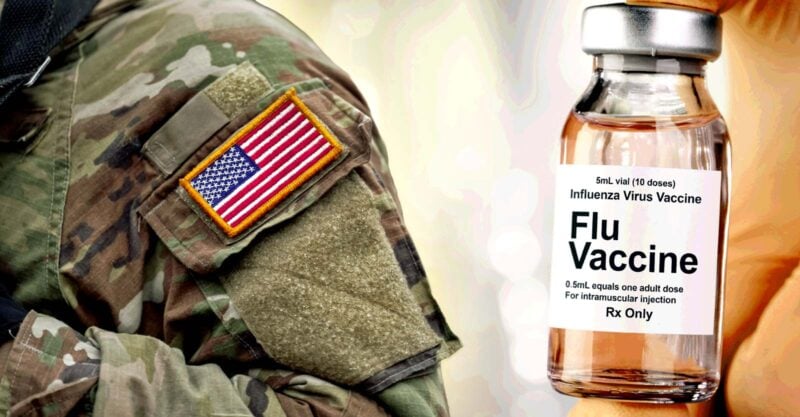


Less than two months after U.S. Defense Secretary Pete Hegseth ended the military’s flu vaccine mandate for service members, several branches of the armed services, including the Army, Navy and Air Force, are again requiring the flu vaccine — a response, they say, to a flu outbreak at a Texas Air Force base.
At least 222 recruits stationed at Lackland Air Force Base in San Antonio have been diagnosed with the flu, ABC News reported Tuesday, citing sources “familiar with the situation.”
Four of the recruits were hospitalized. One recruit, Keon McDaniel, died June 12 following a “medical emergency.”
In an interview today on CHD.TV, nephrologist Dr. Suzanne Humphries cited unconfirmed reports suggesting that McDaniel contracted pneumonia. “It still remains unclear whether his death was actually linked” to the flu outbreak, Humphries said.
Mainstream media reports — including a Washington Post editorial — linked the outbreak and McDaniel’s death to the end of the military’s flu shot mandate. But some experts cast doubt on that narrative and said they still question the need for a military flu shot mandate.
“After reviewing multiple press reports, I could find no evidence that the death … was linked to flu infection,” said internal medicine physician Dr. Clayton J. Baker. “Barring clear evidence that he died due to the flu, it is beyond irresponsible, both epidemiologically and journalistically, to link his death to the purported outbreak.”
Some experts also questioned why media reports would link the flu outbreak to the military’s recent decision to end the flu vaccine mandate, given the timing of both.
“A longer period of lower flu shot uptake, along with occurrence during peak flu season (winter, not summer), would be needed for a stronger causal case,” said epidemiologist and McCullough Foundation fellow M. Nathaniel Mead, Ph.D.


Military branches sought exceptions to new flu shot policy before the outbreak
ABC News reported that the outbreak prompted several branches of the military to request exceptions to the U.S. Defense Department’s flu vaccine policy.
However, the Military Times reported last month, before the Texas outbreak, that several branches requested the exceptions soon after Hegseth announced the new policy.
An Air Force spokesperson told The Defender, “Over the last three weeks, the 37th Training Wing, in close coordination with the 59th Medical Wing, has been managing a localized influenza outbreak among trainees at Basic Military Training.” This led the Air Force to implement “mitigation measures” at that facility.
Chief Pentagon Spokesman Sean Parnell told The Defender that the department received several requests for “exceptions to the policy.”
Parnell said these requests were granted “following a comprehensive review … and in line with standard Department of War practice for adapting force health protection measures to critical operational realities.”
According to Parnell, the decisions “were based upon thorough risk assessments and are designed to maximize operational readiness, lethality, and force generation, while safeguarding at-risk populations.”
Other branches that granted exceptions include the National Security Agency and the Defense Health Agency.
However, the Air Force spokesperson did not clarify whether McDaniel’s death was linked to the flu or to his vaccination status, which has not been publicly disclosed.
Mead said it’s unlikely flu was the direct cause of McDaniel’s death.
“Flu deaths usually come from complications like secondary bacterial pneumonia, severe lung inflammation or worsening of other illnesses, rather than the flu virus itself. That’s why older adults, young kids, pregnant women and those with chronic illness face the highest risk,” Mead said.
Military withholds information about vaccination status of infected recruits
In its editorial, the Post said the outbreak proves that the elimination of the military’s flu shot mandate was an “exceptionally bad idea” aimed at “pandering to anti-vaccine elements” in the Trump administration.
The Post specifically cited U.S. Health Secretary Robert F. Kennedy Jr., accusing him of “profiting” from lawsuits against vaccine makers.
Political figures also weighed in. U.S. Senate Armed Services Committee Chair Roger Wicker (R-Miss.) said ending the flu shot mandate was “a mistake.”
According to ABC News, only approximately 40% of recruits at Lackland had received a flu vaccine as of last week.
The New York Times reported last week that the Air Force’s exemption from the military’s flu shot policy took effect only after the outbreak at Lackland began.
However, it’s unclear what percentage, if any, of the recruits at Lackland received a flu shot after the Air Force was granted the exception. The vaccination status of those who became sick or were hospitalized is also unclear.
Baker said news coverage about the outbreak raises additional questions. “The media reports do not clarify which type of influenza is reportedly active. We do not know if the routine flu shot is designed to provide immunity to the strain involved.”
In attributing blame for the outbreak to the end of the flu shot mandate, the Post cited a French study published in January, finding that the vaccine available for the 2025-26 flu season reduced the chances of illness by approximately 36%.
Dr. Meryl Nass, an internal medicine physician and founder of Door to Freedom, questioned the study’s interpretation of the flu shot’s effectiveness. She said its 36% protection rate means that “nearly two-thirds of recipients [remained] unprotected last fall.”
According to Karl Jablonowski, Ph.D., senior research scientist for Children’s Health Defense (CHD), this result is also lower than the prevailing average efficacy rate for flu vaccines over the past 20 years. “The prior 20 seasons, excluding 2020-21, which had no estimate due to negligible circulation, the vaccine efficacy rate is 40%.”
Questions remain over timing, efficacy of flu vaccinations
According to the Centers for Disease Control and Prevention’s FluView vaccination chart, flu cases were at “minimal” levels across all 50 U.S. states as of June 13.
“The flu season is typically October through May, with the highest transmission between December and February,” Jablonowski said. “If you were considering prophylactic immunization for the 2025-26 season, it would be administered in the fall of 2025.”
Nass noted that recruits who received the flu shots last fall would, by spring, have even less protection against the flu as the vaccine’s effectiveness will have waned.
“The protection they offer, if any, generally is only believed to last several months. So, there would not be much protection now, if any, from a shot 8-9 months ago,” Nass said.
According to a Cleveland Clinic study published last year, people who received a flu vaccine formulated for the 2024-2025 flu season had a 27% higher risk of getting the flu than those who didn’t get the vaccine.
And a 2023 study co-authored by Dr. Anthony Fauci acknowledged that “viruses replicating in the respiratory mucosal environment continue to present a particular challenge for developing effective vaccines with strong protection.”
“The flu shot has never really prevented transmission of the flu and in some years (i.e., last year) the efficacy of preventing the flu is actually negative,” said Brian Hooker, Ph.D., CHD’s chief scientific officer. “Flu would blow through a vaccinated population with nearly the same ease as it would an unvaccinated population.”
Experts question military study suggesting young adults most at risk of flu
ABC News suggested that the living and training conditions faced by recruits at military facilities such as Lackland increase the likelihood of a viral outbreak.
“In basic training, troops live in close quarters, sleeping in tightly packed bays, showering communally and spending much of the day within arm’s reach of one another as they move through drills, instruction and inspections. In that environment, illness can quickly spread once one trainee gets sick,” ABC News reported.
Pam Long, director of CHD’s Military Chapter, questioned that narrative. She pointed out that people in nursing homes and college dorms also live in close quarters. Freshman college students would have a similar level of stress in their new dorms with communal showers and the need to adapt to new demands away from home.
“Why is Texas not seeing an influenza outbreak in the civilian population?” she asked. “Why are those facilities not reporting an influenza outbreak currently?”
Mead said outbreaks can occur among service members living and working in close quarters, but those outbreaks can also affect the vaccinated.
“Even with extensive vaccination, respiratory bugs like flu and adenovirus still spread easily in basic training due to close quarters, shared facilities and the stress of military life,” Mead said.
However, flu outbreaks are uncommon during the warm summer months “because heat, humidity and more outdoor activity usually suppress the virus.”
In an interview with NPR, Dr. Jose Sanchez, former deputy chief of the Armed Forces Health Surveillance Center, suggested that young men of military recruitment age are “not immune to many things” — including flu viruses — because “they haven’t lived long enough to encounter the different pathogens.”
But this statement contradicts official guidance for the population groups that are most at risk of flu — primarily older adults. Last week, a U.S. Food and Drug Administration committee recommended approval of the first mRNA flu vaccine — for adults ages 50 and over.
Humphries said the source of Sanchez’s statement is likely a study published earlier this year, “Seasonal influenza hospitalization incidence rates among U.S. active component service members, 2010-2024,” finding that young, healthy recruits have a higher severe flu burden than older service members. She noted that the study data is based on “the mandatory 100% vaccination era.”
Long said that the study’s results are an “outlier,” as young people in the civilian population do not demonstrate a higher incidence of flu. She suggested the study’s findings potentially indicate a “confounding variable.”
“New recruits are given the flu vaccine with many other vaccines at in-processing in one day,” Long said. “Are recruits reacting to the influenza vaccine or excessive vaccination? Is the shedding of live-virus vaccines causing infection? Research shows that the influenza vaccine increases risk of respiratory illness — a phenomenon referred to as negative efficacy.”
Sanchez also told NPR a similar flu outbreak within the ranks of the military “hasn’t happened in 15 or 16 years.”
However, this appears to be a veiled admission that flu outbreaks can occur even when flu shots are mandated for all service members, as they were during that time. The Military Times noted that the military, which developed the original flu vaccine, has required an annual flu shot since the 1950s, “to preserve the health of the force.”
Long said that although the military lifted its flu shot mandate in April, recruits are often not informed about the new policy and get vaccinated as a result.
“Active duty military members have told me that they must assertively tell their chain of command and troop medical clinics to change their vaccine status to ‘green’ in their medical records if they have been adversely flagged for flu vaccine refusal,” Long said. “The clinics and commanders are not proactively providing informed consent to military members about the new voluntary policy.”


This article was funded by critical thinkers like you.
The Defender is 100% reader-supported. No corporate sponsors. No paywalls. Our writers and editors rely on you to fund stories like this that mainstream media won’t write.
If not flu, then what? Experts suggest other possible causes of the outbreak
With flu cases rare in the late spring and summer months, some experts suggested that the Lackland outbreak may have other causes.
“Flu (Influenza A and B) is pretty rare in summer,” Nass said. “Maybe this is due to a flu-like illness for which a flu shot would provide zero protection?”
Addressing McDaniel’s death, Humphries suggested that other vaccines he may have received could have been a contributing factor. She also cited “cardiac events or general training exhaustion” as possibilities, stating that there has been a combination of high temperatures and high humidity in Texas recently.
Humphries said these conditions reportedly resulted in heat stroke and other heat-related conditions among service members, citing several social media posts by service members based in Texas.
Watch Dr. Suzanne Humphries’ interview on CHD.TV
Related articles in The Defender
- ‘Major Victory’: Military Ends Flu Vaccine Mandate for All Service Members
- Breaking: Moderna’s mRNA Flu Vaccine Gets Unanimous Thumbs-Up Despite Risks, Low Efficacy
- ‘Deeply Concerning’: This Year’s Flu Shots Led to 27% Higher Risk of Flu
- Pentagon Ends Flu Vaccine Mandate for Reservists, But Not Active Duty Troops
- ‘Unwinding the Mess’: DOD Launches Task Forces to Investigate Military COVID Vaccine Mandates