

 Login
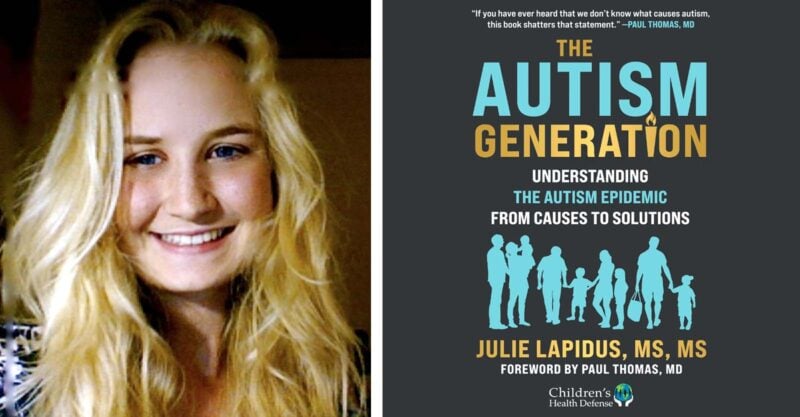


Autism offers important clues to a much broader childhood health crisis, according to Julie Lapidus, author of a new book that combines years of autism research with practical strategies for improving children’s health.
“The Autism Generation: Understanding the Autism Epidemic From Causes to Solutions,” released by Skyhorse Publishing and Children’s Health Defense, examines potential environmental contributors to autism, including vaccine ingredients.
The book also explores integrative approaches to helping children thrive. But its value extends well beyond families directly affected by autism, according to Lapidus.
“The keys in the book could help anyone’s health,” she told The Defender.
Lapidus, a holistic well-being coach, licensed massage therapist and biohacking expert, has spent 16 years researching autism and brain health. Her interest is personal: Her brother is autistic, and his health journey forms the foundation of the book’s first section.
She has since worked with hundreds of parents of children with autism through her Autism Wellbeing Accelerator coaching program.
Lapidus points to the growing number of children facing chronic health problems. She cites data indicating that 54% of U.S. youth have a chronic illness. Other estimates show 1 in 6 children have developmental disorders, including 1 in 10 with attention-deficit/hyperactivity disorder (ADHD) and 1 in 31 with autism.
Chronic physical conditions are also common, with 1 in 12 children diagnosed with asthma and 1 in 13 with food allergies.
“These kids with autism are like canaries in the coal mine,” Lapidus said. “They’re showing us what is making them sick but also what is making a lot of these children sick. It’s so important to look at what is causing the autism epidemic, but it also gives us clues as to what’s causing the chronic childhood illness epidemic in this country.”
‘It has been increasingly challenging to find … information about vaccines’
The book draws on more than 1,392 references and includes detailed tables, charts and other resources to help readers navigate the research.
Lapidus has spent years digging through peer-reviewed research and tracking down information that can be difficult for parents and even healthcare providers to find.
“It has been increasingly challenging to find certain data and information about vaccines in recent years,” she wrote.
The book explores possible environmental contributors to autism and introduces her framework of “neurodisruption.” Lapidus uses the term to describe how prescription medicines, pesticides, toxic metals, pollution, chemicals and other factors may affect brain development.
“I postulate that if anyone were to be exposed to a high enough level of neurotoxins (from vaccines, for instance) they would develop a neurodevelopmental disorder such as autism,” she wrote.
On aluminum levels in vaccines: ‘I couldn’t believe it’
A major focus of the book is the link between mercury and aluminum in vaccines and rising autism rates.
“We need to revisit the immunization policies and how many vaccines children are getting and whether they should even get any vaccines,” Lapidus said. “In my experience, my research, I don’t think any of them are safe. And whether they’re effective is also questionable.”
Lapidus compared the amounts of aluminum and mercury a child could receive under the 1998 Centers for Disease Control and Prevention (CDC) childhood vaccine schedule versus the 2025 schedule.
Using vaccine manufacturers’ package inserts, she calculated that aluminum exposure by 18 months of age increased 13%, from 3,925 micrograms to 4,425 micrograms. Meanwhile, mercury exposure by 18 years of age rose 82%, from 275 micrograms to 500 micrograms.
The book includes tables detailing the aluminum, mercury and thimerosal content of vaccines, based on manufacturers’ package inserts. It also traces changes in vaccine ingredients and schedules over the years.
Lapidus cites independent testing that found four times more aluminum in some vaccine vials than the package inserts listed. And she discusses a 2018 study that, in her view, exposed a U.S. Food and Drug Administration error in how the agency calculated safe aluminum levels in vaccines.
“I don’t know why no one’s talking about it, but I couldn’t believe it,” Lapidus said.
Thimerosal allegedly removed in 2001, but still present in some vaccines
Lapidus also examines thimerosal, a mercury-containing preservative, and its history in vaccines.
“While thimerosal was allegedly removed as a preservative from all childhood vaccines in 2001, it has continued to be present in vaccines on the CDC childhood immunization schedule at levels above EPA [U.S. Environmental Protection Agency] safety limits set for adults,” according to her book.
Her calculations led to another finding that surprised her:
“I recently crunched the numbers and was shocked to discover that a twelve-month-old baby born in 2024 could potentially receive double the amount of mercury at their well-baby visit than a twelve-month-old born in 1998—prior to the ‘removal’ of thimerosal from vaccines! In fact, at twelve months of age, a baby following the CDC schedule in 2024 could potentially receive twenty-six times the amount of mercury the EPA deems ‘safe’ for adults.”
‘It’s never too late to start to help these kids to thrive’
The book is not limited to examining potential causes. Much of it focuses on what families can do to support children’s health.
Lapidus covers nutrition, food allergies, sample meal plans, supplements, gluten-free and casein-free diets, picky eating, camel’s milk, sleep, biohacking and ways to reduce exposure to potentially harmful substances in the home and body.
“A drug-based approach doesn’t work for autism,” she said. “Most of the medications that are prescribed are for psychiatric issues, and they don’t really help these kids. And sometimes they exacerbate issues.”
She also offers guidance for prospective parents. Her “Thriving Baby Blueprint” explores ways to support a healthy pregnancy and reduce potential risk factors for neurodevelopmental disorders, including through maternal and preconception nutrition and attention to household exposures and mercury.
For Lapidus, the key is that progress is possible, regardless of a child’s age.
“Some people think that after a certain age, you can’t do anything for it,” she said. “I’ve worked with older kids and adults, and we’ve seen changes. It’s never too late to start to help these kids to thrive. And there’s always things you can do.”


This article was funded by critical thinkers like you.
The Defender is 100% reader-supported. No corporate sponsors. No paywalls. Our writers and editors rely on you to fund stories like this that mainstream media won’t write.
‘The answers are there. People just have to look at them’
Lapidus encouraged parents and healthcare providers to dig into the research, starting with vaccine manufacturers’ package inserts.
“The main thing is to have them look at the vaccine package inserts, which most doctors don’t even have,” she said.
Lapidus acknowledged that researching a child’s health and exploring new approaches takes effort. Parents must educate themselves, consider aspects of health they may not have explored, and become advocates for their children and families.
But she believes the effort can bring benefits beyond a child’s health. “Even though I focus a lot on the causes, I do think there’s hope for our future,” she said. “I wouldn’t have written this book if it wasn’t for the fact that there are solutions.”
Lapidus said the journey can also help parents improve their own health and find answers for the whole family. She hopes her book will encourage parents to take that first step.
“I feel like a lot of the answers are there. People just have to look at them. Most of the answers are in my book, to be honest,” she said.
“It’s really important that people know that there are things you can do to help improve the health of your family and future generations, and that there is hope for everyone.”
Related articles in The Defender
- 1 in 31 Kids Had Autism in 2022 — Up From 1 in 36 in 2020
- ‘Jaw-dropping’ Study Finds Vaccinated Children Have 170% Higher Risk of Autism
- Aluminum in Vaccines Far Exceeds ‘Safe’ Limits for Infants, Critics Say
- Government Misled Public on Thimerosal Link to Autism ‘for Decades,’ Falsely Claims It’s Been Removed From Vaccines
- ‘Vaccines Do Not Cause Autism’ Claim Built on ‘House of Cards,’ Authors of New Review Say
- What’s Behind Skyrocketing Autism Rates — Better Diagnostics? Or an Avalanche of Toxins?
- Parents With High Chemical Intolerance 6 Times More Likely to Have Child With Autism
- Could Exposure to Mold Play a Role in Autism? More Research Needed, Experts Say
