

 Login
Login
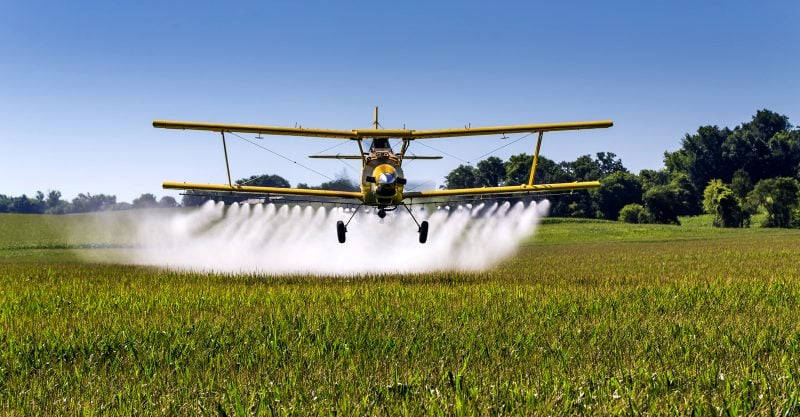


Four public interest groups filed a lawsuit Dec. 21 challenging the Environmental Protection Agency’s rushed re-approval of products containing the dangerous, drift-prone dicamba pesticide.
Over the past four years the dicamba products sprayed “over the top” of soybean and cotton crops genetically engineered to resist the pesticide have caused drift damage to millions of acres of soybeans as well as orchards, gardens, trees and other plants on a scale unprecedented in the history of U.S. agriculture.
The new lawsuit follows the groups’ successful prior cases, decided in June, in which the court ruled the EPA’s previous approval to be unlawful and struck it down.
“Less than six months ago, the Ninth Circuit resoundingly rejected Monsanto’s and EPA’s arguments about this pesticide, detailing its substantial drift harms,” said George Kimbrell, legal director of Center for Food Safety and counsel in the case. “Rather than do what the law and science requires, the Trump administration has again unlawfully promoted pesticide corporations’ profits over protecting the interests of farmers or the environment. So they are getting what they deserve this holiday season: coal in their stockings and a federal lawsuit.”
As today’s lawsuit explains, the EPA again failed in its legal duties to ensure that the pesticide would not cause unreasonable harm to farmers and farming communities as well as to the environment and hundreds of endangered species.
In its June 2020 56-page decision, the court explained that the EPA violated the law when it failed to consider and account for the “enormous and unprecedented damage” caused by dicamba drift — damage that has “torn apart the social fabric of many farming communities.”
However, just days before the November presidential election the EPA rushed to reapprove the dicamba products for five years. This is the third time the agency has registered these products, each time with additional restrictions that have failed to stem devastating drift.
“We’re in court yet again because for four years the EPA has repeatedly claimed dicamba is safe, and for four years the agency has been dead wrong, resulting in millions of acres of damage,” said Nathan Donley, a senior scientist at the Center for Biological Diversity. “The Trump administration keeps insisting it wants to grant ‘certainty’ to farmers, and it’s certainly done that. Farmers across the U.S. are now certain dicamba use poses an extremely high risk of damaging neighboring crops, orchards and forests.”
“It’s absurd that we have to go to court to force EPA to do its job,” said Kristin Schafer, executive director of Pesticide Action Network North America, a plaintiff in the case. “Millions of acres of crops have already been damaged by dicamba. This herbicide is hurting farmers and is already creating more resistant weeds, accelerating a dangerous pesticide treadmill.”
“The Environmental Protection Agency clearly has no intention of living up to its name or its mission,” said Jim Goodman, a retired farmer and National Family Farm Coalition board president, a plaintiff in the case. “The agency continues to work on behalf of corporate profits over the health and wellbeing of farmers, farmworkers and their communities.”
Represented by Center for Food Safety and Center for Biological Diversity, plaintiffs in the case include National Family Farm Coalition and Pesticide Action Network North America.
Background:
According to agronomists, dicamba has caused the most extensive drift damage ever seen in the history of U.S. agriculture. In just four years of use, it has injured at least 5 million acres of soybeans, decimated fruit orchards and vegetable farms, and damaged trees, backyard gardens and natural areas throughout much of rural America.
Recent findings also suggest dicamba endangers human health. Earlier this year scientists at the National Institutes of Health found that use of dicamba can increase the risk of developing numerous cancers, including liver and intrahepatic bile duct cancers, acute and chronic lymphocytic leukemia and mantle cell lymphoma.
In separate actions, thousands of farmers have sued Monsanto and BASF for dicamba drift damages. These cases were consolidated into class-action lawsuits that were settled earlier this year for $400 million. In a separate lawsuit, a jury awarded Missouri peach farmer Bill Bader $15 million for dicamba damage to his peach orchard, and an additional $250 million in punitive damages.
Internal company memos released in the course of the Bader lawsuit revealed that even as Monsanto and BASF publicly denied that their products posed a major drift threat, they were internally projecting thousands of dicamba drift complaints over the first five years of use.
CFS and many others urged the EPA as early as 2010 to reject Monsanto’s petition to approve dicamba for use on the company’s dicamba-resistant soybeans and cotton, warning of precisely the extensive drift damage that has now occurred, as well as the rapid emergence of dicamba-resistant weeds that is already underway on America’s farmlands.
The EPA ignored those warnings, relying entirely on faulty, Monsanto-generated data in concluding drift injury would not occur, and on an ineffective herbicide-resistant management plan.
Originally published by the Center for Biological Diversity.