Login
Login
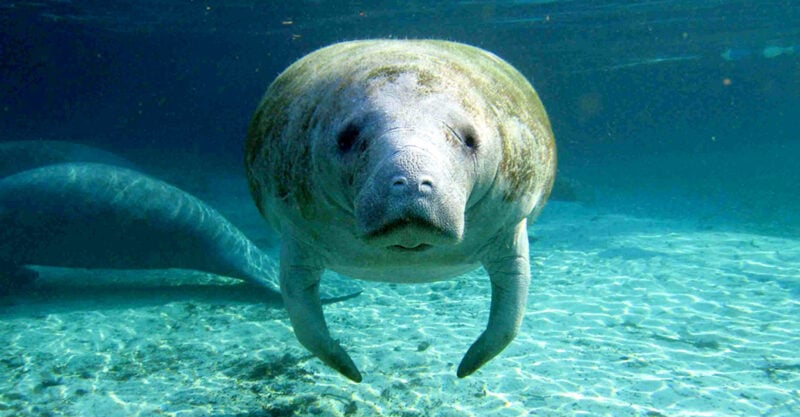


A petition filed Nov. 21 with the U.S. Fish and Wildlife Service (USFWS) urged increased protections for the West Indian manatee after dramatic declines in its population over the last several years.
In 2017, the USFWS downgraded protections for the manatee, a move that was widely criticized by conservation groups as premature. That sentiment has become a reality, with nearly 2,000 manatees dying over the last two years from a range of preventable factors.
West Indian manatees, a species of manatee that includes the Florida and Antillean Manatee subspecies, were first listed under the Endangered Species Act (ESA) in 1973, at a time when there were less than 1,000 individual animals in the U.S.
By 2017, the number of manatees had increased to more than 6,000, leading then-Interior Secretary Ryan Zinke to downlist (downgrade) the animals from endangered to threatened under the ESA.
The ESA works to protect species by listing them as either threatened or endangered. A species classified as endangered is in danger of extinction throughout all or a significant portion of its range and a threatened classification means the species is likely to be endangered within the foreseeable future.
Endangered species are given greater protection than threatened species. While endangered species are broadly protected against “take” — defined as “to harass, harm, pursue, hunt, shoot, wound, kill, trap, capture, or collect, or to attempt to engage in any such conduct.”
However, with threatened species, USFWS can determine an acceptable level of take for the animal in question.


Since the downlisting of the species, manatee populations have declined dramatically. The animals are primarily at risk from a range of hazards, including boat strikes, entanglement with fishing equipment, habitat loss and chemical pollution.
“With Florida’s manatees dying by the hundreds, it’s painfully clear that the 2017 federal decision to downlist the species was scientifically baseless,” said Ragan Whitlock, a Florida-based attorney at the Center for Biological Diversity.
“The Fish and Wildlife Service now has the opportunity to correct its mistake and protect these desperately imperiled animals.”
Boat strikes kill an average of 100 manatees each year, a number which is set to increase alongside growth in human populations in its range.
Cold stress can also harm these creatures, as waters below 68 Fahrenheit can impact immune system functioning, making them more vulnerable to disease or even death. Entanglement in fishing equipment is the cause of death for roughly 10% of deceased manatees.
Chemical pollution likely represents the most far-reaching and growing threat to manatee habitat and survival. The species is seeing the effects of a variety of factors that are unfortunately combining to cause immense damage.
Research finds that marine mammals are more vulnerable to the impacts of certain toxic chemicals because they lack the genetic traits that assist their bodies in breaking down these chemicals. Within the context of increased vulnerability, manatees off the U.S. coast are experiencing chronic exposure to the weedkiller glyphosate.
More than 55% of sampled manatees had glyphosate in their bodies in 2020, a number that steadily increased from the beginning of research conducted in 2009.
Red tides became an additional weight on manatee populations, with 2021 containing a mortality event that killed 1,110 manatees. This devastation continued through to this year, during which time 726 manatees have died. These losses represent nearly one-third of the population at the time of downlisting in 2017.
These dangers are interacting to further harm manatee habitat. Glyphosate in the water not only harms nontarget animals like the manatee, but also nontarget aquatic vegetation that manatees rely upon.
Incidents of red tide and other harmful algae blooms are also exacerbated by nitrogen and phosphorus runoff from industrial farms and highly manicured landscapes. These algae blooms cause a trophic cascade. Floating on the surface, algae blocks sunlight to seagrasses and other submerged aquatic vegetation.
As seagrass is lost, manatees and other animals that rely on it for food and habitat also suffer. In this context, glyphosate, a phosphorous-based herbicide, either directly kills off more aquatic vegetation, or feeds algae blooms as it breaks down.
“Increasing protections for manatees with an endangered listing would provide immediate protection,” said Rachel Silverstein, executive director of Miami Waterkeeper. “With astounding losses of seagrasses around the state, we need to address water-quality issues to give the manatee a fighting chance to survive and thrive.”
Patrick Rose, executive director of Save the Manatee Club, also had strong words to convey to the public:
“In 2017 Save the Manatee Club strongly opposed the biologically unjustified downlisting of the manatee, and in the years since our worst fears have become reality as we approach what will likely be a third winter of mass manatee mortality and aquatic ecosystem collapse.
“Re-designating manatees as endangered will be a critical first critical step in righting a terrible wrong.
“In addition, we call for full implementation of all tools available under the Endangered Species Act, including reinstatement of the Expert Manatee Recovery Team and other expert working groups such as the Manatee Warm-Water Task Force. The time to act is now.”
As advocates working closest with these kind, lovable creatures note, there is no time to delay as population declines are occurring unabated, in real time before our very eyes.
Allowing dead or dying manatees to wash up on U.S. shores en masse when we know the steps necessary to protect these animals is unacceptable and would represent the biggest failures of ESA to date.
The law was already barely working to increase manatee numbers; this necessitates not only the reinstatement of prior protections but further actions to address human activities like boat strikes and pesticide pollution that continue to weigh down these otherwise buoyant animals.
Originally published by Beyond Pesticides.