

 Login
Login



Editor’s note: According to STAT News, MDMA is a synthetic drug that can act as a stimulant and mild hallucinogen, but is primarily considered an “empathogen”: It can amplify emotional connection and feelings of empathy. A common party drug, it is also known as ecstasy or molly.
Last week, the U.S. Food and Drug Administration (FDA) declined to approve MDMA-assisted therapy for the treatment of post-traumatic stress disorder (PTSD) based on data submitted by the developer, Lykos Therapeutics.
Many have criticized the FDA’s decision, arguing that MDMA-assisted therapy has shown tremendous promise in treating PTSD and could be a game-changer for patients.
Notable figures such as presidential hopeful Robert F. Kennedy Jr. tweeted that it was a “scandalous decision” by the FDA to reject the approval, predicting it “will have deadly consequences.”
Scandalous decision by the FDA not to approve MDMA for treatment of PTSD. lThe pharma industry cannot abide by the precedent of a ONE TIME treatment that can cure mental illness (reaching the root of trauma) instead of managing symptoms with a lifetime prescription.
Numerous…
— Robert F. Kennedy Jr (@RobertKennedyJr) August 12, 2024
Time magazine ran an article by PTSD sufferer Christiana Musk, who argued persuasively for the approval of MDMA therapy after she was harmed by traditional psychiatric treatments.
MDMA is a mind-altering drug, commonly known as ecstasy or molly, and is currently illegal in the U.S. So far, the FDA has never approved it for therapeutic purposes.
In contrast, Australian regulators recently approved MDMA and psilocybin for restricted therapeutic purposes in a controlled medical setting, and patients have been receiving treatment since January.
A resurgence in the interest of psychedelic drugs for treating mental health conditions was spurred by a study published in Nature Medicine in 2023.
Of the 104 adults enrolled, half were randomized to receive MDMA plus talk therapy, and the other half to placebo plus talk therapy. After 18 weeks, 71% of people in the MDMA group no longer met DSM-5 criteria for PTSD, compared to 48% in the placebo group.
It is estimated that 5 in every 100 adults in the U.S. suffers from PTSD in any given year. In 2020, about 13 million Americans suffered from the chronic disorder that can be triggered by a traumatic situation and disproportionately affects women and veterans.
The FDA’s decision to reject MDMA-assisted therapy was likely influenced by concerns raised by the agency’s advisory committee in June. Members doubted the validity of the Phase 3 trial data after allegations of scientific misconduct in the trials.
There were concerns about the unblinding of study participants due to the noticeable effects of MDMA, and the “striking lack” of documentation around whether the trial participants had abused the drug.
Kim Witczak, a drug safety advocate and the committee’s consumer representative, voted against the approval of MDMA-assisted therapy in June.
“I don’t believe MDMA-assisted therapy is ready for prime time,” said Witczak.
“This is uncharted territory, and it must be approached with caution,” she concluded after carefully reviewing the submitted data and public comments.


Knowing that these decisions have real-life consequences, Witczak said she was “cautiously optimistic” about a new treatment for PTSD, but in light of the serious concerns over the data, it was something she “couldn’t ignore.”
The allegations of trial misconduct were particularly worrisome for Witczak. Several members of the public alleged in video or written testimony that the data were tampered with to appear more positive and to exclude adverse events.
“If there are reports or claims of misconduct during the initial clinical trials, they must be thoroughly investigated before any product is approved. Too often, it’s only through lawsuits after a product is on the market that we learn about such issues,” she said.
The MDMA trials also had problems with selection bias.
“The efficacy data were promising, but with 40% of participants having previously used MDMA, and the limited transparency about the recruitment process, I question the influence this may have had on the outcomes,” explained Witczak.
Much of the panel’s discussion focused on how the trials were conducted, including issues pertaining to their design. For example, the FDA insisted the drug sponsor use an “inert” placebo.
Usually, this would be ideal, but MDMA has such obvious effects, that it could prevent an objective view of how well the drug worked. In a second Phase 3 trial, more than 90% of people in the MDMA group and 75% in the placebo group correctly guessed their treatment arm.
An active placebo might’ve been more suitable, like the ones they use in antidepressant trials (e.g., atropine) to disguise the “dry mouth” experienced by many users.
Another issue was that the treatment protocol designed by Lykos Therapeutics for the trial was never tested against other evidence-based therapeutic models, nor was it compared to MDMA alone, without any talk therapy.
In her two decades of drug safety advocacy, Witczak is all too familiar with regulators rushing approvals in the face of enormous hype and political pressure, which could lead to unintended consequences.
“Once the genie is out of the bottle it is hard to put it back in,” she said, “The time to be careful and ask tough questions is now, not after approval.”
In the past, SSRI antidepressants like Prozac, Zoloft and Paxil were once hailed as game-changers for depression. But soon after Prozac was released onto the market, reports of suicide and violence began to surface.
The FDA held public hearings in 1991 about the problems, but its advisory panel, which included members with ties to antidepressant manufacturers, voted against the action. It took another 13 years before the FDA added black box warnings to SSRIs.
The FDA has requested that Lykos Therapeutics carry out an additional Phase 3 trial to further study the safety and efficacy of MDMA.
In response, Lykos Therapeutics said the FDA’s decision was “deeply disappointing.”
“While conducting another Phase 3 study would take several years, we still maintain that many of the requests that had been previously discussed with the FDA and raised at the Advisory Committee meeting can be addressed with existing data, post-approval requirements or through reference to the scientific literature,” said Amy Emerson, the company’s CEO.
Compounding the setback, the medical journal Psychopharmacology has just retracted three papers on MDMA-assisted therapy. Several of the authors are affiliated with Lykos therapeutics and the articles include a meta-analysis of MDMA trials and a long-term follow-up study.
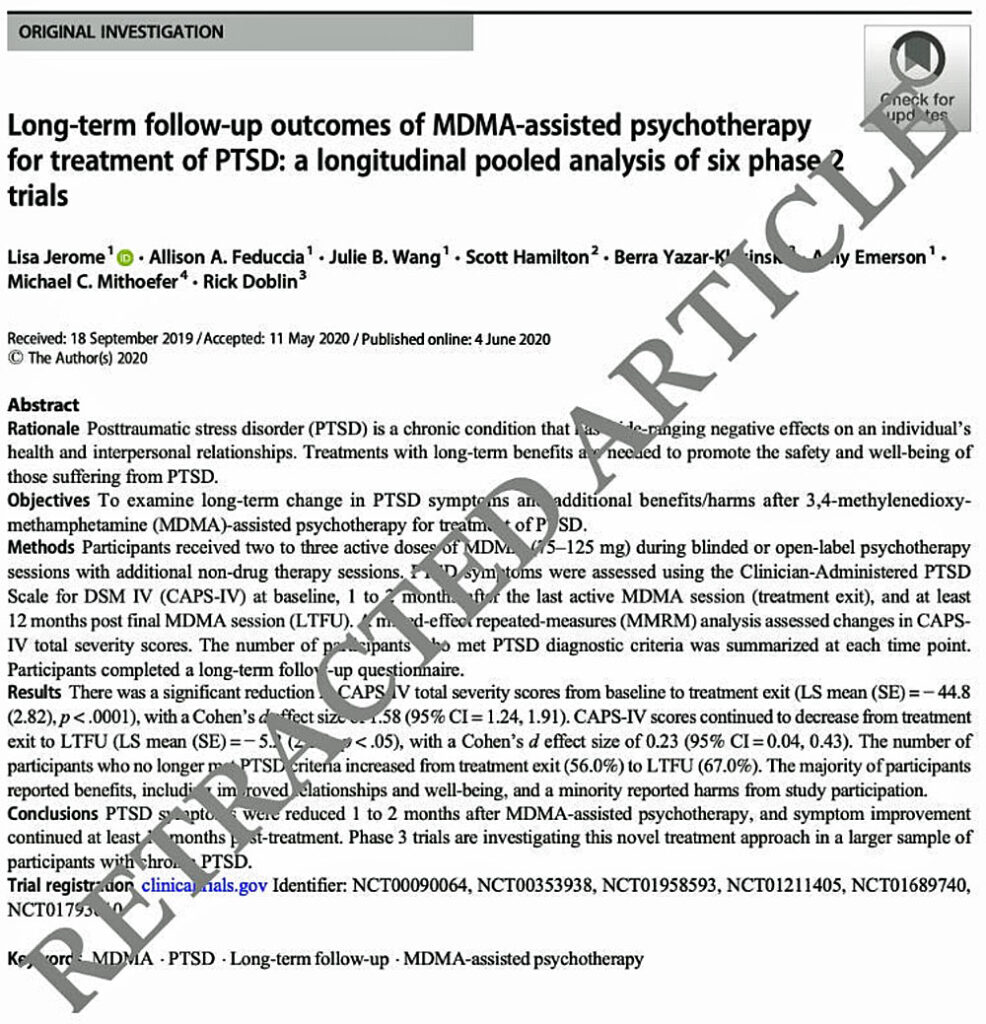
According to the journal’s retraction note, the decision to pull the studies was driven by “protocol violations amounting to unethical conduct” at one of the study sites.
Witczak, who remains committed to advocating for the highest standards in drug safety said, “At the end of the day, I genuinely want people who are suffering to have access to effective tools and options.”
She added, “If MDMA-assisted therapy is approved with unresolved concerns and issues arise, it could damage the credibility and potential of the entire psychedelic field.”
Originally published on Maryanne Demasi’s Substack page.
The Defender on occasion posts content related to Children’s Health Defense’s nonprofit mission that features Mr. Kennedy’s views on the issues CHD and The Defender regularly cover. In keeping with Federal Election Commission rules, this content does not represent an endorsement of Mr. Kennedy, who is on leave from CHD and is running as an independent for president of the U.S.
