

 Login
Login
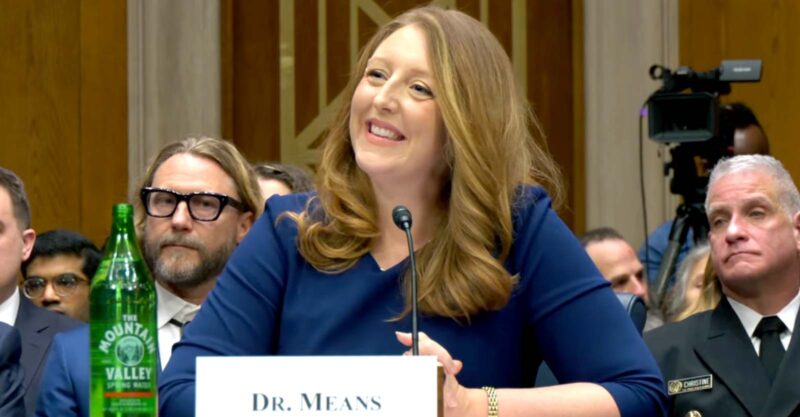


Dr. Casey Means on Wednesday defended her nomination for U.S. surgeon general, fielding questions on vaccines, informed consent and her role in the administration’s “Make America Healthy Again” (MAHA) agenda.
President Donald Trump nominated Means in May 2025 at the recommendation of U.S. Health Secretary Robert F. Kennedy Jr. Her initial hearing was postponed when she gave birth to a son. The nomination expired at the end of the session, and Trump renominated her Jan. 13.
Means, a holistic medicine doctor and co-author of “Good Energy,” has emerged as a prominent voice in the MAHA movement, which calls for sweeping changes to food systems, chronic disease prevention and federal health policy. Her brother, Calley Means, serves as a senior adviser at the U.S. Department of Health and Human Services.
If confirmed, Means would serve as the nation’s top public health voice and oversee the 6,000-member U.S. Public Health Service Commissioned Corps, a federal branch whose officers include physicians, nurses, scientists and engineers.
Her nomination drew criticism from some public health advocates who questioned her past comments on vaccines and her alignment with Kennedy’s health agenda.
Sen. Roger Marshall (R-Kan.) introduced Means as a “uniquely qualified Stanford-trained physician” who left traditional surgical training after growing “disillusioned” with a system focused more on symptoms than root causes.
In her opening remarks before the U.S. Senate Health, Education, Labor and Pensions (HELP) Committee, Means framed the country’s health challenges in stark terms.
“Our nation is angry, exhausted and hurting from preventable diseases,” she said.
She urged public health leaders to address “evidence-based modifiable drivers of chronic diseases,” including ultraprocessed foods, chemical exposure, inactivity, chronic stress and “over medicalization.”


Every medication carries ‘risks and benefits’
Throughout the two-and-a-half-hour hearing, senators pressed Means on vaccines, medications and controversial treatments — from the abortion pill Mifepristone to psychedelic mushrooms. She repeatedly returned to one core principle: informed consent.
“I don’t want to be a broken record,” she said, but every medication carries “risks and benefits” and requires “a nuanced conversation with your doctor.”
“I don’t think it’s responsible to make a blanket statement for all Americans,” Means added, arguing that individualized care would “help restore trust in public health.”
Lawmakers questioned Means extensively about vaccines and the updated federal guidance.
Means expressed support for changes to the federal childhood immunization schedule and said she backs stronger safety oversight.
“Broadly speaking, I am very supportive of what’s been laid out by this administration in regard to vaccines.” That includes “gold standard placebo-controlled trials,” transparent studies of vaccine injury and research free of conflicts of interest.
She rejected claims that she opposes vaccination. “Anti-vaccine rhetoric has never been a part of my message,” she said. She called vaccines “a key part of any infectious disease public health strategy.
Still, she emphasized improving doctor-patient dialogue. Sen. Bill Cassidy (R-La.) noted that such conversations already occur.
Means replied, “I believe that parents want to have a good faith conversation without shame with their doctors about vaccines and that we need to move toward a medical culture where that’s possible. And I genuinely believe that will help restore trust in public health.”
Means called the hepatitis B (Hep B) vaccine “important” and “life-saving,” while acknowledging debate over giving the shot to newborns within 12-24 hours of birth.
“I think that certainly, if we’re talking more broadly about promoting universal [Hep B] vaccination in children at some point in childhood, I think that’s a worthy goal,” she said.
When asked directly whether she accepts evidence that vaccines do not cause autism, Means said, “I do accept that evidence.” However, she also called for continued research into “comprehensive, cumulative exposures” that may contribute to autism.
Means said most people recognize that many factors influence health and that researchers are trying to determine whether the large number of medications children receive may play a role in the disorder.
‘My vision in this role is to get more whole, healthy foods on American plates’
Senators also targeted food policy — a cornerstone of the MAHA agenda.
Sen. Bernie Sanders (I-Vt.) challenged Means on junk food marketing. She responded that the surgeon general lacks authority to ban advertising, but agreed that the country feeds children “nutritionally devoid food” while facing an obesity crisis.
“My vision in this role is to get more whole, healthy foods on American plates,” she said.
Means praised federal updates to the dietary guidelines for what she described as “a full-throated … denunciation of ultraprocessed food,” calling the shift “historic.”
She also endorsed efforts to close the “generally regarded as safe,” or GRAS, loophole, which allows companies to self-certify ingredient safety without formal government review.
“By addressing this loophole … about what’s going into our food, this is going to trickle down to affect medical education, affect culture, affect what companies are putting in the food,” Means said.
When Sen. Jim Banks (R-Ind.) asked what message she was uniquely qualified to deliver as the “first MAHA surgeon general,” Means praised the MAHA strategy as “an unbelievably positive, comprehensive, forward-thinking way of addressing the root cause of why we’re sick.”
‘We must, as a country, move away from using toxic inputs in our food supply’
Means repeatedly argued that the healthcare system focuses too much on “reactive sick care” instead of prevention.
“Ninety percent of health care costs are now going to chronic diseases,” she said, urging a shift toward metabolic health and lifestyle-based interventions.
She cited research suggesting metabolic syndrome affects “93% of American adults,” and is linked to dementia, cancer, diabetes and heart disease. The issue stems from how cells produce energy and relates directly to diet and lifestyle, she said.
“If we’re addressing shared root causes, we’re going to be able to stop the whack-a-mole medicine that’s not working for us,” Means said.
Lawmakers also asked Means about chemical use in farming, including glyphosate.
She said she has “the utmost respect for the American farmer” and called agricultural reform “very complex.” While acknowledging the food system relies on chemicals to maintain affordability, she urged further study and gradual change.
“We must, as a country, move away from using toxic inputs in our food supply. And we must study these chemicals more to understand their effects,” she said. “We cannot overturn the entire agriculture system overnight. That would hurt farmers, it would hurt food prices.”
She added that the administration is committed to understanding “what’s in our food” and reducing reliance on “toxic chemicals that are hurting human health.”


This article was funded by critical thinkers like you.
The Defender is 100% reader-supported. No corporate sponsors. No paywalls. Our writers and editors rely on you to fund stories like this that mainstream media won’t write.
‘Patients deserve to know’ what the data are showing
Several senators questioned Means about past comments describing hormonal birth control as having “horrifying side effects.” She defended access while reiterating the importance of informed consent.
“I absolutely believe these medications should be accessible to all women,” Means said. She said doctors often lack time for full informed-consent discussions. She cited risks such as blood clots and stroke for women with specific conditions.
Means also noted that infertility is “going up about 1% per year” in men and women. Many of the contributing factors are lifestyle-related, according to Means.
“Patients deserve to know what the data is showing and not just a myopic view” focused solely on technological or surgical interventions, she said.
The HELP Committee will vote on whether to advance Means’ nomination to the full Senate.
If confirmed, she would become the public face of the administration’s MAHA strategy — elevating informed consent, metabolic health and food system reform as central pillars of U.S. public health policy.
Watch the nomination hearing here:
Related articles in The Defender
- Trump Taps MAHA Supporter Dr. Casey Means for Surgeon General
- Concerned About Casey Means? ‘Your Vigilance Is Valid. Your Questions Are Vital. But Please Don’t Withdraw.’
- RFK Jr. Flips the Food Pyramid
- Trump Directs USDA to Make More Glyphosate, Signals Liability Protection for Pesticide Makers
- Kennedy Takes Aim at FDA Loophole That Allows Unsafe Ingredients in Food
