Login
Login
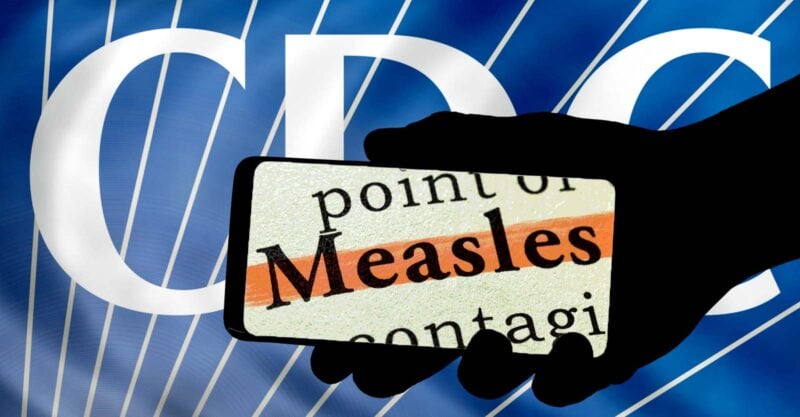


The federal government has revised how it counts measles deaths in response to ongoing questions over whether three recent deaths reported in Pennsylvania as “measles-associated” were actually caused by measles.
The Guardian reported Monday that the Centers for Disease Control and Prevention (CDC) will base its measles death count on data from the National Center for Health Statistics (NCHS). The NCHS describes itself as “the nation’s principal statistics agency,” providing data on how Americans’ health “changes over time.”
Previously, the CDC drew its measles death figures from the National Notifiable Diseases Surveillance System (NNDSS), which receives public health surveillance data from state, local and territorial health departments.
The key difference between the two systems is this: the NCHS tracks only the official causes of death as reported on death certificates, while the NNDSS reports include additional information about a person’s health status at the time of death.
This means the CDC’s official measles death tally will now depend on whether measles is recorded as the underlying cause of death in NCHS mortality records, or as an additional condition that existed at the time of death.
The change comes amid public disputes between Pennsylvania health officials and political figures over whether all four of the recent measles-related deaths in the state occurred due to measles or other underlying health factors.
The CDC’s move elicited a mixed response from physicians and health freedom advocates, with Steve Kirsch, founder of the Vaccine Safety Research Foundation, calling it “a change in bookkeeping, not epidemiology.”
“The CDC has moved from a surveillance system that attributes deaths based on the full clinical picture to a coding system that only counts measles if it happens to be listed as the underlying cause,” Kirsch said. “That systematically undercounts deaths where measles triggered the fatal complication — pneumonia, encephalitis — but isn’t the box a physician happened to check first.”
Death certificates are “notoriously inconsistent” in the manner they are filled out, Kirsch said. Relying on them to track official death trends “is a downgrade in accuracy dressed up as a technical adjustment.”
Karl Jablonowski, Ph.D., senior research scientist for Children’s Health Defense, agreed that death certificates are “far from perfect” but said NNDSS data coming from state health departments “may be co-opted by political means for political ends.”
“CDC changing to the NCHS is an added layer of protection of the information coming in and being reported out, and that is that at least one medical doctor certified the disease underlying the death,” Jablonowski said.
Dr. Ben Edwards, an integrative medicine family practitioner who last year successfully treated hundreds of children infected with measles during an outbreak in Texas, called the change “a positive move by the CDC” that “will allow for a more accurate picture of what actually happened to the patient.”
RFK Jr. called for more accurate system for tallying measles deaths
The dispute over what caused the two initial measles-related deaths in Pennsylvania went national late last month when Pennsylvania Gov. Josh Shapiro suggested the deaths occurred in unvaccinated individuals, and blamed the deaths on the Trump administration’s approach to vaccination policy.
U.S. Health Secretary Robert F. Kennedy Jr. responded on social media by accusing Shapiro of announcing the deaths with “giddy delight” for partisan purposes.
Pennsylvania continues to list the initial two measles-related deaths in its official count, even though a local coroner disagreed with characterizing one of those deaths as having been related to measles.
Lancaster County Coroner Stephen Diamantoni said a newborn who died shortly after birth last month tested positive for measles. However, Diamantoni said the pathologist who performed the autopsy determined the primary cause of death was a lacerated spleen, not measles.
The other death initially reported, which also occurred last month in Lancaster County, involved a 6-week-old Amish infant who was born with Amish lethal microcephaly — a condition that typically causes infants to die within six months of birth. Diamantoni said the infant died from measles.
Meanwhile, the Pennsylvania Department of Health (DOH) today confirmed two other measles-associated deaths. One of those was a 40-year-old woman in Jefferson County, who died on Sept. 12. The DOH previously listed the death as “from complications associated with measles.”
Jefferson County Coroner Greg Furlong told The Defender the woman, who never received the measles-mumps-rubella (MMR) vaccine, suffered from a “long, long history” of underlying illnesses, but that her measles infection likely served as the catalyst for her death.
The fourth death, announced today, was an 18-year-old in Mifflin County. The Mifflin County coroner said the teen died “due to complications of measles” after developing “acute disseminated encephalomyelitis … a rare and severe neurological complication of measles.” The Defender reached out to the Mifflin County coroner but did not hear back by the deadline.
As of Monday, Pennsylvania has confirmed 693 measles cases as part of the state’s ongoing outbreak. Four of the cases involved people who were vaccinated.


This article was funded by critical thinkers like you.
The Defender is 100% reader-supported. No corporate sponsors. No paywalls. Our writers and editors rely on you to fund stories like this that mainstream media won’t write.
As of today, CDC shows no deaths from measles in the U.S.
Reuters reported earlier this month that disputes over whether the Pennsylvania deaths were from measles led Kennedy to ask CDC Director Erica Schwartz not to count the first two deaths in the official CDC figures.
“The day after the Reuters report was published, the CDC changed its data source on measles deaths,” The Guardian reported. According to the CDC, the deaths were excluded because available information did not establish whether measles caused or contributed to the two deaths last month or if those people died from other causes.
The Washington Post late last month reported that this was an “unusual” move because the CDC has traditionally relied on information from state and local health departments for such information.
The DOH defines “measles-associated death” as a death that occurs “within 30 days of symptom onset in an individual with clinical evidence of a measles infection and a positive laboratory test and that is not due to unrelated causes.”
As of today, the CDC’s measles webpage shows no deaths from measles in the U.S. this year. The figure is accompanied by a disclaimer stating that NCHS “does not currently have any death records from 2026 that indicate measles is the underlying cause.”
The U.S. Department of Health and Human Services (HHS) did not respond to The Defender’s request for comment by press time. HHS spokesperson Emily Hilliard told The Guardian, “CDC will report measles deaths if and when the National Center for Health Statistics reports measles as the underlying cause of death.”
Kirsch said that under this system, “the effect is predictable,” as “fewer deaths will be attributed to measles without a single fewer child dying.”
“If the goal were transparency, the CDC would publish both numbers side by side and explain the discrepancy — not quietly swap one system for another and leave the public to wonder whether the outbreak is actually receding,” Kirsch said.
Edwards said the previous system resulted in the classification of non-measles deaths as measles deaths on the basis that the deceased were infected when they died.
“As we learned in the cases of the young Mennonite girls in Gaines County in 2025, which were both classified as measles deaths, they were in fact treatable bacterial pneumonias that were not properly treated. So, in my opinion, these should not be officially listed as measles deaths, and I believe they would not have been if this more accurate classification system was used.”
Related articles in The Defender
- 40-Year-Old Pennsylvania Woman With ‘Long, Long History’ of Underlying Illnesses Dies After Catching Measles
- 6-Week-Old Amish Infant With Fatal Genetic Condition Died From Measles, Coroner Confirms
- Pennsylvania Coroner Investigating Death of Second Child With Positive Measles Test
- Coroner Contradicts Pennsylvania Health Officials, Says Measles Didn’t Cause Newborn’s Death
- 2 ‘Measles-Associated’ Deaths in Pennsylvania Spark Media Blitz — But Officials Won’t Release Details
- 8-Year-Old in West Texas Died From Hospital-acquired Pneumonia, Medical Records Show