Login
Login


By Peter C. Gøtzsche
In my vaccine book, I give numerous examples that the Centers for Disease Control and Prevention (CDC) cannot be trusted in relation to vaccines and infections.
The CDC has claimed, for example, that influenza vaccines reduce hospitalizations and mortality even though the randomized trials did not find this. The CDC did not provide a single comment that its claims were based on deeply flawed case-control studies.
On Aug. 17, Maryanne Demasi, Ph.D., published a very disturbing article showing that corruption and scientific misconduct at the CDC are not things of the past.
In June, the CDC’s vaccine advisory panel met for the first time since being overhauled by U.S. Health Secretary Robert F. Kennedy Jr., in order to get rid of the financial conflicts of interest. Kennedy had promised that his new appointees would demand full transparency and scrutinize the evidence before making recommendations.
However, if the documentation provided by the CDC to its advisory panel is flawed, it is difficult or impossible for the panel to make rational, evidence-based recommendations.
This is exactly what happened when the panel voted about whether to endorse Merck’s monoclonal antibody for babies against the respiratory syncytial virus (RSV), nearly identical to Sanofi’s version approved in 2023.
The CDC assured the committee there were “no safety concerns,” but there surely were. Professor Retsef Levi, who cast one of the two dissenting votes, noticed a troubling pattern across four major clinical trials conducted by Sanofi.
In each, there was a consistent imbalance in “nervous system” serious adverse events, most often including seizures, in the treatment groups compared to controls.
Merck’s Dr. Anushua Sinha downplayed the concerns, saying there had been “extensive analysis of the events” and that Merck’s investigators had deemed that none of the nervous system harms were related to its product.
This is not reassuring. Two days after Maryanne’s article, I published a book where I document — in my capacity as an expert witness in a U.S. lawsuit that gave me access to 112,000 pages of Merck’s confidential study reports — that Merck committed scientific misconduct when it concealed serious neurological harms of its Gardasil vaccines against the human papillomavirus (HPV) and that the European Medicines Agency was complicit in the fraud.
Levi acknowledged that the numbers in the clinical trials were small and indicated that his decision would hinge on the post-marketing surveillance data.
This data, on Sanofi’s drug, came from the CDC’s Vaccine Safety Datalink system. The presentation was delivered by Matthew Daley, a pediatrician at Kaiser Permanente Colorado, part of an organization that has received funding from Sanofi.
When seizure outcomes appeared on the screen, the slide stayed up for barely a minute.
The results were split into two groups based on the age of when babies received the injection:
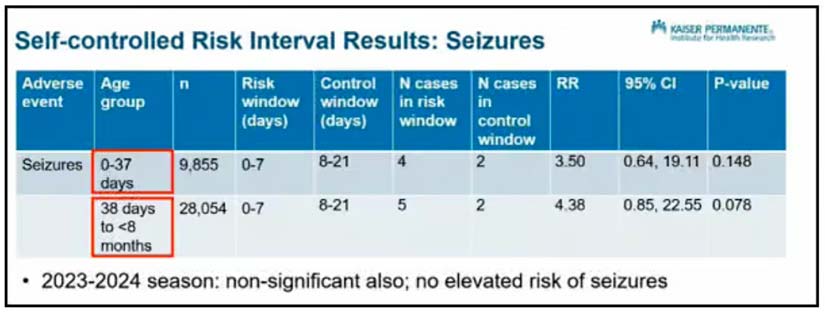
Daley’s conclusion, that CDC’s data showed “no significant increased risk,” was false. If the two age groups are combined in a meta-analysis, the risk is significantly increased, risk ratio 3.93, 95% confidence interval 1.21 to 12.79, P = 0.02.
The only reason I can see for splitting the data and not telling the panel what the whole data set shows is to have a deliberate intention to deceive. Scientifically, it makes zero sense to split the data.
Moreover, the age groups are also nonsensical. The neonatal period is defined as the first four weeks of life, so why choose a cutoff of 37 days?
The observation periods are also weird. One would expect the risk ratio for the youngest group to be 4.00, but it was 3.50 because the risk window is not one week, but eight days. Thus, the risk ratio becomes (4/8) ÷ (2/14) = 3.5.
I believe that the CDC defrauded its vaccine advisory panel and that the approval of monoclonal antibodies against RSV by the U.S. Food and Drug Administration and the CDC was a harmful decision.
Despite all of Kennedy’s good intentions, there is still a long way to go before the CDC becomes clean and trustworthy. I doubt it will ever happen.
The CDC has accepted millions of dollars from the drug industry through the CDC Foundation. During fiscal years 2014 through 2018, the CDC Foundation received $79.6 million from companies like Pfizer, Biogen and Merck.
Originally published by Brownstone Institute.
Dr. Peter Gøtzsche co-founded the Cochrane Collaboration, once considered the world’s preeminent independent medical research organization. In 2010, Gøtzsche was named professor of Clinical Research Design and Analysis at the University of Copenhagen.