

 Login
Login
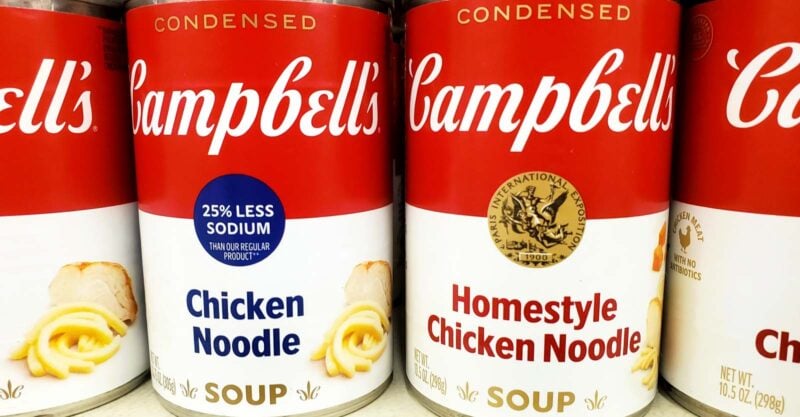


Campbell’s scrambled to contain fallout Tuesday after reports surfaced of a secret recording of a company executive who appeared to mock customers, insult employees and disparage the food giant’s products — including suggesting products contained “chicken that came from a 3D printer.”
Campbell’s placed the executive accused of making the comments on leave pending an investigation. The company also said its “soups are made with No Antibiotics Ever chicken meat. Any claims to the contrary are completely false.”
Campbell’s soup labels state that the company uses “bioengineered food ingredients.” But on its website, the company clarified that this “refers to genetically modified crops — canola, corn, soybean, sugar beets, etc. that are grown by the vast majority of American farmers. This language on our labels refers to ingredients derived from those crops, not chicken.”
However, claims that the company uses lab-grown meat prompted Florida Attorney General James Uthmeier to announce that Florida’s consumer-protection division would investigate the allegations. Florida has a statewide ban on lab-grown meat.
Uthmeier posted on X that his office would “demand answers from Campbell’s” and “shut down” any violators.
We don’t do the fake, lab grown meat here in Florida. We’ll enforce the law and shut down!
Thanks to @GovRonDeSantis and @WiltonSimpson for championing this cause, and the Florida Legislature for passing it into law, @dannyalvarezsr @JayCollinsFL. https://t.co/TxPF3uvxiC
— James Uthmeier (@JamesUthmeierFL) November 24, 2025
If accurate, executive’s comments ‘unacceptable,’ Campbell’s says
The employee who made the secret recording — former cybersecurity analyst Robert Garza — sued Campbell’s on Nov. 20 in Michigan’s Wayne County Circuit Court, alleging racial discrimination and harassment.
Garza claimed that Martin Bally, Campbell’s vice president and chief information security officer, made the remarks during their November 2024 meeting. Garza said the company fired him after he relayed Bally’s comments to a supervisor, and said he planned to report them to human resources.
According to The Guardian, Garza scheduled the meeting with Bally to discuss his salary. However, Garza alleged, the meeting turned into an hour-long tirade of Bally attacking Campbell’s products and customers, making racist comments about Indian employees and admitting he had gone to work while high on marijuana edibles.
Garza said he left the meeting feeling “pure disgust” but kept the recording private until January, when he reported Bally’s behavior to a supervisor. He claimed Campbell’s terminated him 20 days later without any prior disciplinary action.
Garza’s lawsuit accuses Campbell’s of retaliatory dismissal and maintaining a racially hostile work environment. According to Newsweek, Bally called the company’s Indian employees “idiots” and also said, “We have s— for f—ing poor people. … I don’t buy Campbell’s products barely any more.”
Campbell’s — which changed its name from the Campbell Soup Company last November to reflect its broader brand portfolio — said the comments captured in Garza’s recording, if accurate, are “unacceptable” and do not reflect the company’s values or culture.
Lab-grown meat ‘meets the definition of cancer’
Florida became the first state to ban the sale, manufacture and distribution of lab-grown or “cultivated” meat in 2024, and six more states have since adopted similar laws, according to the National Agricultural Law Center.
“Florida is fighting back against the global elite’s plan to force the world to eat meat grown in a petri dish,” Gov. Ron DeSantis said in a May 2024 statement announcing the state’s ban.
Cultivated meat uses techniques developed in the biopharma industry. Producers take cells from live animals or from a cell bank — which creates “immortalized” cells from cultured stem cells — and grow them in large steel tanks called cultivators or bioreactors.
They feed the cells a mix of sugars, amino and fatty acids, salts and vitamins, prompting the cells to rapidly multiply into masses or sheets of muscle and connective tissue that can be processed as meat.
The National Cancer Institute has noted that uncontrolled, indefinite cell division is a defining feature of cancer cells — a point critics invoke when arguing against lab-grown meat.
In the secret recording, Bally suggested that Campbell’s used bioengineered meat in its soups. Attorney and political commentator Tom Renz seized on that allegation, arguing that lab-grown meat relies on cell-culturing methods similar to those used to produce tumor cells.
On his program, the “Tom Renz Show,” Renz said, “So lab-grown meat, which is what they’re talking about, it comes from cancer cell lines. … But it’s not meat. It’s not even sort of meat. It’s literally just cancer. It meets the definition of cancer in more ways than I can count.”
In Renz’s Substack newsletter, he argued that Bally’s allegations against Campbell’s raise significant legal and ethical concerns, including failure to disclose engineered ingredients, deceptive marketing practices, and questions about what regulators permit under current labeling standards.
Renz contends that if Big Food companies knowingly sell food derived from biologically immortalized cell lines while marketing it as “natural” or “real meat,” litigation is not only possible but likely.
In addition to stating that “the chicken meat in our soups comes from long-trusted, USDA approved U.S. suppliers and meets our high quality standards,” Campbell’s also said this: “Keep in mind, the alleged comments heard on the audio were made by a person in IT, who has nothing to do with how we make our food.”
Renz said these issues could also spark a broader cultural debate about food transparency, bioengineering and the future of what Americans eat.


This article was funded by critical thinkers like you.
The Defender is 100% reader-supported. No corporate sponsors. No paywalls. Our writers and editors rely on you to fund stories like this that mainstream media won’t write.
Campbell’s still facing claims over tainted baby food
Campbell’s is also facing an April 2024 lawsuit alleging that major baby food brands sold products contaminated with toxic heavy metals.
Ten families sued multiple companies — including Campbell’s — claiming their children developed autism and attention-deficit/hyperactivity disorder (ADHD) after eating baby food tainted with arsenic, lead, mercury and cadmium.
On Oct. 1, a federal judge dismissed claims against several defendants but refused to dismiss key claims against Campbell’s.
The ruling means families can continue pursuing their case against Campbell’s, which oversaw its former subsidiary Plum Organics during the period at issue.
U.S. District Judge Jacqueline Scott Corley in the Northern District of California ruled that the amended complaint plausibly alleges Campbell’s exceeded “accepted norms of parental oversight” and directly influenced Plum’s limits for heavy metals, testing decisions and ingredient sourcing.
The litigation stems from a 2021 congressional report showing major baby food products contained toxic metals at 5 to 177 times the U.S. Food and Drug Administration’s drinking-water limits.
Investigators found companies rarely tested finished products and relied on ingredient tests that understated contamination. A follow-up report that year found several companies — including Campbell’s — initially withheld internal data before later disclosing test results showing high metal levels and lax standards.
Related articles in The Defender- DOD Funding Research on Fake Meat Rations to Improve Soldiers’ ‘Military Readiness’
- Federal Judge Upholds Florida Ban on Lab-Grown Meat, as Other States Propose Similar Bans
- USDA Approves First Lab-Grown Meat in U.S., But Scientists, Food Safety Experts Aren’t Sold on It
- FDA Declares Lab-Grown Chicken ‘Safe to Eat’ — But Scientists, Food Safety Advocates Have Questions
- Court to Consolidate Lawsuits Alleging Baby Food Makers Knew Products Were Contaminated With Heavy Metals
