

 Login
Login
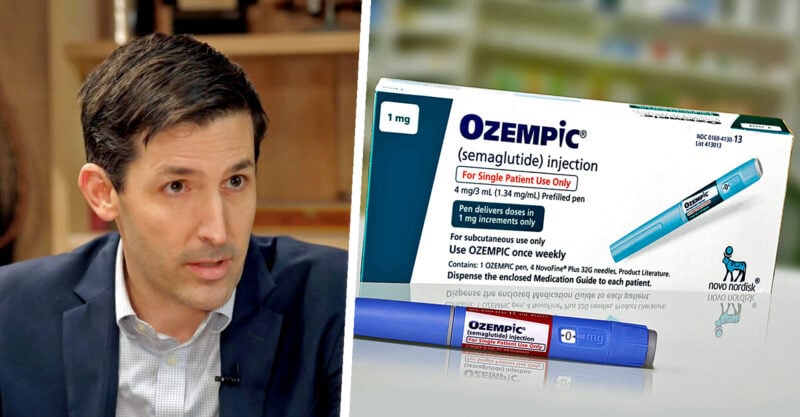


A pharmaceutical industry whistleblower warned that Ozempic, the new diabetes and obesity drug sold by Novo Nordisk, poses a potential safety “disaster.”
Calley Means, founder of health tech firm TrueMed, during the Feb. 2 episode of “The Tucker Carlson Encounter” cited numerous reported side effects — including gastrointestinal issues and suicidal thoughts — of the popular weight-loss drug.
Means also cited reports of lingering issues after people stopped using the drug.
Ozempic is the brand name for semaglutide, an injectable drug that reduces appetite and causes weight loss in people who are obese or overweight.
Means, co-author of the book, “Good Energy: The Surprising Link Between Metabolism and Limitless Health,” also argued drugs like Ozempic fail to address the current metabolic health crisis in the U.S., which is rooted in poor nutrition and lifestyle choices.
While Wall Street cheers Novo Nordisk’s projected $1 trillion stock value by 2030, Means contended, “Obesity is not an Ozempic deficiency” but rather a symptom of declining metabolic health that prescription drugs fail to remedy.
According to Means, surging obesity rates have created perverse financial motivations that prioritize lifelong pharmaceutical use over preventative care.
Fundamental healthcare reforms are needed, he argued, to reverse the spikes in lifestyle diseases. “This miracle drug is too good to be true,” he said.


‘We have a metabolic health crisis’
The roots of the obesity epidemic lie in the deterioration of metabolic health among American adults and even teens over the past generation, Means told Carlson.
He cited statistics indicating 50% of teens and 80% of adults are currently overweight, with 60% harboring pre-diabetes symptoms.
“We didn’t become systematically lazier in the past generation as Americans — and frankly suicidal. Something has happened,” Means said.
Other lifestyle diseases like heart disease and diabetes are all reaching record highs as well.
“Twenty-five percent [of teens] have fatty liver disease,” he said, “which is something you only used to see in elderly alcoholics.”
According to Means, the diabetes crisis ultimately comes down to “cellular dysfunction [and] cellular disruption” caused by the unhealthy, addictive foods we eat.
“We have a metabolic health crisis,” Means stated, pointing to flaws in national nutrition standards, agriculture subsidies that favor processed ingredients and heavy pharmaceutical marketing driving demand for drugs over diet and exercise.
“The USDA [U.S. Department of Agriculture] … is completely corrupt,” he said, asserting that 95% of the guidelines for nutrition standards are paid for by food companies, while 90% of subsidies go to highly processed food.
For an average 2-year-old, “10% of their diet can be added sugar,” he said.
Means called out the agricultural industry for encouraging such unhealthy behaviors, adding “Food stamps, which 15% of Americans depend on for nutrition — 10% of all food stamps funding goes to soda.”
“We’re the only country in the world that allows that,” he said.
RFK Jr: “We’re Being Mass Poisoned”
“Americans didn’t suddenly get lazy,” says @RobertKennedyJr, speaking on the obesity crisis.
“We’re being mass poisoned by a food industry that is highly subsidized and that owns Congress.”
“We’re the only country in the world that allows… pic.twitter.com/qbNuKhdUoO
— The Vigilant Fox 🦊 (@VigilantFox) February 5, 2024
‘Medically, Ozempic is an absolute disaster’
While Ozempic has shown the ability to deliver significant weight loss results in clinical trials, concerns around its safety profile and side effects are mounting.
Means said that even in the U.S., where the drug is approved to treat obesity, up to 30% of patients prescribed Ozempic stop using it within three months, attributing this in part to harsh gastrointestinal side effects.
Its makers also admit metabolic impacts after stopping the injections remain unknown, he said.
Ozempic “paralyzes your stomach,” Means said. “And there are studies now saying that [the inability] … to digest food actually stays after you go off the drug. You’re consistently seeing patients who go off the drugs gain the weight back.”
Means theorized that disrupting digestive processes critical for serotonin production may contribute to mental health issues, citing European regulators’ recent probe into links between Ozempic and similar weight-loss drugs and increased depression and suicidal thoughts among users.
“Your serotonin — what produces your contentment and happiness — 95% is made in the gut,” he said. “Ozempic essentially is gut dysfunction.”
Between lingering gastrointestinal, metabolic and mental side effects, Means said, “Medically, Ozempic is an absolute disaster.”
Means said that European regulators haven’t approved this drug for use with obesity in the EU.
“Almost all of Novo Nordisk revenue is coming from taking advantage of Americans,” he said. “They’re taking advantage of a broken … system in the United States.”


‘They’re doing cartwheels on Wall Street’
While Novo Nordisk downplays legitimate medical concerns in pursuit of sales growth, the potential costs to society are extreme according to health trends Means cited.
With 80% of American adults now overweight amid declining metabolic health markers, analysts forecast more than $1 trillion in annual Ozempic revenues if prescription rates increase in line with current obesity trends.
“Do the math on $20,000 per patient, 80% of American adults,” Means said. “It’s the biggest target market for any drug in American history.”
“Food stocks are going down, pharma stocks are going up … They’re doing cartwheels on Wall Street,” he remarked.
Transitioning patients en masse to lifelong injections may have “Wall Street going crazy,” Means said, but we need to understand it’s “an all-out assault to convince us that this is the appropriate drug.”
“On a societal level … pumping everyone [with] Ozempic for [the remainder of] their lives isn’t the first thing you do to solve obesity,” he said. “We have a dirty tank. If a fish tank is dirty, you clean the tank — you don’t drug the fish.”
According to Means, Big Pharma has changed our consensus reality to ignore all of the contributing environmental factors, and instead look to drugs like Ozempic as “our savior.”

‘The Rosetta Stone for understanding corruption’
Calling Ozempic “the Rosetta Stone for understanding corruption,” Means attributed the embrace of Ozempic as a quick fix to warped economic incentives that prioritize treatment revenue over meaningful solutions.
He pointed to statistics showing healthcare captures nearly 20% of U.S. gross domestic product — the most of any country globally. “And as it grows, it produces worse results. It is not slowing down,” Means added.
“Medical schools, pharma companies, hospitals, doctors, nurses, insurance companies — they make money when people are sicker for longer periods of time,” Means said. “The second you get someone off the chronic disease treadmill, that’s not a profitable patient.”
Regarding Ozempic, Means said, “We had a 68-week study for a lifetime recommendation to 50% of teens in America to receive these injections.”
He also said hidden conflicts of interest perpetuate the status quo, claiming pharmaceutical advertising and political lobbying “buy off” both media coverage and medical providers.
Means pointed out that Big Pharma is the largest spender on TV news ads, alleging “Novo Nordisk specifically is the largest spender on foundational obesity research.”
“You have a situation where additionally, Novo Nordisk … has given $30 million in direct bribes to obesity doctors,” he alleged. “This is what’s done. The drug makers spend hundreds of millions of dollars a year in direct cash payments to doctors.”
Means also alleged Novo Nordisk pays civil rights groups to frame obesity treatment access through a social justice lens.
“[They’re] paying the NAACP to say that not supporting Ozempic is a civil rights issue,” he said, saying the organization is a registered lobbyist for the drug maker.
When it comes to the NAACP, the playbook is clear – label opponents of government funding for obesity injections as racist.
Here are official talking points from Novo Nordisk saying lack of access to Ozempic is an example of systemic racism. pic.twitter.com/AdTU11MyP6
— Calley Means (@calleymeans) March 27, 2023
Means called out the American Diabetes Association and the American Academy of Pediatrics for supporting Ozempic use while being majority-funded by Big Pharma.
He singled out the American Academy of Pediatrics as “a vector for badness given [its] performance during COVID.”
“Our institutions, particularly the healthcare industry, have completely let us down,” he said.
“Why aren’t doctors giving their patients prescriptions for food interventions if they have pre-diabetes … or allowing them to use their medically tax-advantaged dollars to [pay for] exercise [programs]?” Means asked.
“If you actually follow the science,” these would be the correct medical interventions, rather than drugs like Ozempic, he said. “We’re so gaslighted by this. It’s just pill, pill, pill.”
He added:
“Our biggest industry, the healthcare industry, is profiting from us being sick. It’s just that simple. We need to unwind that or we’re going to destroy our human capital and destroy our [national] budget.”
Better health calls for ‘incentivizing better eating, better farming’
According to Means, addressing declining health requires rethinking reliance on pharmaceutical approaches.
“We need to get back to root causes in America and talk about food, talk about exercise, sleep,” Means stated.
Government officials could change agricultural subsidies favoring processed ingredients, restrict pharmaceutical advertising, and require conflict-of-interest disclosures in academic research, he said.
More broadly, he advocated for “incentivizing better eating, better farming” and for getting Americans “more active,” refocusing the healthcare system on creating health.
“You can change your biomarkers in three months if you go on a functional medicine-type program and really have curiosity about what you’re eating [and] your behavior,” he said.
Watch ‘The Case Against Ozempic’:
The Defender on occasion posts content related to Children’s Health Defense’s nonprofit mission that features Mr. Kennedy’s views on the issues CHD and The Defender regularly cover. In keeping with Federal Election Commission rules, this content does not represent an endorsement of Mr. Kennedy, who is on leave from CHD and is running as an independent for president of the U.S.
