

 Login
Login
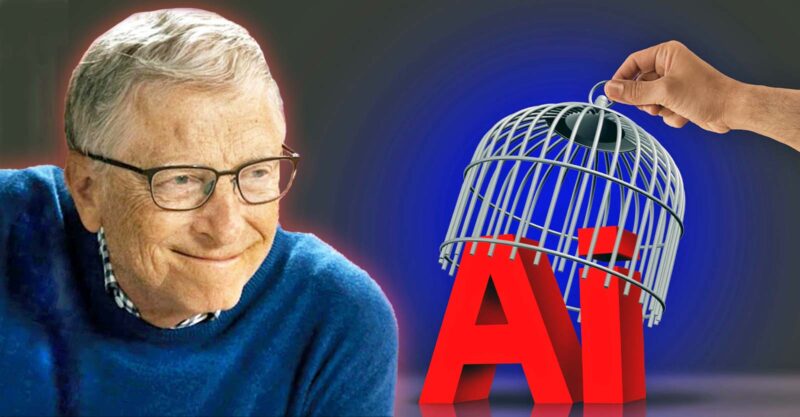


By Collapse Life
Let’s just start by saying we already know all the arguments for why we shouldn’t listen to Bill Gates.
His insidious and deplorable Jeffrey Epstein associations, his financial interests, his habit of exercising enormous policy influence absent any democratic accountability … we could go on, skipping over Gates’ penchant for jabbing experimental liquid into the arms of children in developing countries.
Yet, he’s one of the most recognizable names in the world, and for better or worse, he is an agenda-setter with extraordinary access. He secures meetings with heads of government and works directly (through his foundation) with the principals of some of the world’s largest corporations.
We don’t suggest listening to him to receive wisdom from on high. On the contrary, we think it’s worth exploring what he says for the signs of what powerful institutions may soon try to implement.
In this context, let’s look at what Gates said about artificial intelligence (AI) in his 6,000-word manifesto, released Aug. 26 and entitled “The turbulent AI era is here. The choices we make now are critical.”
Basically, he says AI cat is out of the bag — there’s no going back (DUH!). He believes it can greatly benefit humanity but that it may not do so evenly, with some people being hurt substantially more than others.
“If the world takes the right steps,” he says, “AI will be a force for good and leave everyone better off.”
But he doesn’t think the world has taken the right steps … at least not yet. “I don’t see evidence that leaders, experts, and communities are confronting the challenges adequately.”
What are those challenges?
First, he warns that AI will make some jobs go away forever, especially entry- and mid-level ones.
Second, he has concerns about the potential for AI to empower the criminally minded to “target victims at every scale: individuals, companies, and governments.”
And finally, he’s worried about the toll AI will take on our kids’ development and human relationships in general.
“We are only beginning to understand the dangers that the internet — especially social media — can pose to young people’s development. We’re seeing compulsive use, disrupted sleep, cyberbullying, and exposure to harmful content.
“AI could magnify many of these risks by making them more persuasive and difficult to escape, and we should not wait another generation to start taking them seriously.”
From a more optimistic perspective, Gates suggests AI has the potential to be a game changer in healthcare, agriculture and education. This is where our skepticism really amps up, especially because those are three areas his foundation specifically focuses on globally.
Gates addresses this potential conflict of interest directly, saying:
“I have benefited enormously from the technology industry. Although I have diversified my portfolio quite a bit, I still have financial ties to it.
“I am working with Microsoft and other AI companies in my role as chairman of the Gates Foundation to try and ensure AI is deployed in ways that will truly benefit people around the world.
“However, my views on AI are not motivated by the potential to make money for myself. Any profits generated by my investments, including those related to technology, will go to the Gates Foundation to tackle global inequity. Of course, readers will have to decide for themselves whether this clouds my view.”
There’s a bit of a false distinction going on there. Sending profits from his technology investments to the Gates Foundation doesn’t remove the institutional interest — it just redirects the gains to another powerful organization he chairs and has used for decades to pursue his priorities.
The foundation may arguably be even more of a benefit to him than any increase to his financial portfolio. Through the foundation, he has the ability to choose global priorities, partner with corporations and governments, and help determine the technological solutions that will be deployed to address global challenges.
Looking at some of those proposed solutions, it’s classically technocratic:
- He wants new national and international bodies to manage the AI transition (more bureaucracy, of course!).
- He wants some jobs set aside specifically for humans (what he calls the ‘Human Reserved’ domain).
- He wants to change the tax system so companies have less incentive to replace people with machines.
The idea of setting aside certain jobs is probably the clearest example of how Gates sees the future for us humans.
He paints a picture of a world where automation runs the economy and certain jobs are preserved for humans not because machines couldn’t do them, but because allowing machines to take them over could be economically or socially damaging.
Inevitably, we have questions: Who gets to decide what jobs are set aside? Would the protections be permanent or are we just creating temporary holding pens? What happens if one country chooses to preserve human labor and another opts for automation?
Ultimately, this part of Gates’s three-step solution treats human participation as the exception — a little morsel thrown to the people who do the jobs that are deemed worthy of protection.
The tax question starts to fall apart as soon as you ask, “What is a robot?” When corporations already go to great lengths to avoid paying taxes, we can already imagine where this proposal ends up.
And then we have the biggest and most consequential proposal: new national bodies and an international AI organization modeled partly on nuclear inspections, aviation regulation and environmental treaties.
“It is fair to wonder,” Gates muses, “whether the world’s institutions are up to the task of designing and implementing this new architecture. Government moves slowly when it moves at all, and polarization within and between countries makes it harder than ever to get things done.”
Hear that? That’s the sound of the technocratic gears spinning wildly in Gates’ head.
Governments and most institutions aren’t up to the task, he says. He even raises the possibility that increasingly powerful AI systems could act against our interests and that we could lose control.
AI is like Godzilla, and humanity is like a crowd fleeing through the streets of Tokyo. We are sprinting into an unknown future, looking over our shoulders, realizing no government can shoot down, reason with, or outrun this giant, out-of-control reptile.
Gates isn’t just warning about the dangers of AI. He’s arguing that the dangers it presents require a complete reorganization at the global level.
He wants to see an entirely new architecture of national and international authority, reaching into employment, education, taxation, energy, elections, public health, law enforcement and the financial system.
He offers few details about what powers this international organization would have, who would appoint its leaders, what it would inspect, or how its decisions would be enforced.
But he makes it abundantly clear that a response on this scale is what he believes is needed to protect humanity.
Why anyone would listen to him is beyond us … still, for what it’s worth, Gates’ manifesto (like so many other manifestos coming out from tech bros these days) is another reason to be hypersensitive to the rapid-fire changes taking place all around us.
Originally published by the Collapse Life Substack page.
Collapse Life focuses on the challenges and triumphs of surviving and thriving in our turbulent world.