

 Login
Login


More than 100 people gathered this month in Channelview, Texas, to react to a Public Health Watch investigation into dangers posed by the Houston area’s petrochemical barge industry.
The story, published last December, revealed that the Texas Commission on Environmental Quality, or TCEQ, estimated the loading and unloading of barges and other small vessels released 5.1 million pounds of volatile organic compounds, or VOCs, into Harris County in 2023, the most recent data available.
That’s 28% more than Texas’s largest single VOC emitter — a 3,400-acre Exxon Mobil refining and petrochemical complex on the county’s eastern edge — released over the same period.
VOCs include benzene, toluene and other highly combustible substances that can cause blood, kidney and liver cancers.


“It wouldn’t shock me if that [the 2023 estimate] is underestimated by a magnitude or more,” said Tim Doty, a former TCEQ scientist who spent more than a decade monitoring emissions along the Houston Ship Channel and San Jacinto River, where the county’s largest concentration of barges is located.
“It’s still an emission source that is, you know, generally uncontrolled and that the TCEQ doesn’t have a good handle on.”
The TCEQ has not responded to requests for comment on Public Health Watch’s findings. An agency spokesperson declined to attend the Channelview town hall.
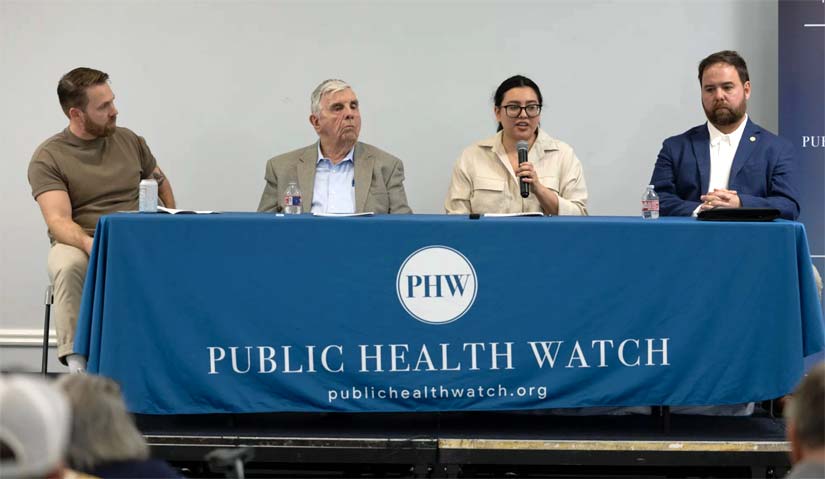
Panelists address a crowd at the town hall in Channelview on March 5. From left: Public Health Watch reporter David Leffler, barge expert Frank Parker, Public Health Watch reporter Salina Arredondo and Texas A&M epidemiologist Dr. Garett Sansom. Credit: Anto Tavitian.
The event drew a strong turnout from residents, advocates, local news outlets, government agencies and elected officials who heard from a panel of experts: Frank Parker, a retired barge-industry consultant with more than 20 years of experience; Dr. Garett Sansom, an epidemiologist and assistant professor at Texas A&M University’s School of Public Health; and Salina Arredondo, a Public Health Watch staff writer who led the barge investigation.
Panelists explained how barge emissions occur, why regulators struggle to measure them and what the findings could mean for communities along the river. At times, the conversation grew emotional.
“All these people in this community that have health issues, high blood pressure, diabetes, cancer — cancer is number one. I’m a survivor myself, and that’s why I’m here,” said Juanita Johnson, who lives in the Houston neighborhood of Pleasantville.
“We need to get more involved.”
Others voiced frustration at the maze of regulations that make it difficult for residents to have a say about the intrusion of barges into their neighborhoods.
“The area where the barges park out in the river just off I-10, what gives them the right to park there?” asked Nathan Mathews, a senior captain with the Channelview Fire Department, drawing loud applause from the crowd.
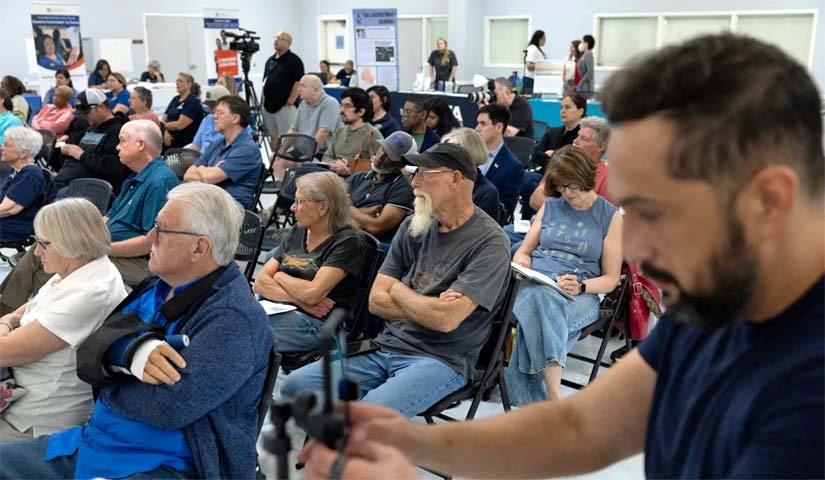
More than 100 people turned out for the town hall in Channelview to hear about health risks posed by barges clogging the San Jacinto River. Credit: Anto Tavitian.
The agency most responsible for the proliferation of barges in Harris County is the Port of Houston, which owns the submerged land beneath the ship channel and the river.
The port decides which companies are allowed to rent space on the waterways to park, or “fleet,” their barges.
A port representative attended the town hall but declined to give a formal statement.
“We did want to hear what y’all had to say, but I’m not prepared to talk today,” said Garry McMahan, the agency’s real property manager who oversees the approval of barge leases, known as submerged lands leases.
Officials representing U.S. Rep. Sylvia Garcia’s office, state Rep. Anna Hernandez’s office and Harris County precincts two and three were also present. Fox 26 Houston covered the event and produced a two and a half minute segment.
“We do have to show up in numbers and we have to let [officials] know that our lives are at stake here,” said Adrian Shelley, director of the Texas office of Public Citizen, a nonprofit advocacy organization.
Anyone wishing to express concern about the barges can contact [email protected], and copy [email protected], who is keeping a record of barge-related complaints.
This article was originally published by Public Health Watch, a nonprofit investigative news organization. Find out more at publichealthwatch.org.
