 Login
Login


Finding Our Way Back to the Village: We Were Never Meant to Do This Alone.
Motherhood can feel lonely in a world that’s more connected than ever. We’re surrounded by opinions, expectations and carefully curated lives, while quietly carrying our own fears, struggles and uncertainties. Maybe the village isn’t about finding people who agree with us — it’s about finding people who show up.
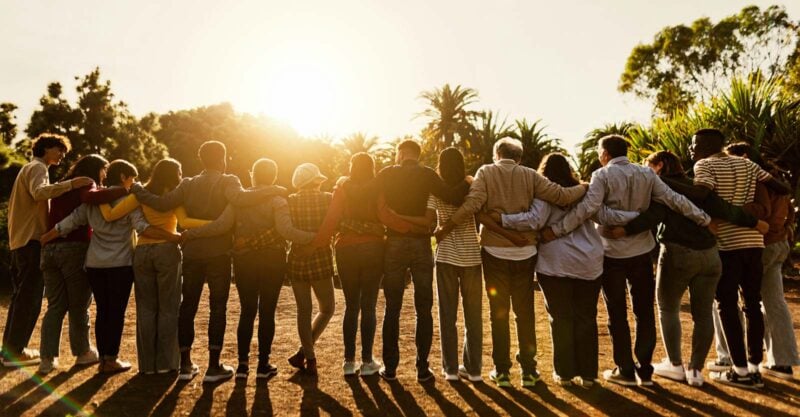
Motherhood has become a line in the sand.
Working moms vs. stay-at-home moms. Breastfeeding vs. bottle-feeding. Vaccinated vs. unvaccinated. Homeschooling vs. traditional school. Medication vs. natural approaches.
We pick a side and defend it. Somewhere along the way, we forget the human being on the other side. But what if motherhood wasn’t meant to work this way?
We’ve never been more connected — we can reach anyone, anywhere in an instant. Yet, somehow we’ve become so disconnected from one another and from our humanity.
We’ve traded conversation for comments, community for followers and understanding for algorithms. We’re getting better at finding people who agree with us and worse at listening to those who don’t.
Motherhood is simply one place where that disconnect becomes especially visible. Perhaps that’s why the phrase “It takes a village” keeps coming up. The village was never about agreement. It was about showing up.
That matters in health advocacy, too. We can fight for better science, transparency, informed consent and accountability without losing sight of the people behind the debate.
We can disagree and still listen. We can question and still have compassion. We can stand firm without turning against one another.
Maybe we don’t need more agreement. Maybe we need more humanity. To see the person behind the opinion and remember we were never meant to do this alone.
The story of Lindsay Clancy has exposed us to something far beyond the courtroom. It brings us face-to-face with a difficult truth: We rarely know what someone is carrying beneath the surface.
Online, the case has become a battle of narratives — people taking sides, dissecting information, sharing their theories, and in some cases using this tragic story as entertainment.
Whatever your beliefs about her actions, mental health, treatment or accountability, one thing is undeniable: A mother was suffering. That does not erase the unimaginable harm and loss that occurred. It doesn’t eliminate accountability, but two truths can coexist.
What happened was horrific. And a human being was suffering profoundly
Compassion does not mean condoning. Empathy does not erase accountability. It means being willing to look at the whole picture and acknowledge how little we may know about what is happening inside another person.
We’ve become masters at wearing the mask — making the outside look beautiful while hiding the mess inside. We run on coffee and concealer, shuttling kids from one activity to the next, snapping photos for social media and checking the boxes.
We’ve been taught that being busy is being productive while curating the highlight reel and hiding the mess underneath.
And if everyone is performing “fine,” how does anyone know when they’re not?
Mothers carry so much. We research, schedule, advocate, organize, care and protect — all while worrying about our children and holding our families together.
We are the glue.
But who holds the mother together?
Maybe that’s the question we need to ask more often. Because beneath the opinions, choices and expectations of motherhood is a reality we don’t talk about enough: So many of us are struggling.
We’re carrying fear, exhaustion, grief, uncertainty and the pressure to somehow keep it all together. Sometimes, instead of meeting vulnerability with compassion, we meet it with judgment.
But what if we paused long enough to remember that we are all carrying something?
The mother who looks like she has it all together may be barely holding on. The person we disagree with may be carrying a burden we know nothing about.
Maybe this is how we find our way back to the village?
Our struggles aren’t a competition, and there is no prize for carrying the most. The village was never about agreement. It was about showing up for each other.
Showing up when someone says, “I need help.” Showing up without judgment. Showing up even when we see things differently.
Maybe rebuilding the village starts with something much smaller than agreement.
It starts with being willing to be vulnerable, because our energy is contagious — and when we let ourselves be human, we give others permission to do the same.
A smile at a stranger. Eye contact. Listening without judgment. Choosing connection over being right. Seeing the person behind the opinion instead of making them wrong for it.
We may never agree on everything. But we can choose how we show up for one another.
Maybe that’s how we find our way back to the village.
Not by erasing our differences, but by remembering we’re human first — and we’re in this together.
Do you have a story you’d like to share with the CHD Community? Click here for details.