

 Login
Login


By Sarah Intelligator, Esq.
I’m furious. I’m disappointed. I’m frustrated. I’m tired.
On June 25, in a 7-2 decision, the U.S. Supreme Court held that Monsanto could not be sued under state-law failure-to-warn claims based on the absence of a cancer warning that the U.S. Environmental Protection Agency (EPA) did not require. Like what in the actual f*%k?!
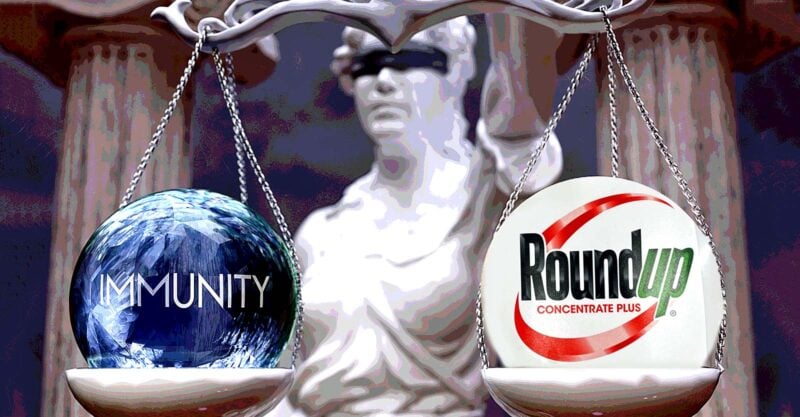
In the aftermath of the decision, enraged environmental activists, health-conscious mothers, wellness influencers and all those devastated by what appeared to be the pièce de résistance in the corporate capture of America took to social media. These posts claimed that the Supreme Court had granted Monsanto blanket legal immunity.
If true, this would not only represent a blow to the American people who entrust the government to protect them against known harms, but it would suggest that corporate interests have somehow managed to infiltrate the highest court — with it, vanquishing any last vestige of hope for the future health of our country.
Of course, I am deeply troubled by the stranglehold that corporations have on politicians, the media, medicine and all of the very institutions that stand in the position to keep corporate interests in check.
The insidious corporate enmeshment has effectively given this Leviathan carte blanche to harm Americans for profit, often with impunity.
However, as an attorney who studied constitutional law, I find myself compelled to dig beyond the sensationalistic social media posts and read the court’s decision.
The success of an appeal often hinges on the way the legal questions are framed. In the case of Monsanto Co. v. Durnell, the question was not whether Monsanto should be shielded from liability for manufacturing a product that has been linked to cancer.
Rather, the issue was, by and large, whether federal law blocks individuals from filing state-level lawsuits against pesticide manufacturers for failing to warn consumers about health risks when a federal agency, in this case, the EPA, previously approved the product’s label without those warnings.
To understand the court’s analysis, we need to understand the Supremacy Clause.
Under the U.S. Constitution, federal laws are considered the “supreme Law of the Land,” taking precedence over conflicting state or local laws. The Supreme Court’s role is to interpret the Constitution and federal law. This distinction matters. We should fear a world in which our Supreme Court Justices engage in judicial activism.
In Monsanto Co. v. Durnell, the plaintiff contended that, under state laws, companies have a duty to warn consumers if their product is dangerous. The plaintiff additionally argued that Monsanto failed to meet this duty because Roundup did not feature a cancer warning.
Monsanto, on the other hand, asserted that the EPA evaluates pesticide safety at the federal level.
Monsanto argued that the agency repeatedly concluded that glyphosate does not cause cancer and, therefore, Roundup did not necessitate a cancer warning on the bottle. Accordingly, a state lawsuit forcing Monsanto to add a warning would violate federal law.
The question before the Supreme Court was not whether Roundup causes cancer, nor was it whether Monsanto should have a duty to warn consumers of the potential health risks associated with using Roundup.


Instead, the justices were asked to consider three key questions:
- First, the court was tasked with interpreting the precise scope of the Uniformity Clause of the Federal Insecticide, Fungicide, and Rodenticide Act (FIFRA). While allowing states to entirely ban the use of a pesticide, the Uniformity Clause forbids states from altering or adding to the product’s safety label.
- Next, the court needed to determine whether the EPA’s formal determination that glyphosate does not require a cancer warning counts as a “federal labeling requirement” that triggers the Supremacy Clause and overrides state-level lawsuits.
- Finally, the court had to decide whether a state court jury verdict awarding damages to an injured plaintiff legally functions as an impermissible state requirement for a different label.
The Supreme Court ultimately held that FIFRA’s Uniformity Clause preempts state-law failure-to-warn claims if the lawsuit would force a manufacturer to add a warning that the EPA did not require.
No matter how dismayed I am by it, the court’s holding is ostensibly correct, in light of the issues presented.
Furthermore, the court’s decision does not appear to confer blanket immunity to Monsanto.
Rather, the Supreme Court’s decision in Monsanto Co. v. Durnell precludes state-law failure-to-warn claims based on the absence of an EPA-approved cancer warning. While, in many ways, this decision effectively acts as a liability shield, it is not tantamount to legislation barring injured plaintiffs from suing any pesticide companies.
The Supreme Court’s holding is, thus, distinguishable from the National Childhood Vaccine Injury Act of 1986, which conferred virtual legal immunity to vaccine manufacturers from civil lawsuits for injuries or deaths caused by routine childhood vaccines.
So, is it possible that powerful corporate interests finally captured the judicial branch of our government? Sure. Frankly, it wouldn’t surprise me. My distrust of this nefarious supervillain notwithstanding, I don’t believe that the Monsanto Co. v. Durnell decision is the result of corporate capture — at least not insofar as the Supreme Court is concerned.
The EPA, however, is a different story.
At the risk of venturing too far down the conspiracy theory rabbit hole, the following bears noting:
- Linda Fisher served as an assistant EPA administrator before becoming Monsanto’s Vice President of Government Affairs. She subsequently returned to the EPA as deputy administrator.
- Between 1970 and 1973, and again from 1983 to 1985, William D. Ruckelshaus served as the very first EPA administrator. Following his high-profile public career, he was hired to serve on Monsanto’s board of directors.
- Steven Jellinek served as the EPA’s first assistant administrator for Toxic Substances. After leaving public service, he founded a regulatory consulting firm that represented Monsanto, helping the company navigate the exact chemical laws he previously enforced.
- Stephen Johnson served as EPA administrator from 2005 to 2009. Following his time at the agency, he joined the board of Scotts Miracle-Gro, the exclusive consumer market distributor for Monsanto’s premier herbicide.
- Jess Rowland served as the deputy director of the EPA’s Pesticide Division. Internal Monsanto emails unsealed during litigation revealed Rowland allegedly promised a Monsanto executive he would attempt to “kill” a separate federal investigation into glyphosate (Roundup) by the U.S. Department of Health and Human Services. Court records further showed Rowland tipped off the company by leaking an internal EPA report before its official release. After retiring from the EPA, Rowland went on to consult for chemical industry firms closely linked to Monsanto.
You get the picture …
As a mother and as an American, I understand the instinct to hold the Supreme Court accountable.
But as an attorney, I find the expectation that the Justices should engage in judicial activism whenever it appears morally justified to be a dangerous one. It would establish a precedent that would disturb the system of checks and balances upon which our entire government is predicated.
The court’s decision in Monsanto Co. v. Durnell fundamentally rattled us because it served as an unsettling reminder that the agencies we entrust with our health and safety remain inextricably captured by corporations completely indifferent to the public’s well-being.
Still, we cannot allow these devastating blows to derail us. We must remain loud and continue fighting as though our lives depend on it — because when it comes to the chemical and pharmaceutical industries, they do.
Originally published on Sarah Intelligator, Esq Substack page.
Sarah Intelligator, Esq is a family law attorney and the author of “Live, Laugh, Find True Love: A Step-By-Step Guide to Dating and Finding a Meaningful Relationship.”