Login
Login


By Emily Kopp
Scientists at the center of the “lab leak” controversy visited Dr. Anthony Fauci’s institute at the National Institutes of Health (NIH) in 2017 to discuss their research — just months before NIH lifted a pause on high-risk virology, and two years before a novel coronavirus emerged near their lab in Wuhan.
Wuhan Institute of Virology (WIV) Senior Scientist Shi Zhengli passed a security screening to visit National Institute of Allergy and Infectious Diseases (NIAID) staffers in June 2017, where she gave a presentation about novel coronaviruses, emails obtained by U.S. Right to Know show.
Shi is known internationally as the “Bat Lady” for her work with bats and their coronaviruses. Though ostensibly a civilian lab, the WIV has conducted research projects “for defensive and biosecurity needs of the military” since at least 2017, according to U.S. intelligence.
EcoHealth Alliance, a U.S. research organization, partnered closely with the WIV, subcontracting NIAID funding to Shi’s lab, and arranged the meeting.
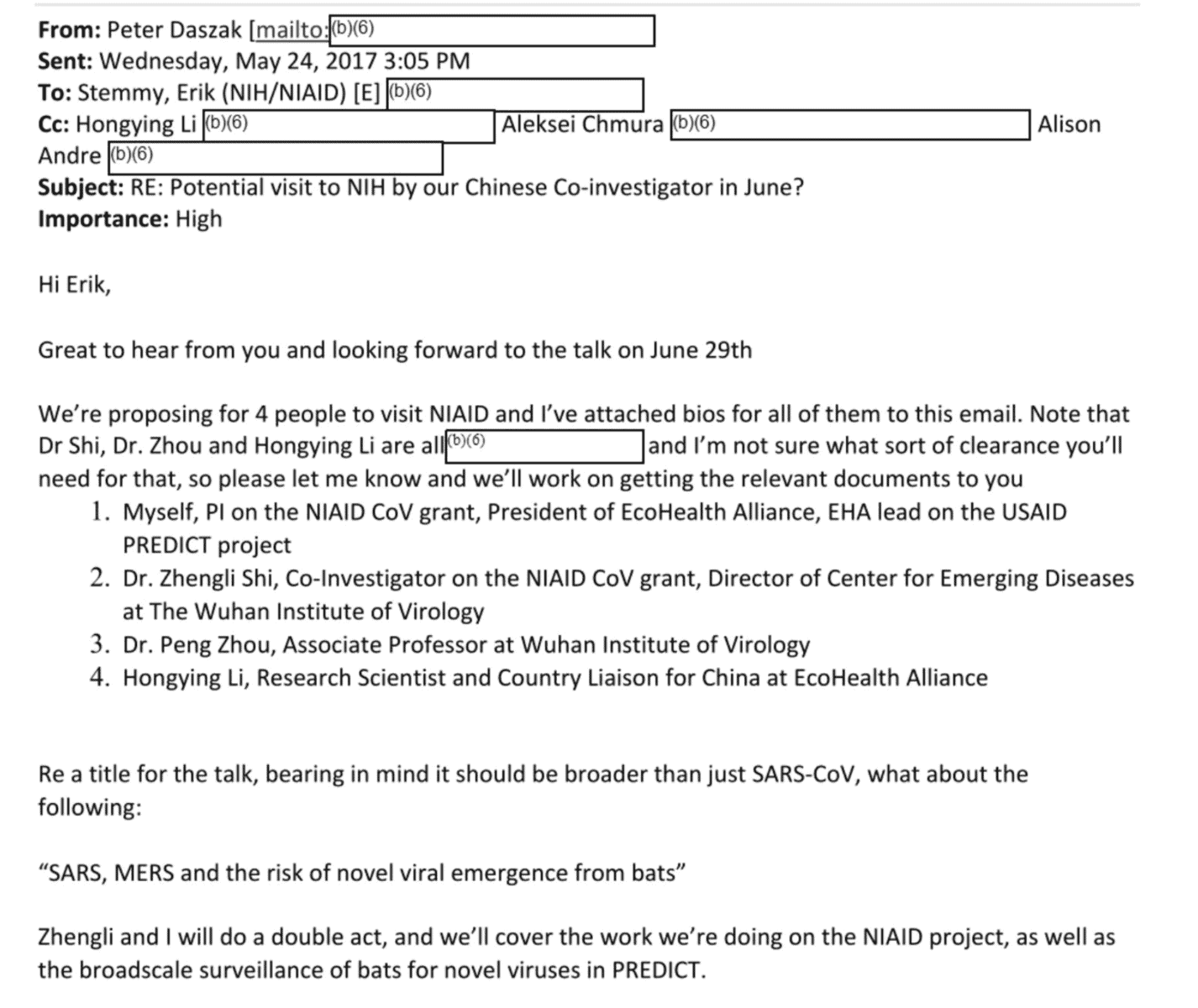
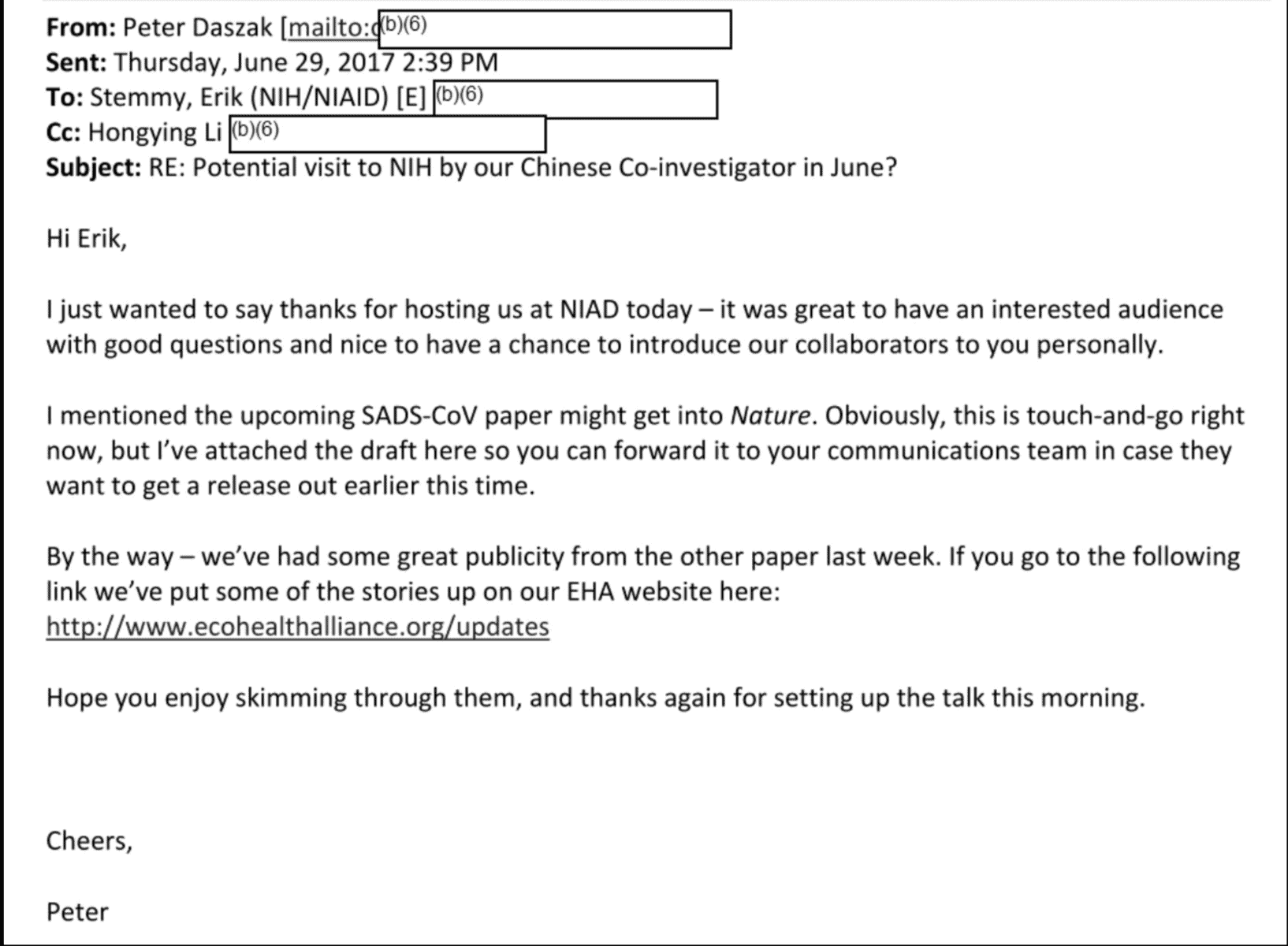
“Zhengli and I will do a double act,” EcoHealth Alliance President Peter Daszak, Ph.D. said of their June 2017 meeting with NIAID’s Division of Microbiology and Infectious Diseases Respiratory Diseases.


Fauci himself met with Daszak four months later, in October 2017. The subject of the meeting may have been an outbreak of an animal coronavirus called Swine Acute Diarrheal Syndrome.
By December 2017, NIH had resumed funding for gain-of-function research that generates new viruses in the lab following a three-year pause and debate about the possibility that such research could cause a pandemic.
Daszak arranged the meetings at NIH with the program officer overseeing his research there, Erik Stemmy, who managed coronavirus research at NIAID’s Division of Microbiology and Infectious Diseases.
U.S. Right to Know obtained the emails in a Freedom of Information Act (FOIA) lawsuit against the NIH.
Together with other emails obtained through FOIA, the email demonstrates the awareness of Fauci and his top aides of the novel coronavirus research underway at the pandemic’s epicenter.
Fauci did not mention this 2017 meeting with Daszak in a 2022 sworn deposition with the attorneys general of Missouri and Louisiana.
“I don’t even remember meeting him, but I do know that someone showed me a picture at a meeting where somebody said, here, take a picture with him,” Fauci said of Daszak.
“But that is not unusual, when you go to a scientific meeting, you run into hundreds of people. And I believe that this Dr. Daszak is one of the people that I almost — well, I did run into him because I believe I’ve seen a photograph of he and I together at a meeting.”
NIAID did not respond to questions.
The revelation comes just days before Fauci will give sworn testimony to congressional investigators. Fauci is slated to testify in a closed-door transcribed interview on Jan. 8 and 9.
Shi’s visit
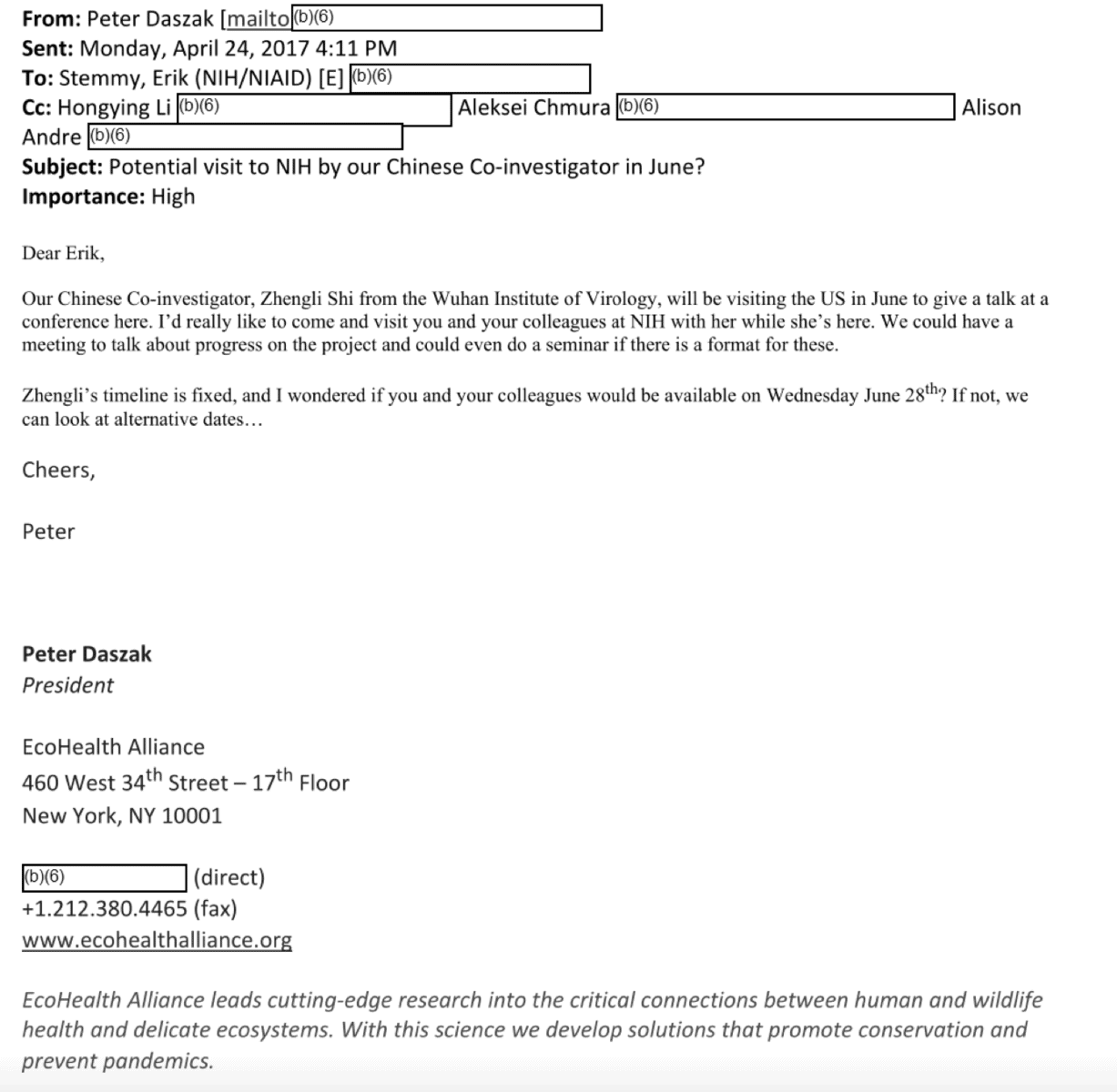
“Our Chinese Co-investigator, Zhengli Shi from the Wuhan Institute of Virology, will be visiting the US in June to give a talk at a conference here. I’d really like to come and visit you and your colleagues at NIH with her while she’s here,” Daszak wrote on April 24, 2017.
Shi’s security screening to visit the NIAID was not included in the documents provided to U.S. Right to Know, and it’s not clear what it entailed.
A May 24, 2017, email shows Daszak seeking a security clearance for Shi as well as Peng Zhou, an associate professor at the Wuhan Institute of Virology, ahead of a June visit to the U.S.
The title of a joint talk by Daszak and Shi was billed as “SARS [severe acute respiratory syndrome], MERS [Middle East respiratory syndrome] and the risk of novel viral emergence from bats,” the email shows.
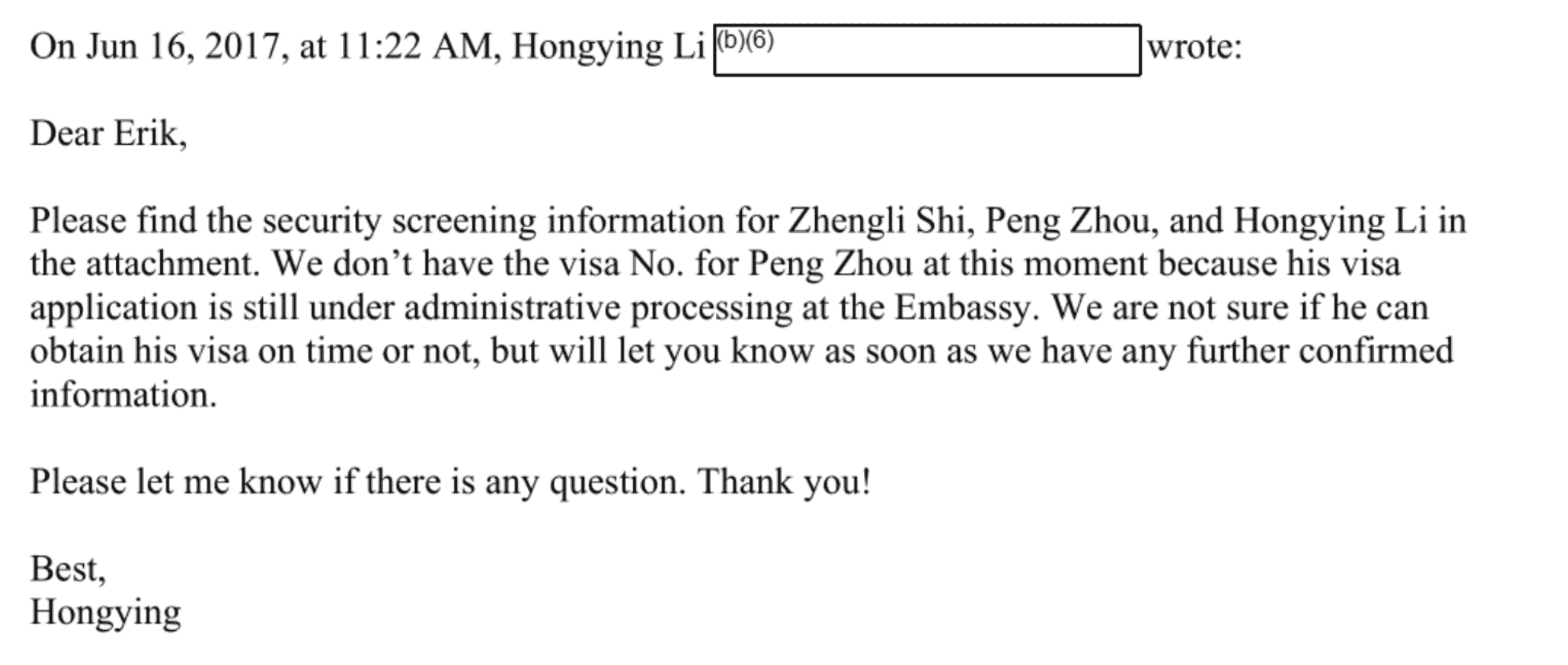
A June 16, 2017, email shows an EcoHealth Alliance staffer sharing security screening information with Stemmy.
A June 29, 2017, email from Daszak suggests that Chinese collaborators on the project were present at the NIAID.
“Thanks for hosting us as NIAD [sic] today … nice to have a chance to introduce our collaborators to you personally,” Daszak said.
It’s unclear whether ties between the Wuhan Institute of Virology and the Chinese military factored into Shi’s security screening.
Highly redacted U.S. Department of State cables obtained by U.S. Right to Know last year show that the U.S. possesses “cyber evidence” of military “shadow labs” at the Wuhan Institute of Virology.
A 2021 State Department fact sheet stated that “despite the WIV presenting itself as a civilian institution,” it has conducted classified research on behalf of the Chinese military “since at least 2017.”
The People’s Liberation Army (PLA) researchers conducted virological research at the Wuhan lab, and the lab’s civilian scientists have worked alongside scientists associated with the PLA, according to a declassified assessment released by the Office of the Director of National Intelligence last year.


Biosecurity concerns
The emails raise yet more questions about the rigor of U.S. regulations on virology experiments that may generate new pandemic viruses, including how and why high-risk research was outsourced to a rival nation.
The year before, in 2016, Stemmy and Daszak carved out an exemption to a pause on gain-of-function research, allowing EcoHealth Alliance and the Wuhan Institute of Virology to move forward with research that generated new SARS-related coronaviruses with enhanced transmissibility and virulence, according to reporting by The Intercept.
EcoHeath would run afoul of even these ad hoc rules with gain-of-function experiments that enhanced the transmissibility and virulence of SARS-related coronaviruses, including a tweak that increased the viral load of a virus by up to 10,000 times, NIH acknowledged in 2021.
Last month, U.S. Right to Know revealed that Daszak misled the Pentagon about planned research to generate new coronaviruses with furin cleavage sites, a genetic motif shown to make viruses more transmissible. SARS-CoV-2, the virus that causes COVID-19, is the only sarbecovirus with a furin cleavage site.
A formal research proposal submitted by Daszak and Shi in 2018 stated that this research would occur in the U.S. in a biosafety level three lab, a relatively rigorous level.
But private drafts indicated this language was designed to placate grantmakers at the Defense Advanced Research Projects Agency, and that key tests would in fact occur in Wuhan at a biosafety level two lab, an inadequate biosafety level, apparently to save on costs.
What Fauci knew
Fauci has dismissed the relevance of this research to the worst pandemic in a century. He falsely claimed in Senate testimony in 2021 that NIAID did not fund gain-of-function research in Wuhan.
In an interview last year with Australian media, Fauci downplayed the significance of NIAID’s funding to EcoHealth and its collaborators in Wuhan.
But emails obtained through FOIA show that Fauci was alerted by Jan. 27, 2020, that his institute had funded “among the biggest players in coronavirus work,” namely EcoHealth Alliance and its collaboration with the Wuhan Institute of Virology.
Fauci had been alerted by Feb. 1, 2020, that this research included gain-of-function experiments.
In the very early hours of Feb. 1, 2020, Fauci dispatched his aide Hugh Auchincloss to investigate whether his institute had funded the gain-of-function collaboration. It had.
Originally published by U.S. Right to Know.
Emily Kopp is an investigative reporter with U.S. Right to Know.