Login
Login


By Edward Carver
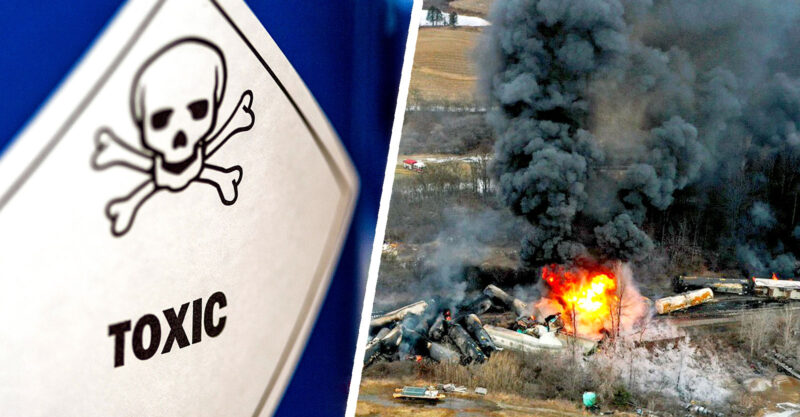
Toxic chemicals released during fires following the Norfolk Southern train derailment in Ohio last year spread to 16 states and likely Canada, according to a study released on June 19.
The pollution, some of which came from the burning of vinyl chloride, a carcinogen, spread over 540,000 square miles, showing clearly that “the impacts of the fire were larger in scale and scope than the initial predictions,” the authors of the study, published in Environmental Research Letters, found.
Lead author David Gay, coordinator of the National Atmospheric Deposition Program, said that he was very surprised by the way the chemicals had spread.
“I didn’t expect to see an impact this far out,” he told The Washington Post.
Gay said the results did not mean “death and destruction,” as concentrations were low on an absolute scale — “not melting steel or eating paint off buildings” — but that they were still “very extreme” compared to normal, with measurements higher than recorded in the previous ten years.
“I think we should be concerned,” Juliane Beier, an expert on vinyl chloride effects who didn’t take part in the study, told the Post, citing the possibility of long-term environmental impacts on communities.
A Norfolk Southern train crashed in East Palestine, Ohio, a village near the Pennsylvania border and the Appalachian foothills, on Feb. 3, 2023.
Dozens of train cars derailed, at least 11 of which were carrying hazardous materials, some of which caught fire after the accident and burned for days. Fearing a large-scale explosion, authorities drained the vinyl chloride from five cars into a trench and set it alight in a controlled burn.
A former U.S. Environmental Protection Agency (EPA) official later said that the controlled burn went against EPA rules; the head of the National Transportation Safety Board said the deliberate burning was unnecessary.
The local impact of the fires was felt acutely in the month after the accident — a “potent chemical odor hung in the air for weeks,” according to The Guardian, and people reported nausea, rashes and headaches.


The new study helps explain the wider environmental impact. The researchers looked at inorganic compound samples in rain and snow at 260 sites. The highest levels of chloride were found in northern Pennsylvania and near the Canada-New York border, which was downwind from the accident.
The authors also found “exceptionally high” pH levels in rain as far away as northern Maine. They did not look at organic compounds such as dioxin or PFAS, which likely also spread following the accident, The Guardian reported. The elevated inorganic chemical levels dropped two to three weeks after the accident.
Norfolk Southern has agreed to pay nearly $1 billion in damages following two settlements reached in recent months.
In April, the company reached a $600 million deal with class action plaintiffs living within 20 miles of the derailment site. That deal won’t be finalized until the residents officially agree.
In May, the company reached a separate $310 million settlement with the federal government. The company has said that it has already spent $107 million on community support and removed the impacted soil.
Norfolk Southern makes billions in profits every year, and the company gave its CEO a 37% pay hike last year, drawing widespread criticism. The company also spent $2.3 million on federal lobbying last year, according to OpenSecrets data reported by Roll Call.
Originally published by Common Dreams.
Edward Carver is a staff writer for Common Dreams.