Login
Login
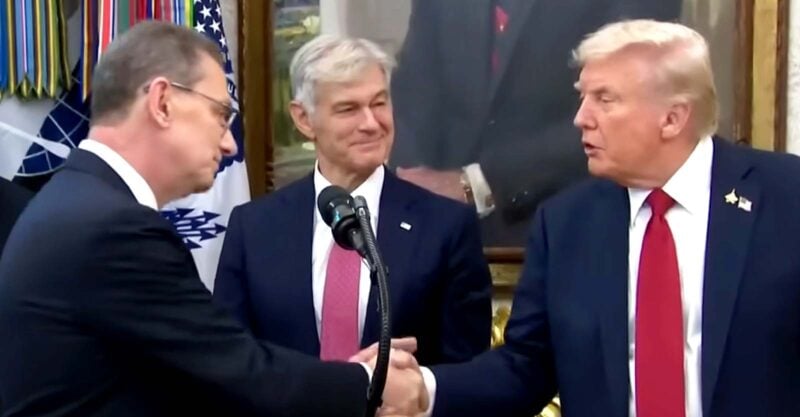


Pfizer’s stock “surged” late Tuesday after CEO Albert Bourla announced an agreement with President Donald Trump to lower its U.S. drug prices and invest $70 billion in U.S. manufacturing.
Critics of the deal say the public deserves to know exactly how the company and the government are collaborating.
Trump held a press conference with Bourla on Tuesday, but the president released few details. Under the deal, Trump will refrain from imposing tariffs on Pfizer for three years. Pfizer will boost its domestic manufacturing, make its drugs available to Medicaid at a discounted rate, and sell its products directly to U.S. patients at a discounted rate via the yet-to-be-launched government website, TrumpRX.
The agreement gives Pfizer “certainty and stability” on tariffs and pricing, Bourla said in a press release.
As of press time, neither the White House nor Pfizer provided any further details about the deal. “Specific terms of the agreement remain confidential,” Pfizer’s press release stated.
According to Pfizer, the deal paves the way for the drugmaker to develop new products related to “cancer, obesity, vaccines, and inflammation and immunology.”
Children’s Health Defense (CHD) CEO Mary Holland said it was “troubling” for the Trump administration to keep the details of its agreement with Pfizer confidential. Though arguably legal, the move “completely undermines” the administration’s commitment to transparency, she said, adding:
“The failure to provide any details of the U.S.-Pfizer pricing and tariff exemption deal is even more egregious in light of Pfizer’s long record of past criminal conduct and its knowing role in producing mRNA gene therapies, marketed as vaccines, that caused thousands of deaths and injuries.
“Pfizer knew that its mRNA shots neither stopped infection nor transmission.
“CHD stands firmly for a recall of the mRNA products currently on the market. The Vaccine Adverse Event Reporting System makes perfectly clear that these products are unsafe.”
CHD Chief Scientific Officer Brian Hooker agreed. “There really needs to be a ‘full stop’ with Pfizer, period, given the drugmaker’s duplicitous behavior around the COVID-19 jab.”
The federal government should be investigating Pfizer, not collaborating with it, Hooker said. “No transparency, no deal.”
Groups submit FOIA requests to see government’s deal with Pfizer
Today, the watchdog group Public Citizen sent a Freedom of Information Act (FOIA) request to federal agencies to obtain a copy of Trump’s deal with Pfizer. Peter Maybarduk, Public Citizen’s Access to Medicines director, said in a statement that Trump’s deal raises more questions than it answers.
“The White House must publish the text of the Pfizer deal, so Americans know what they are getting,” Maybarduk said.
The Informed Consent Action Network also submitted a FOIA request today to obtain a copy of the agreement, attorney Aaron Siri told The Defender.
Attorney Ray Flores said it was disappointing that groups have to FOIA for the information, given the administration’s stated commitment to “radical transparency.”
“It appears that FOIA will be the only avenue to get a heavily redacted copy of the agreement,” Flores said. “If we are fortunate, after waiting a few years, we might be able to piece together the details.”
CHD General Counsel Kim Mack Rosenberg said Pfizer has a history of not disclosing information shared with the government that people have a right to see. “When that information comes to light, it almost invariably does not reflect well on Pfizer,” she said.
Pfizer’s concessions protect bottom line, ensure speedier drug approvals
Cantor Fitzgerald analyst Carter Gould told The Wall Street Journal that Pfizer didn’t adjust any of the company’s financial guidelines due to the deal, suggesting that the deal wouldn’t negatively affect its financial performance.
Gould wrote in a research note that the deal appeared “largely benign.”
For instance, Pfizer already discounted its drugs for Medicaid patients, so the low prices stipulated in the deal may not be that much of a pricing difference, the WSJ said.
Most people have health insurance plans that come with lower out-of-pocket costs, so the number of people who buy Pfizer’s drugs directly at discounted rates on the TrumpRX website may also be negligible, according to the WSJ.
Also, Pfizer may already have been planning to spend the $70 billion that it committed to allocate to U.S. manufacturing, BMO Capital Markets analyst Evan David Seigerman told the WSJ.
According to Seigerman, the deal ingratiated Pfizer with Trump, who has threatened to tariff pharmaceutical companies that refuse to sell their products to U.S. patients at prices comparable to what patients in other wealthy nations pay.
“If we don’t make a deal, then we’re going to tariff them an extra 5, 6, 7, 8 percent,” Trump said Tuesday in the press conference with Bourla at the White House.
The deal also means that Pfizer will receive special status when its new drug approval applications are reviewed.
The Defender is 100% reader-supported. No corporate sponsors. No paywalls. Our writers and editors rely on you to fund stories like this that mainstream media won’t write. 

This article was funded by critical thinkers like you.
U.S. Food and Drug Administration Commissioner Marty Makary, who also spoke at Tuesday’s press conference, said drugmakers who make their U.S. drug prices equivalent to the prices paid in other developed nations would be eligible for his agency’s new voucher program that speeds drug approvals.
“A voucher to get a review in weeks has a market street value of about $500 million, because every day is money,” Makary said.
Pfizer and the White House did not immediately respond to a request for comment.
Related articles in The Defender
- Trump Strikes Drug Price Deal With Pfizer, Announces ‘Trump RX’ Website for Consumers
- Will Pfizer Be Held Accountable? Federal Judge Sends Kansas Lawsuit Against COVID Vaccine Maker Back to State Court
- Pfizer Vaccine Linked to Higher All-Cause Mortality Rate Than Moderna Shot
- FDA Asks Court to Shut Down Lawsuit Over Pfizer COVID Vaccine Documents