Login
Login


By Julia Conley
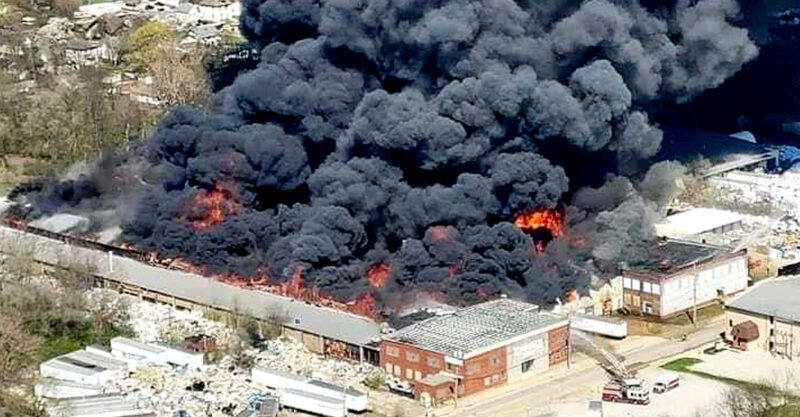
Officials in the city of Richmond, Indiana, said Wednesday that a fire that broke out at a plastics facility on Tuesday is expected to continue burning for several days, sending huge plumes of black smoke — that doubtlessly contain toxins — into the environment there.
Authorities have not released the name of the business owner or company, but The New York Times reported that the complex was formerly owned by Hoffco/Comet Industries, which produced garden and lawn motors before closing in 2009. The facility is now used to store large amounts of plastic for resale and recycling.
“The smoke is definitely toxic,” said Indiana State Fire Marshal Steve Jones in a news briefing on Tuesday. “There is a host of different chemicals that plastics give off when they’re on fire, and it’s concerning.”
WATCH 🚨 This footage show large and intense fire in the recycling processing facility in Richmond, Indiana. Winds reportedly began carrying the smoke into Ohio, according to FOX19
— Insider Paper (@TheInsiderPaper) April 11, 2023
About 2,000 people in a half-mile radius of the blaze were ordered to evacuate the area Tuesday, and officials don’t know when the order will be lifted. The Richmond Community School District canceled classes for the entire town on Wednesday.
The smoke was drifting toward the east and northeast on Tuesday, and Richmond residents whose homes are in the path of the smoke were advised to “shelter in place, turn off HVAC units, keep windows and doors closed, and bring pets inside.”
The U.S. Environmental Protection Agency and Indiana Department of Environmental Management began taking air samples in the area on Tuesday to help determine what toxins have been released from the fire.
Chemicals that can be released from plastic when it burns include dioxins, furans, mercury and polychlorinated biphenyls (PCBs).
Dioxins, furans and PCBs have similar toxicity levels, according to the Centers for Disease Control and Prevention (CDC), which says that “people who have been unintentionally exposed to large amounts of these chemicals have developed a skin condition called chloracne, liver problems, and elevated blood lipids.”
Animals exposed to the chemicals in lab studies have developed cancers and reproductive problems.
Exposure to high amounts of mercury can rapidly cause serious lung damage, and low concentrations can cause “neurological disturbances, memory problems, skin rash, and kidney abnormalities,” according to the CDC.
Richmond Fire Chief Tim Brown told CNN that firefighters who arrived at the scene Tuesday afternoon found a semitrailer behind the facility engulfed in flames that spread to piles of plastic on the property and to several buildings in the 14-acre complex.
“There’s plastics inside buildings, there’s plastics outside buildings, there’s plastics in semitrailers that are throughout the grounds here at the complex, so we’re dealing with many types of plastics,” Brown told reporters. “It’s very much a mess.”
The fire chief added that the facility had been a known fire hazard and that the owner had been warned of the danger posed by their storage methods.
“We knew it wasn’t a matter of if, it was a matter of when this was going to happen,” he said at the press briefing.
“The battalion chief was very frustrated when he pulled up because we knew it wasn’t a matter of if, it was a matter of when this was going to happen.”
This is true of so many factories that produce hazardous materials, and it has GOT to change. https://t.co/QZEUZ5yL91
— Food & Water Watch (@foodandwater) April 12, 2023
Richmond Mayor Dave Snow told The Associated Press that the owner had been “under a city order to clean up and remediate that site,” but had not obeyed the order.
Philadelphia Inquirer Columnist Will Bunch argued that the disaster would not have happened without the fossil fuel industry “foisting plastics on the world as its ‘Plan B’ to sustain its profitability.”
A massive toxic fire is raging at a plastics plant in Indiana. It doesn’t have to be this way — Big Oil and Gas is foisting plastics on the world as its “Plan B” to sustain its profitability. Here’s my recent column about that https://t.co/6BAkmM9byv
— Will Bunch (@Will_Bunch) April 12, 2023
“Worldwide production of plastic has nearly doubled since the start of the 21st century, as oil and gas giants look for profitable uses of their fossil fuels while a climate-change-weary world looks increasingly to transition toward wind or solar power or electric cars,” Bunch wrote in March after several environmental disasters threatened the drinking water and the environment in communities across Pennsylvania.
Originally published by Common Dreams.
Julia Conley is a staff writer for Common Dreams.