Login
Login
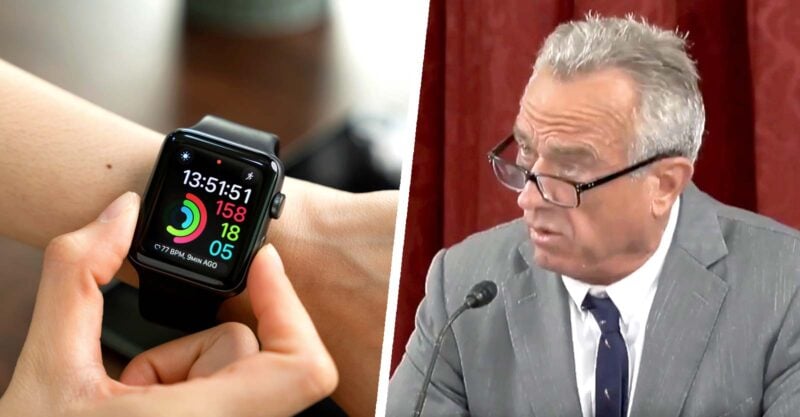


Charles Eisenstein, Robert F. Kennedy Jr.’s former chief speechwriter, published a defense of Kennedy’s statement that “every American should be wearing a wearable within four years,” arguing that critics engaged in “hysterical reactions” and “cancel culture” toward Kennedy’s verbal misstep.
While I agree that immediately “throwing Bobby under the bus” is counterproductive, Eisenstein’s dismissal of substantive infrastructure concerns misses the deeper issues at stake and reveals a dangerous dynamic in the Make America Healthy Again (MAHA) movement.
This isn’t about Kennedy’s character or political purity. I’ve been a great supporter of his work for many years — his impact on my own awakening and the world has been significant and enormously positive.
But the fear of creating a counterpoint to RFK Jr.’s critics has given rise to hero worship — just as dangerous as the cancel culture Eisenstein warns about. Hero worship is antithetical to the very sovereignty MAHA claims to represent.
We must recognize our own role in the system and acknowledge that if the system is as corrupt as we say it is, waiting for one man to fix it is magical thinking. We need to engage critically, not passively.
If the MAHA movement is real, it has to be from the ground up — everyone needs to take control of their own actions and their own discernment. Of course, it’s great to have people on the inside, but waiting for the cavalry to come will be our doom.
While Kennedy has obviously been a sparkplug and has done extraordinary advocacy and legal work over many years, MAHA isn’t RFK Jr. or his appointees — it’s millions of people reclaiming their biological sovereignty.
The movement’s power comes from individual awakening and local action, not from political personalities.
It’s preposterous to think anyone is above criticism, whether their intentions are sinister or just misguided. True cognitive sovereignty means understanding our own minds rather than defaulting to personality-based thinking — whether that’s parroting The New York Times attacks on Kennedy or worshiping at the altar of Bobby (even those of us who believe him to be a good man) and “trusting the plan.”
Kennedy is one person inside a vast system, and I understand that creates constraints and pitfalls. When he clearly knows mRNA shots are dangerous, yet they remain on the market despite the U.S. Department of Health and Human Services having the authority to remove them, it certainly makes one wonder about who’s really making decisions — the invisible hand at play.
We need to focus less on individual players and more on the entire system steering in a particular direction, an apparatus so complex that not everyone can possibly keep track of all its moving parts.
This systemic approach is what drove my recent analysis of the wearables infrastructure, documenting concerns that Eisenstein’s piece doesn’t address, instead focusing on dismissing critics as engaging in “hysteria.”
I was compelled to write this response because, even though Charles may not know of me or my writing, I took strong exception to his argument.
This isn’t about personality politics or ideological purity. It’s about recognizing that we’re being systematically transformed into commoditized data streams, potentially hooked up to what can only be described as the Borg — I know that sounds like a sci-fi movie, but alas, here we are. Imagine telling someone about the “Internet of Bodies” 25 years ago.
The wearables infrastructure isn’t just about health optimization — it’s about biometric colonization, which I’ve explored in depth in “Node Without Consent” and “The Invisible Leash,” and the financial control mechanisms that I’ve been documenting for the last few years.
The evidence for this biometric colonization comes directly from the architects themselves.
The real infrastructure: The World Economic Forum’s own materials show wearables as components in comprehensive digital identity systems connecting health data to financial services, government access, and social platforms. This isn’t conspiracy theory — it’s their documented strategy.
Economic coercion: When insurance rates, employment opportunities, and basic services become tied to wearable compliance, “choice” becomes meaningless.
The progression is systematic: wearable detects irregularity → triggers automated medication reminders → insurance adjusts premiums → employers flag productivity concerns → economic survival becomes dependent on biometric compliance.

The “temporary aid” fallacy: Kennedy’s clarification that glucose monitors would serve as temporary aids to help people learn healthy habits ignores how these systems are already being integrated into permanent economic infrastructure. Once the surveillance apparatus is built, temporary becomes evergreen through economic necessity.
Moreover, promoting wearables before completing the electromagnetic fields (EMF) safety research Kennedy himself promised risks normalizing constant electromagnetic exposure that may undermine the biological harmony MAHA seeks to restore.
This argument also reveals a paternalistic assumption that Americans are too lazy to manage their own health without technological intervention — the exact mindset that enables surveillance infrastructure.
Privacy protection illusion: Eisenstein suggests data will be “subject to health privacy laws,” but this misses the integration point entirely. When wearables feed into digital identity systems connected to banking, employment, and social platforms, traditional health privacy frameworks become irrelevant.
The data isn’t just medical — it’s behavioral, emotional and predictive.
Evergreen surveillance: Your biometric data reveals patterns about behavior, reproductive cycles, and psychological states that you might not even know yourself. Platforms processing this data conceptualize it as “continuous emotional telemetry” designed to anticipate behavior — even protest — before action occurs.
The bigger picture: As Catherine Austin Fitts warns, wearables represent components of “the control grid” — systems integrating health surveillance with digital currencies. When combined with central bank digital currencies, this creates a digital gulag where biological compliance becomes the price of economic participation.
The political compromise trap: Eisenstein frames this as a necessary “political compromise,” but some infrastructure can’t be compromised on. Building surveillance systems hoping to control their use later is like constructing a prison and assuming you’ll never be the inmate.
The infrastructure itself becomes the weapon.
The most dangerous moment for any movement is when legitimate criticism gets reframed as disloyalty to a leader. This pattern of defending leaders over principles is exactly how other movements got co-opted.
Unity doesn’t mean acquiescence. We can support MAHA’s goals while questioning methods that undermine biological sovereignty. That’s not divisiveness — it’s staying true to virtue over tribe.
Eisenstein warns against “excommunicating anyone who makes an ill-considered remark,” comparing policy critics to cancel culture. But there’s a crucial distinction between personal attacks on Kennedy and systematic analysis of surveillance infrastructure.
Questioning a program isn’t canceling a person. In fact, thoughtful policy critique is exactly what healthy movements require to avoid the groupthink that destroys them.
Kennedy’s “clarification” that he wants wearables to be “universally available” doesn’t address the core issue: these systems transform humans from conscious biological entities into managed resources. Whether his choice of words was poor or not, we’re discussing the systematic replacement of embodied consciousness with algorithmic interpretation.
The stakes couldn’t be higher. We’re not just debating health policy — we’re deciding whether humans will maintain sovereignty over their own biology.
This requires recognizing that government works for us, not the other way around and that our consent must be informed, not manufactured through economic coercion.
True autonomy comes from understanding our own minds and bodies, not from devices that mediate our relationship with our own biology. The first act of resistance is remembering you don’t need a machine to tell you how you feel.
This isn’t hyperbole — it’s about preserving what makes us human.
Originally published on Joshua Stylman’s Substack page.