Login
Login


In a recent opinion piece, Dr. Paul Offit, the Merck-endowed Director of Vaccine Education at Children’s Hospital of Philadelphia (CHOP), continues in a conversation with Robert F. Kennedy Jr., discussing the safety and efficacy of vaccines.
While Offit is considered an authority in the field, it’s crucial to scrutinize the evidence and arguments he presents.
In this article, I provide a comprehensive, evidence-based rebuttal to Offit’s claims, focusing on the science, logic and reason that should underpin any discussion about vaccine safety.
Offit’s logical fallacies vs. Kennedy’s call for comprehensive research
Offit’s commentary, while persuasive to some, employs several logical fallacies that need to be addressed.
For instance, he often resorts to ad hominem attacks, dismissing those who question vaccine safety as “anti-vaccine,” rather than addressing the scientific concerns they raise. This tactic serves to undermine the credibility of his opponents without actually engaging with their arguments, a classic example of the ad hominem fallacy.

The need for more comprehensive research is not a fringe opinion but a scientific necessity.
A study published in the Journal of Toxicology and Environmental Health highlights the limitations of existing research on thimerosal, calling for more thorough studies to understand its pharmacokinetics and toxicology.
Another study in BMC Immunology emphasizes the need to study the interactions between risk factors for serious adverse events and vaccine doses, types, and co-administration — areas that have been insufficiently studied.
Offit also frequently cites “the consensus” as somehow being above scrutiny when vaccine safety is on center stage. Citing consensus among medical organizations does not provide definitive proof of universal or sufficient vaccine safety.
While consensus is important, it should not replace rigorous, unbiased scientific investigation. Science progresses by questioning established norms, and the field of vaccine safety should be no exception.
Furthermore, Offit employs a strawman argument, misrepresenting the positions of those who question vaccine safety to make them easier to refute. In this case, his strawman is created by labeling those who question vaccine safety as “anti-vaccine.”
This is a gross oversimplification of the nuanced concerns many people have — and ignoring them won’t make them go away.
There are many who fully support vaccination but are calling for more rigorous studies to ensure that vaccines are as safe as they can be, especially for vulnerable populations. Labeling them as “anti-vaccine” serves only to shut down meaningful dialogue.
Furthermore, Offit uses the slippery slope fallacy, suggesting that questioning the safety of vaccines could lead to widespread disease outbreaks. Concern over vaccine safety does not necessarily mean whole-scale abandonment of vaccination.
But Offit’s concern does not mean that somehow all vaccines are equally safe or effective for all individuals, nor does it mean that the public shouldn’t scrutinize new or existing vaccines for safety and efficacy. One cannot effectively replace rigorous data with fear.
While Offit is considered by many to be an authority in the field of vaccinology, his arguments often rely on logical fallacies rather than robust scientific evidence.
These tactics may serve to sway public opinion, but they do little to advance a nuanced, evidence-based discussion on vaccine safety.


Thimerosal and its understated risks
One of the most significant concerns regarding vaccine safety is the use of thimerosal, a mercury-containing compound included in multi-dose vials.
Offit asserts that thimerosal, a mercury-based preservative used in some vaccines, is safe and does not contribute to adverse health outcomes. However, this claim overlooks a body of evidence suggesting otherwise.
Vaccine-derived inorganic mercury accumulation in the brain
A major point of concern is the accumulation of inorganic mercury in the brain, as indicated by a study involving monkeys exposed to methyl and ethyl mercury.
While the clearance rate for inorganic mercury from methyl mercury could be estimated, the same could not be said for inorganic mercury derived from thimerosal, implying potential accumulation and long-term risks.
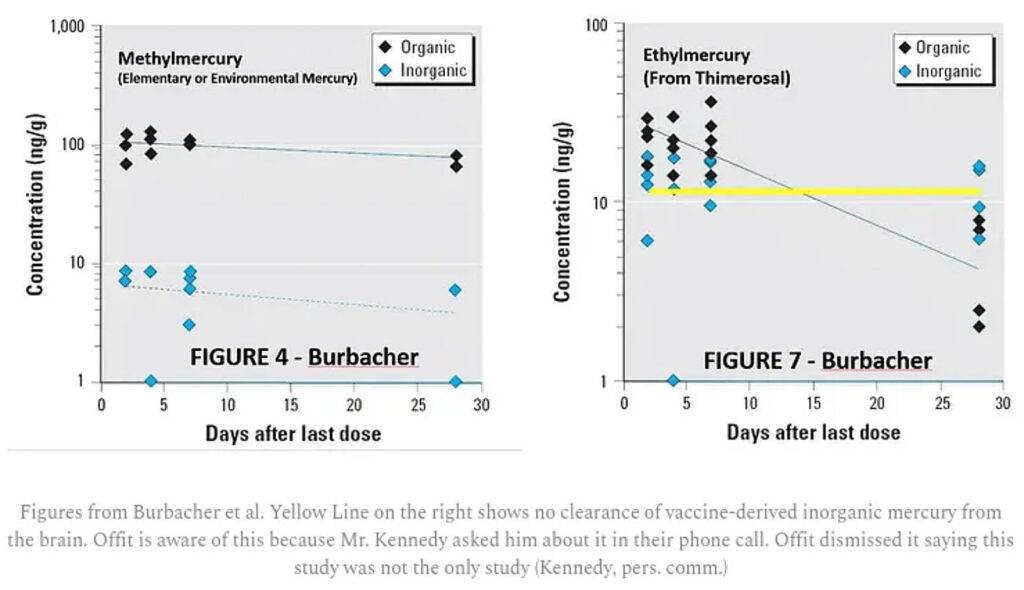
Contrary to Offit’s assertion that ethylmercury (the type of mercury in thimerosal) is less toxic and is eliminated from the body more quickly than methylmercury, the study shows that inorganic mercury levels in the brain remained flat over time for monkeys exposed to thimerosal.
This flat line suggests potential accumulation under repeated dosing, a finding that was not observed in monkeys exposed to methylmercury.
Thimerosal impairs immunity — The impact of thimerosal on our immune system
Recent research has shown that a substance called thimerosal, which is sometimes used in vaccines, can mess with an important part of our immune system.
This part is called ERAP1, and it’s like a helper that makes sure our immune system is working the way it should. When ERAP1 isn’t working well, our body’s defense system can get out of whack, making us more likely to get sick.
One study, published in a science journal called ACS Medicinal Chemistry Letters, found that thimerosal can actually stop ERAP1 from doing its job. This is a big deal because it could mean that our immune system won’t respond as well as it should when we’re exposed to germs.
Another study, this one in the journal BMC Immunology, also found that thimerosal can interfere with the same protein. This study reported that ERAP1 helps control inflammation in our bodies.
When ERAP1 isn’t working right, we can get more inflammation, which is a sign that our body is struggling to fight off something harmful. Inflammation is known to be involved in chronic illnesses such as autoimmunity, neurodegenerative diseases and cancer.
This means that we should be truly careful about putting substances like thimerosal into our bodies, especially when they can mess with something as important as our immune system.
Society should expect that someone like Offit, who is in charge of educating people about vaccines as a major, would not only know about these risks but he would also discuss them openly.
CDC studies fall far short
It’s also worth noting that the Centers for Disease Control and Prevention’s (CDC) list of studies claiming to exonerate thimerosal has been critically analyzed and found lacking in methodological rigor.
Many of these studies rely on highly adjusted models without proper model selection criteria, leading to unwarranted generalizations about vaccine safety.
Paul Offit’s conflicts of interest
When evaluating the credibility of any claim by persons involved in a scientific debate, it’s essential to consider potential conflicts of interest that could bias their opinions.
Offit, often cited as an authority on vaccine safety, has several financial ties that are worth noting for a balanced perspective.
Offit is the chief of the Division of Infectious Diseases and the director of the Vaccine Education Centre at CHOP. He also holds a consultant position with Merck, a major pharmaceutical company.
Notably, Merck funds his research chair at CHOP to the tune of $1.5 million. Offit has also received a $350,000 grant from Merck for the development of a rotavirus vaccine in the past.
In 1998, Offit was part of the CDC advisory board that approved the use of a rotavirus vaccine for the National Vaccine Program. At that time, he held a patent for a competing rotavirus vaccine produced by Merck, from which he stood to gain financially.
The first approved rotavirus vaccine was later found to be harmful and was withdrawn from the market, leading to a government investigation into the U.S. Food and Drug Administration’s and CDC’s policy decisions.
The investigation concluded that these agencies did not adequately enforce conflict of interest rules. Offit did not recuse himself from the discussion of RotaTeq with his peers before the final vote.
In 2006, when Merck’s rotavirus vaccine RotaTeq was approved, Offit received patent rights along with his co-inventors.
This entitled them to ongoing royalties, amounting to millions of dollars, from institutions to which they ceded their inventor rights. These financial gains raise questions about Offit’s impartiality in matters related to vaccine safety and efficacy.
This information was brought forward in Kennedy’s book, “Thimerosal: Let the Science Speak.” Showing how Offit misrepresents the facts to mislead, here’s the exact quote from that book:
“In a 2008 Newsweek article, Offit acknowledged receiving a portion of the $182 million CHOP earned by selling its interest in future royalties for the vaccine; an investigation by Age of Autism estimated the minimum amount received by Offit as $29 million.”
The book cites The Daily Beast as the source of that admission and points to an Age of Autism article by Dan Olmsted and Mark Blaxill for further information. But the ultimate source was the Newsweek article, which read:
“Offit isn’t apologizing. He acknowledges that he got a ‘small percentage’ of the $182 million Children’s Hospital of Philadelphia received when it sold its interest in future royalties for the vaccine RotaTeq. (He won’t give a precise amount, but says ‘It’s like winning the lottery.’)
“And he has served as both a paid and unpaid member of a scientific advisory board at Merck, which makes RotaTeq. Drug companies routinely hire experts as consultants, despite concerns by some that these relationships can undermine scientific credibility.”

Given these substantial financial ties to the pharmaceutical industry, it’s reasonable to question whether Offit’s advocacy for vaccines is influenced by factors other than unbiased scientific inquiry.
While financial incentives do not necessarily invalidate someone’s scientific contributions, they do provide context that should be considered when weighing the validity of their arguments.
While Offit is a prominent figure in the field of vaccinology, it’s important to note that he has had financial ties to vaccine manufacturers. Transparency and acknowledgment of such ties are crucial for an unbiased scientific discourse.
Conclusion
It is essential to approach the topic of vaccine safety with scientific rigor and impartiality. Logical fallacies and conflicts of interest have no place in this important discussion. We call for more rigorous, unbiased scientific investigation into the safety and efficacy of vaccines, particularly concerning the effects of thimerosal on ERAP1.
Also, there’s a history related to the likely accumulation of inorganic mercury from thimerosal in the brain: It’s the point that Kennedy raised with Offit during their conversation that Offit could not address. And it’s an important point that Offit failed to answer in his recent letter.
Originally published on James Lyons-Weiler’s The Kennedy Beacon Substack page.
James Lyons-Weiler, Ph.D., is the CEO and director of IPAK, The Institute for Pure and Applied Knowledge, and founder of IPAK-EDU.org, an online institution that has been helping the public empower themselves through knowledge since 2020. He publishes Popular Rationalism on Substack.
The Defender on occasion posts content related to Children’s Health Defense’s nonprofit mission that features Mr. Kennedy’s views on the issues CHD and The Defender regularly cover. In keeping with Federal Election Commission rules, this content does not represent an endorsement of Mr. Kennedy who is on leave from CHD and is running as an independent for president of the U.S.