

 Login
Login
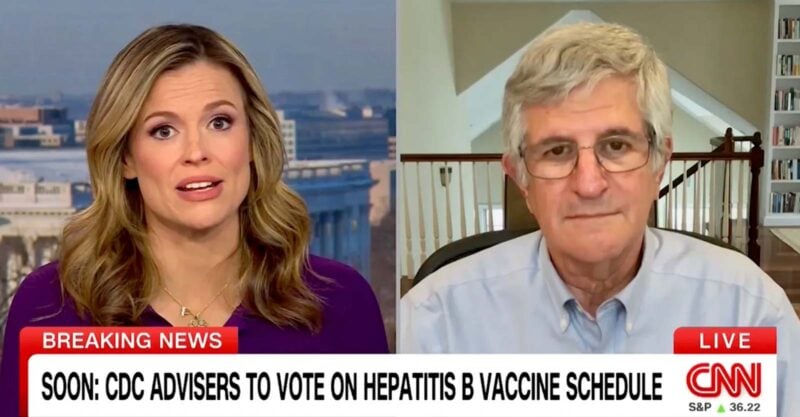


When Dr. Paul Offit appeared on CNN on Dec. 5 to discuss the Centers for Disease Control and Prevention’s (CDC) contentious hepatitis B meeting, he spoke with the certainty that has made him one of legacy media’s go-to commentators on vaccines.
Offit told viewers he had not been invited to speak at the Advisory Committee on Immunization Practices (ACIP) meeting that was unfolding in Atlanta that very day.
That claim was false.
CDC officials had contacted him repeatedly — via emails, phone calls and a speaker-request form — inviting him to present at the upcoming meeting.
Offit acknowledged receiving a request, but then told the audience he was not invited to attend.
From there, the misinformation only escalated.
He warned viewers that “millions” of Americans were silently carrying hepatitis B, claimed that “50% of people in this country” were chronically infected without knowing it and suggested newborns were at risk through everyday contact with nannies, daycare workers and family members.
None of those claims was true.
But the CNN host did not challenge him. No fact-checker intervened. And once again, a highly amplified “expert” delivered a series of false statements that left the public with a distorted picture of the facts.
Offit’s false account of the ACIP invitation
Offit began by correcting the anchor’s introduction. She noted that he had been invited to present at ACIP and had declined.
He promptly replied: “I actually wasn’t invited to present at today’s meeting. I was invited back in October to come speak about vaccines to this group.”
The host sought clarity: “So just to be clear, you were invited back in October to speak, and you declined that.”
Offit replied: “It was a vague recommendation to come speak to us … The way that it was framed today that I was asked to come speak today about this subject, that’s not true.”
But emails obtained exclusively by MD Reports tell a different story.
On Oct. 23, a CDC official emailed Offit with the subject line “Speaker Invitation – ACIP meeting.”
The message was explicit: “I am reaching out to invite you as a speaker to an upcoming ACIP meeting and would appreciate the opportunity to connect.”
When that email bounced, the CDC re-sent it to Offit’s University of Pennsylvania address — the one his own institution had confirmed as correct. A CDC staffer also phoned him and left a voicemail.
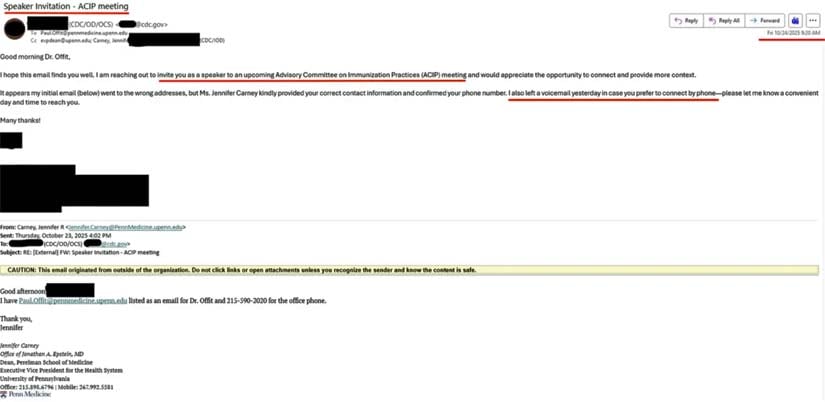
Offit did not respond.
The CDC then emailed him at the Children’s Hospital of Philadelphia address as well. And to eliminate any doubt, they also submitted a speaker-request form through the Children’s Hospital of Philadelphia booking portal. The system automatically confirmed receipt.
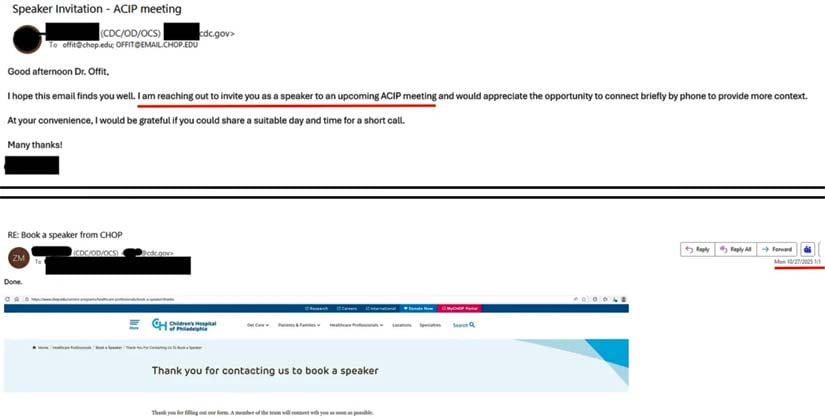
There is nothing “vague” about any of this.
Nor was there ambiguity about which meeting the CDC meant. Between October and December, ACIP had only one meeting scheduled — the same one CNN was covering live.
Offit, a former ACIP member, knows exactly how the committee operates. He knows how invitations are issued and what they refer to. Yet on television, he claimed the outreach was unrelated.
The internal documents contradict him. He was invited. He was contacted multiple times. He declined to engage — then told the public the invitation was “not true.”
Moments later, he described ACIP as a “clown show,” an “anti-vaccine advisory committee” that “puts children in harm’s way,” before launching into claims about hepatitis B that bore no resemblance to the evidence.
Offit uses modeling data to rewrite history
Offit told CNN that before universal infant vaccination, “30,000 children under the age of 10” contracted hepatitis B each year.
But no such epidemic ever occurred.
Childhood hepatitis B in the U.S. was consistently rare, largely confined to small immigrant communities from high-prevalence regions. In almost all instances, pediatric infection occurred through perinatal transmission.
Although Offit did not cite a source, his “30,000” figure appears to come from modeling work — specifically Armstrong (2001) — which did not actually count real cases.
Instead, the model tried to estimate infections by combining small serosurveys with assumptions about maternal infection, household transmission and demographics.
It extrapolated from only a handful of data points, and when those assumptions are corrected, the estimates become insignificant.
Put simply, these were speculative reconstructions, not surveillance data.
CDC data presented to ACIP last week make this clear.
The national surveillance system shows acute hepatitis B cases in children under 10 were extremely low — around 400 per year — before the universal birth dose was introduced.
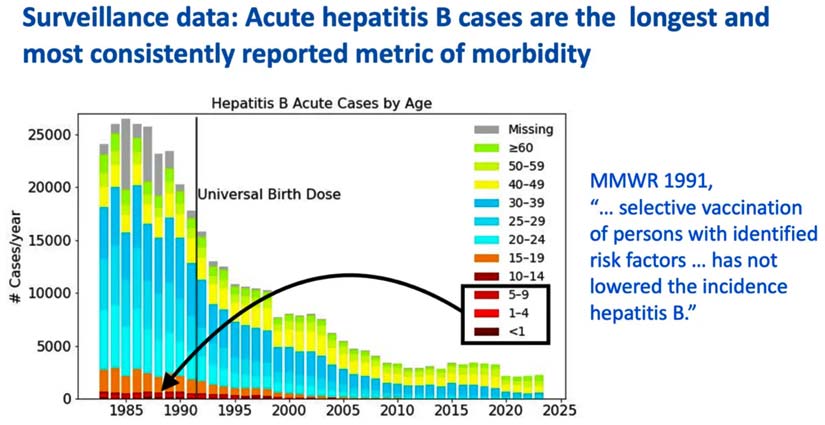
Offit’s claim of “30,000 children under 10” infected annually is not grounded in evidence. It is a significant overstatement based on flawed modeling, not surveillance data.
Offit claims “50% of Americans have chronic hep B.”
Offit first said that “50% of people with chronic hepatitis B don’t know they have it,” a statement fairly consistent with underdiagnosis among chronic carriers.
But minutes later, he escalated to this: “50% of people in this country have chronic hepatitis B and don’t know it.”
If true, that would mean 165 million Americans are chronically infected — an impossibility. The real figure is about 0.3% of the U.S. population — with even lower rates (0.14%) among U.S.-born adults.
Offit exaggerated the real number by several hundredfold.
He then urged viewers to imagine an infant being held by “your nanny … somebody at daycare … a friend or family member” as a potential source of infection — a narrative that bears no resemblance to actual risk.
Chronic hepatitis B in the U.S. is overwhelmingly concentrated among first-generation immigrants from high-prevalence countries, not childcare workers or the general population.
For infants born to hepatitis-B-negative mothers, the risk of infection through routine social contact is extraordinarily low.

The myth of casual-contact transmission
Offit leaned heavily on the idea of “horizontal transmission,” suggesting children contract hepatitis B from casual household interactions — sharing toothbrushes, towels or simply being held by an infected adult.
The evidence does not support this either.
Hepatitis B is not transmitted through casual contact. While Hepatitis B DNA can appear in saliva, real-world transmission requires blood-to-blood or sexual exposure — not the everyday interactions Offit invoked.
The CDC website is explicit: hepatitis B is not spread by sharing eating utensils, breastfeeding, hugging, kissing, holding hands, coughing or sneezing.
Decades of household-transmission studies show infections in children outside childbirth are exceedingly rare.
When they do occur, they typically trace back to a chronically infected household member with high viral load or shared blood-exposure items such as razors.
A 2020 FOIA request confirmed there has been no documented case of hepatitis B transmission in U.S. school settings at any level.
Yet, on CNN, Offit invoked the spectre of infection through ordinary contact to heighten public fear and justify universal newborn vaccination. Because if every human interaction is a potential risk, then vaccination becomes the only defence.
Offit goes silent
Offit was offered the opportunity to clarify his remarks. He did not respond.
That silence contrasts sharply with the certainty he brings to national television, where his claims are delivered without scrutiny and his financial ties to vaccine manufacturers are almost never mentioned.
Offit is not an impartial commentator. He earned millions from the sale of his stake in Merck’s rotavirus vaccine, RotaTeq, and has long been aligned with the pharmaceutical industry, whose products he routinely defends.
Yet major outlets such as CNN continue to present him as a neutral authority. His interviews are friendly, uncritical and stripped of context. Viewers are not told about his conflicts of interest.
His statements are taken at face value. And when they are inaccurate — as they were in the CNN segment — they go uncorrected.
Public health relies on trust, honesty and transparency. When influential experts make false claims, and networks fail to scrutinise them, the public is misled.
Offit declined the opportunity to clarify his statements. The record now speaks for itself.
Originally published on Maryanne Demasi’s Substack page.
