

 Login
Login


A new report by the Centers for Disease Control and Prevention (CDC) shows developmental delays among children ages 3 to 17 rose from 5.1% in 2018 to 6.1% in 2021.
More broadly, the report reveals that nearly 1 in 10 children in the U.S. were diagnosed with a developmental disability in 2021, an increase from previous years.
The CDC’s National Health Interview Survey (NHIS), which monitors the nation’s health through household questionnaires, collected data on three categories of developmental disabilities: autism spectrum disorder (ASD), intellectual disability and “other developmental delay.”
“A lot of times developmental delays might be temporary diagnoses that evolve into something like autism, potentially, or intellectual disability,” said Benjamin Zablotsky, Ph.D., a statistician for the CDC’s National Center for Health Statistics and lead author of the new report, in an interview with CBS News. “But also a lot of times children do age out of those.”
According to the Cleveland Clinic, a child is considered to have a developmental delay when that “child is slow to reach one or more developmental milestones compared to their peers.” Each milestone is tied to four aspects of their growth: motor, visual and social skills and language development.
The prevalence reported was higher for each condition — ASD, intellectual disability and developmental delays — than in a 2014-2016 NHIS report.
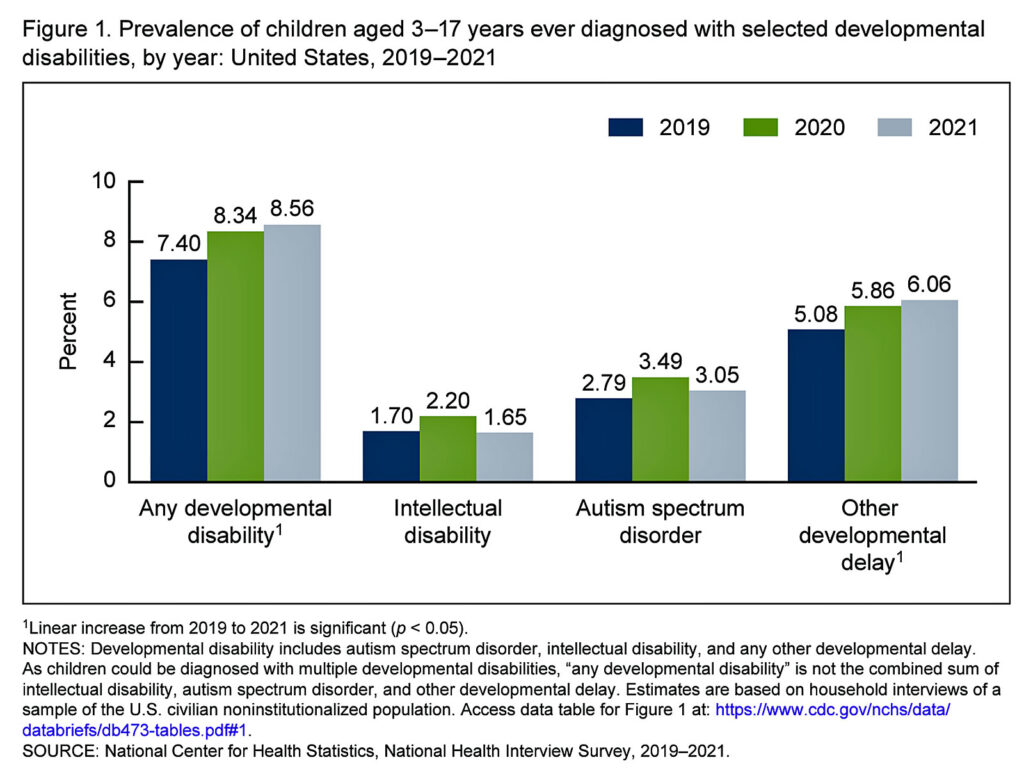
However, the CDC said the estimates in the July 2023 report “may not be comparable” with estimates dating before 2019, when the agency redesigned the survey.
Other key findings from the report include:
- the prevalence of any developmental disability was lowest in non-Hispanic Asian children compared with other race and Hispanic-origin groups
- the prevalence of intellectual disability increased with age, while the prevalence of other developmental delays decreased with age
- boys were more than three times as likely to be diagnosed with autism spectrum disorder than girls — 4.66% compared to 1.5%.
The CDC report did not offer any potential causes for the uptick in diagnosis of any conditions during the observed time period.
Commenting on the report, Brian Hooker, Ph.D., senior director of science and research for Children’s Health Defense, told The Defender:
“Given the draconian lockdown measures, it is no wonder that more children are lagging behind in development. School closures, ineffective online learning, masking and lack of socialization place a huge burden on children, and I believe this is why we’re seeing the effects of non-optimal learning now.”
Lockdowns, masks likely played a role in uptick, experts say
Dr. Elizabeth Mumper, a pediatrician with the Rimland Center for Integrative Medicine in Lynchburg, Virginia, pointed to research showing that lockdowns were associated with verbal, motor and cognitive performance declines in infants and children.
“Normal child development is influenced by peer play, which was curtailed during 2020 and 2021. Children learn to read emotions by looking at faces, and faces partially covered by masks were confusing for developing kids.
“Substituting screen time learning for in-person instruction has had devastating effects on children’s academic progress. Unfortunately, those in charge failed to weigh the social, emotional and developmental impact of extreme lockdown measures on family life and child development.”
According to Japanese researchers at Kyoto University and the University of Tsukuba development of 3- to 5-year-old children was delayed by 4.39 months on average due to the impact of the COVID-19 pandemic.
The researchers, whose work was published earlier this month in JAMA Pediatrics, said few studies have been robust enough to explore, much less draw conclusions, about the association between the pandemic and development among infants and preschoolers.
To bridge the knowledge gaps, they said, “This study examined the association between the COVID-19 pandemic and early childhood development by using census-based cohort data from a Japanese municipality, investigating not only the population mean but also variations in development.”
The study used parent questionnaires to determine child development in the following eight domains: physical motor, manipulation, receptive language, expressive language, language concepts, social relationships with children, social relationships with adults, and discipline.
The researchers wrote:
“Variations in development were greater during the pandemic than before the pandemic regardless of age. Additionally, the quality of care at nursery centers was positively associated with development at age 3 years during the pandemic, while parental depression appeared to amplify the association between the pandemic and delayed development at age 5.”
CDC report confirms recent findings on autism rates
The July 2023 NHIS report comes on the heels of two publications that dropped earlier this year: a CDC report that 1 in 36 children have ASD and a study published in the journal Pediatrics citing tripled autism rates among children in the New York and New Jersey metropolitan area from 2000 to 2016.
The CDC did not investigate the reasons behind the continued rise in autism rates cited in its March 23 report.
“Our best guess, consistent with the general rise in autism prevalence rates, is that it is more equitable access to evaluations and diagnoses,” said Kelly Shaw, a CDC epidemiologist and researcher, in an interview with the “Today” show.
However, earlier this year, Toby Rogers, Ph.D., told The Defender he rejected that theory:
“The unwillingness of the CDC to even ask why these numbers are increasing is a massive ‘poker tell’ that they know but are prohibited from talking about it.
“Two high-quality, multi-million dollar studies in California (Byrd et al., 2002; Hertz-Picciotto and Delwiche, 2009) both concluded that better awareness, changes in diagnostic criteria and earlier age of diagnosis only explain a small fraction of the rise in autism.
“The authors of these studies urged public health officials to place greater emphasis on researching the toxicants that might be driving the increase in autism prevalence. [For a longer discussion of these studies please see Rogers, 2019.] The fact that the CDC is still refusing to properly investigate autism causation is outrageous.”
There has been a 1,000-fold increase in autism prevalence since the 1930s and a 25-fold increase over the past several decades.
