Login
Login


After a four-year legal battle, the plaintiffs in the landmark censorship case, Missouri v. Biden, scored a victory.
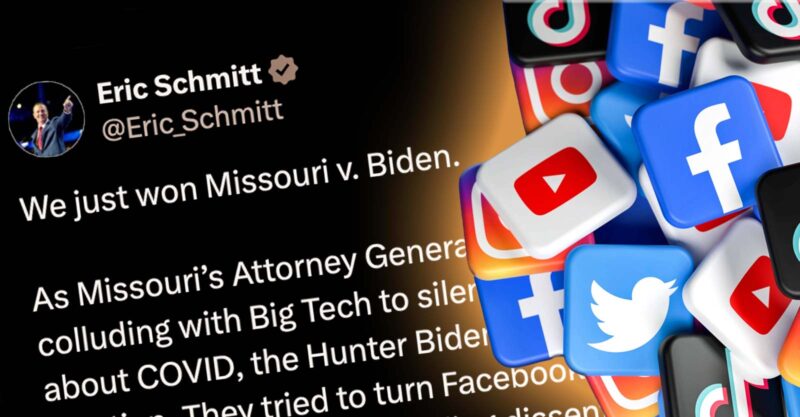
Missouri Sen. Eric Schmitt, who served as the state’s attorney general when the case was filed, said in a post on X, “We just won Missouri v. Biden. … This is the first real, operational restraint on the federal censorship machine. It locks in the First Amendment principle we fought for: modern technology doesn’t erase your rights, and government labels don’t strip speech of protection.”
We just won Missouri v. Biden.
As Missouri’s Attorney General, I sued the Biden regime for brazenly colluding with Big Tech to silence Missouri families — censoring the truth about COVID, the Hunter Biden laptop, the open border, and the 2020 election. They tried to turn… pic.twitter.com/90BYFNf59p
— Eric Schmitt (@Eric_Schmitt) March 24, 2026
In 2022, the attorneys general of Missouri and Louisiana and several individual plaintiffs, including Jay Bhattacharya, M.D., Ph.D.; Martin Kulldorff, Ph.D.; Dr. Aaron Kheriaty; and Jill Hines sued the Biden administration.
The suit alleges the federal government violated the First Amendment free speech clause by suppressing speech on social media platforms, including speech related to COVID-19. The case was later renamed Murthy v. Missouri.
On March 24, U.S. District Judge Terry A. Doughty in Louisiana issued a consent decree in the case forbidding the federal government from coercively pressuring social media companies to censor speech.
The decree, which is binding for 10 years, states:
“The Surgeon General, the Centers for Disease Control and Prevention (CDC), the Cybersecurity and Infrastructure Security Agency (CISA) (‘Enjoined Defendants’), and their employees and agents, shall take no actions, formal or informal, directly or indirectly — except as authorized by the Constitution, statute, judicial order, or regulation — to threaten Social-Media Companies with some form of punishment (i.e., an adverse legal, regulatory, or economic government sanction) unless they remove, delete, suppress, or reduce, including through altering their algorithms, posted social-media content containing protected free speech.”
However, the decree added that the prohibition is limited to the plaintiffs’ social media content and “does not extend to social-media content posted by non-parties.”
A consent decree is a settlement approved by the court, according to Cornell Law School.
The decree names Facebook, Instagram, Twitter or X, LinkedIn and YouTube.
Children’s Health Defense (CHD) General Counsel Kim Mack Rosenberg called the decree “a step in the right direction.” She said:
“While the consent decree applies to the parties and to use of a limited number of social media companies, the decree makes strong statements about the importance of protecting free speech generally, which bodes well for all those sharing information and those who receive information.”

Modern technology doesn’t change government’s First Amendment obligations
In the consent decree, the federal government acknowledged that modern technology does not change its obligation to honor the First Amendment. The decree states:
“The Parties also agree that government, politicians, media, academics, or anyone else applying labels such as ‘misinformation,’ ‘disinformation,’ or ‘malinformation’ to speech does not render it constitutionally unprotected.”
Missouri Attorney General Catherine Hanaway said in a press release that the decree was a “huge win” that secures “a wall of separation between tech and state to preserve our First Amendment right to free, fair, and open debate.”
Bhattacharya called the consent decree “historic.” He experienced censorship early in the COVID-19 pandemic when he co-authored the “Great Barrington Declaration,” a document criticizing lockdowns for the physical and mental health harms they would cause — especially for children.
Bhattacharya withdrew from the lawsuit when he became director of the National Institutes of Health (NIH). Still, he weighed in on the news, writing on X, “Though I had to switch to the government side in the case after I became NIH director, I’ve never been more pleased by ‘losing’ in my life.”
Huzzah! The consent decree in Missouri v. Biden is a historic victory for free speech in the US. Though I had to switch to the government side in the case after I became NIH director, I’ve never been more pleased by “losing” in my life. A huge win for all Americans. https://t.co/wIZ4xvNZzo
— Jay Bhattacharya (@DrJBhattacharya) March 24, 2026
Kulldorff, another co-author of the “Great Barrington Declaration,” also withdrew as a plaintiff when he took a role within the U.S. Department of Health and Human Services (HHS).
Case went all the way to Supreme Court
Missouri v. Biden, later renamed Murthy v. Missouri, was one of several lawsuits filed during the COVID-19 pandemic that challenged the Biden administration’s attempts to get social media companies to suppress or remove content that went against the government’s preferred narrative.
For joint discovery, the case was consolidated with Kennedy et al. v. Biden et al., a similar censorship case brought by CHD and its founder, Robert F. Kennedy Jr., in 2023.
CHD’s case was later renamed CHD v. Trump, after Biden left office and Kennedy became HHS secretary. CHD’s case is still ongoing.
Jed Rubenfeld, the attorney representing CHD in its case and a professor at Yale Law School, said:
“The consent decree is a spectacular win for the country, for the First Amendment, and for all the plaintiffs who fought so hard and so long in this litigation, including CHD.
“Acknowledging the assault by proxy on free speech during the Biden years, the decree prohibits federal agencies from inducing social media censorship through threats.”
On July 4, 2023, Doughty issued an injunction in Missouri v. Biden, barring several federal agencies and members of the Biden administration from communicating with social media companies.
The defendants appealed, but the 5th U.S. Circuit Court of Appeals affirmed Doughty’s ruling.


This article was funded by critical thinkers like you.
The Defender is 100% reader-supported. No corporate sponsors. No paywalls. Our writers and editors rely on you to fund stories like this that mainstream media won’t write.
The U.S. Supreme Court reversed the lower courts’ ruling. However, instead of ruling on the case’s merits, a majority of the justices determined that none of the plaintiffs had legal standing to bring the suit.
Three justices dissented. Supreme Court Justice Samuel A. Alito Jr. — who was joined in his dissent by Justices Clarence Thomas and Neil M. Gorsuch — said in his dissenting opinion that the Biden administration’s censorship was “blatantly unconstitutional, and the country may come to regret the Court’s failure to say so.”
While the other six justices held that none of the plaintiffs showed enough evidence to have standing, Alito wrote that plaintiff Jill Hines, the director of advocacy for Stand for Health Freedom, had “more than sufficient” evidence to establish her standing to sue. He wrote:
“For months in 2021 and 2022, a coterie of officials at the highest levels of the Federal Government continuously harried and implicitly threatened Facebook with potentially crippling consequences if it did not comply with their wishes about the suppression of certain COVID-19-related speech. Not surprisingly, Facebook repeatedly yielded.
“As a result, Hines was indisputably injured, and due to the officials’ continuing efforts, she was threatened with more of the same when she brought suit.”
Given Hines’ standing, Alito said, “We are obligated to tackle the free speech issue that the case presents.”
“The Court, however,” he said, “shirks that duty and thus permits the successful campaign of coercion in this case to stand as an attractive model for future officials who want to control what the people say, hear, and think.”
HHS and Kulldorff did not immediately respond to our request for comment.
Related articles in The Defender
- Three Justices Dissented in Landmark Censorship Case — Here’s What They Said and Why It Matters
- Breaking: Supreme Court Rules in Favor of Biden Administration in Censorship Case — but CHD, Kennedy Lawsuit to Move Forward
- Facebook Dumps ‘Fact-checkers’ One Day After CHD Asks Supreme Court to Hear Censorship Case Against Meta
- ‘Big Victory’: CHD Lawsuit Alleging Key Biden Officials Colluded With Tech Giants to Censor Free Speech Consolidated With Missouri Censorship Case
- ‘Unacceptable and Wrong’: Google Admits to Censoring COVID Content Under Pressure From Biden Administration