Login
Login


While infant mortality in the U.S. has fallen to historic lows, a new analysis of infant deaths in Illinois’ most populous county paints a grim picture: Between 2019 and 2023, more than 200 babies died unexpectedly.
The analysis, which focused on sleeping conditions, reinforces decades of public messaging that infants should be placed on their backs to sleep, on a firm, flat mattress free of pillows, blankets or other soft objects.
But a closer reading of the report raises new concerns: Does focusing on sleep environments capture the full picture behind these deaths?
The Cook County Sudden Unexpected Infant Death (SUID) Case Registry documented 208 sudden unexpected infant deaths between 2019 and 2023. Researchers found that 99% of the infants were sleeping in conditions that did not meet recommended safe sleep guidelines.
Nearly two-thirds of the infants were sharing a sleep surface with another person when they died, while approximately 90% were sleeping with, on or near soft bedding.
Those findings mirror decades of recommendations from the Centers for Disease Control and Prevention (CDC) and the American Academy of Pediatrics (AAP), which continue to emphasize safe sleep practices as the most effective strategy for reducing preventable sleep-related infant deaths.
Yet deeper within the report are findings that point to a much more complicated picture.
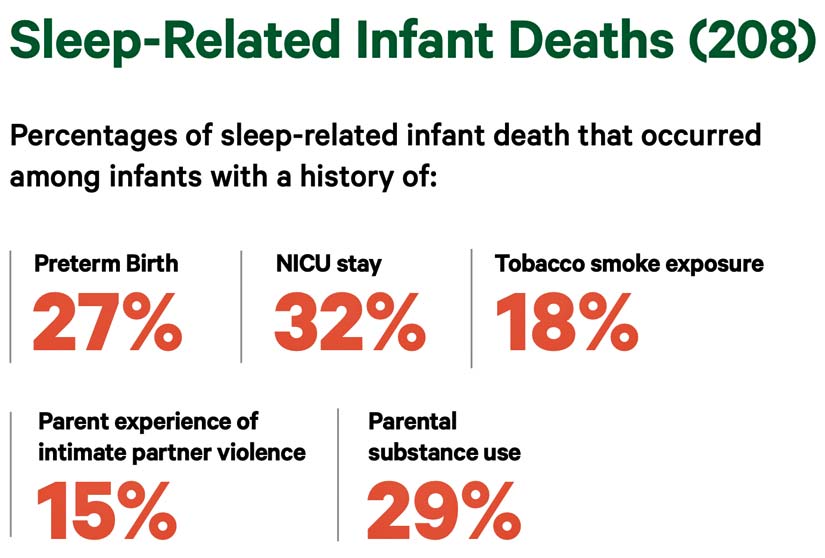
What else did babies have in common?
More than one-quarter of the infants in the study were born prematurely, and nearly one-third had spent time in a neonatal intensive care unit after birth.
Almost 1 in 5 had documented tobacco smoke exposure. Fifteen percent had a parent who had experienced intimate partner violence, and 29% came from families with a history of substance use.
Meanwhile, nearly 1 in 6 infants died while temporarily away from their usual home. Those temporary arrangements often lacked a crib, and investigators noted that some cases were associated with housing instability.
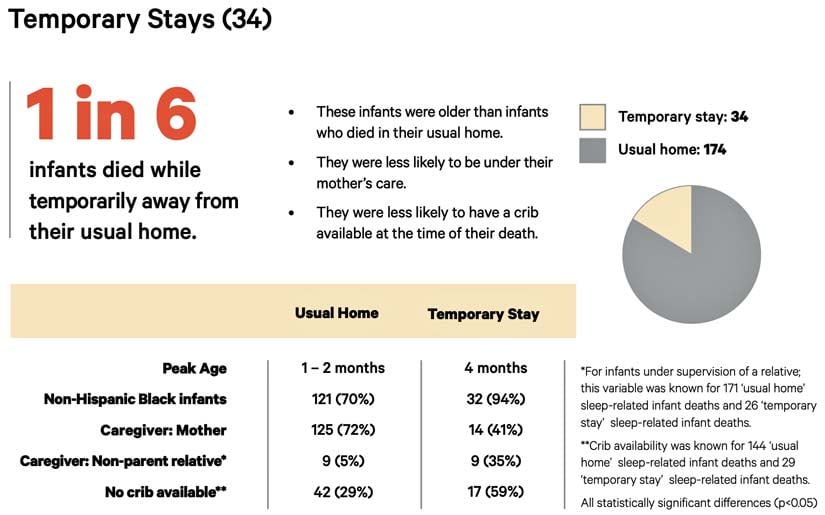
Ten of the 13 families had prior involvement with child welfare agencies, and nearly half of the infants were being cared for by someone other than a parent when they died.
Black infants died at rates 14 times higher than white babes
While SUID rates have declined since the 1990s, significant racial and ethnic disparities persist, according to the CDC.
The Cook County study highlighted such stark racial imbalances. Black infants died at rates 14 times higher than white infants, while Hispanic infants died at rates 2.3 times higher.
Michele Spikes-Cain, associate director of nursing for the Cook County Department of Public Health, told The Defender these figures reflect differences in healthcare access, housing, economic opportunity, caregiver support and other social determinants of health rather than race itself.
“Addressing these systemic factors is essential to improving outcomes,” Spikes-Cain added. “Sleep-related infant deaths remain a significant public health concern.”
Rush University Medical Center pediatrician Dr. Gina Lowell, who leads the SUID Case Registry in Chicago, echoed these sentiments.
“Such disparities are driven by inequitable access to resources that support health and safety for families,” she said.
SIDS ‘leaves families with more questions than answers’
The findings come as national infant mortality statistics continue moving in the opposite direction.
The CDC defines SUID as the sudden, unexpected death of an infant younger than age 1. This broad umbrella definition includes SIDS, accidental suffocation or strangulation in bed, and deaths from unknown causes.
SIDS is defined as an unexpected death before age 1 with its cause unknown “even after a complete investigation.”
SIDS is the third leading cause of death among infants after birth defects and prematurity, but the medical industry remains unsure of its underlying causes.
Dr. Lindsey Wimmer, founder and executive director of Star Legacy Foundation, an organization that provides support and advocacy related to pregnancy loss and neonatal death, said SIDS is particularly catastrophic because “exact causes are unknown.”
Wimmer said though room-sharing without bed-sharing until the baby is 6 months old and avoiding smoke exposure can help prevent SIDS, its inherent triggers remain mysterious.
“SIDS is a devastating event that leaves families with more questions than answers,” she told The Defender.
Researchers and public health officials describe SIDS as a complex condition with multiple contributing factors. Christina Parks, Ph.D., said immune response can play a role in the death of some babies.
“When an infant’s body lacks key anti-inflammatory nutrients and antioxidants, acute immune activation from illness or other stressors may overwhelm the body’s ability to regulate inflammation,” Parks said. “This inflammation may affect areas of the brainstem involved in breathing and heart rate.”
U.S. infant mortality rate still higher than most high-income countries
The category for SIDS was not initiated until the late 1960s after a sudden rise in unexplained infant deaths. The World Health Organization’s International Classification of Diseases (ICD) eventually assigned the code in 1971.
In 2022, approximately 3,700 U.S. infants died from SUID, including 1,529 deaths classified as SIDS, according to the CDC.
According to provisional federal data released by the National Center for Health Statistics, the U.S. infant mortality rate hit a record low in 2024 at 5.52 deaths per 1,000 live births, essentially unchanged from 2023.
The report found an 8% decline in SIDS, from 40.2 to 37.0 deaths per 100,000 live births, along with a 5% drop in postneonatal mortality and a 5% decline in mortality among full-term infants.
While the second straight year without an overall increase marks continued stability, the U.S. infant mortality rate remains substantially higher than those of many other high-income countries.
Can vaccines trigger SIDS? The debate continues
The Cook County analysis did not include vaccination data. The report did not ask, among those infants who died, how many received vaccinations, which vaccinations they received, and how recently they received them.
Questions about a possible link between routine childhood vaccinations and SIDS have resurfaced following a renewed inquiry by Sen. Ron Johnson (R-Wis.) into the withdrawal of a 2021 peer-reviewed paper by researcher Neil Z. Miller.
Johnson has asked the publisher of Toxicology Reports, Elsevier, to explain the decision, following a similar request by U.S. Health Secretary Robert F. Kennedy Jr.
Miller’s research analyzed reports submitted to the federal Vaccine Adverse Event Reporting System (VAERS) identifying 2,989 reports of infant deaths in VAERS occurring within 60 days of vaccination from 1990 to 2019.
Separately, researchers recently published a hypothesis paper in the International Journal of Medical Sciences suggesting that genetic differences affecting infant metabolism could merit additional research into immune responses to vaccine components. The authors emphasized that further large-scale studies would be necessary to evaluate their hypothesis.
Concerns about vaccines and SIDS have circulated for decades. In a 2008 Age of Autism column, journalist Dan Olmsted cited a 1979 internal Wyeth (now Pfizer) memorandum describing changes in distribution of DTP (or DTaP) vaccine lots following reports of infant deaths in Tennessee.
Olmsted argued the policy appeared intended to avoid “correlations being drawn between DPT vaccine lot numbers and SIDS deaths.”
Olmsted also cited “A Shot in the Dark,” a book that suggested that a cluster of infant deaths following vaccination warranted greater investigation. However, several studies have concluded there was no evidence to support such a causal association.
In a June 2025 Substack commentary, Dr. Pierre Kory posited that routine childhood vaccines may cause substantially more infant deaths than public health agencies acknowledge, relying primarily on reports submitted to the federal VAERS system, historical claims about SIDS and criticism of federal vaccine-benefit estimates.


This article was funded by critical thinkers like you.
The Defender is 100% reader-supported. No corporate sponsors. No paywalls. Our writers and editors rely on you to fund stories like this that mainstream media won’t write.
AAP rejects link between SIDS, vaccines
Meanwhile, the AAP maintains that routine childhood vaccinations are not associated with an increased risk of SIDS, noting that infants receive several vaccines during the same period when SIDS is most common, which can lead to concerns about a possible connection.
“While it’s natural for parents to be concerned about their baby and fearful of sudden infant death, claims about a link to vaccines are false,” the AAP materials claim. “Extensive research and scientific review have found no evidence that vaccines cause sudden infant death.”
Public health agencies also note that SIDS rates declined substantially after the “Back to Sleep” campaign promoting safe infant sleep positions and that numerous studies have not found a causal relationship between recommended childhood vaccinations and SIDS.
However, pediatric research published in several medical journals asserts that the campaign did not lead to a dramatic reduction in SIDS deaths.
Cook County health officials say continued efforts should focus on safe sleep education, expanded prenatal and postpartum care, nurse home-visiting programs and addressing social and economic conditions associated with infant mortality.
“Every infant death is a tragedy for families and communities,” Spikes-Cain said. “Continued collaboration among healthcare providers, public health agencies, hospitals and community organizations is essential to ensuring families receive the education, resources and support they need to promote infant safety.”
Related articles in The Defender
- Breaking: Mother of Twins Who Died 8 Days After Vaccinations Charged With Murder
- Exclusive: Sen. Ron Johnson Demands Journal Turn Over Records Related to SIDs and Vaccines Study
- Louisiana Lawmakers Move to Analyze Data on Vaccines and SIDS
- 8-Week-Old Dies of SIDS One Day After ‘Routine’ Vaccines — Were the Shots to Blame?
- 11-Week-Old ‘Anna’ Died Hours After Her ‘Routine’ Vaccines. Nearly 12 Years Later, a Court Ruled the Vaccines Killed Her