Login
Login
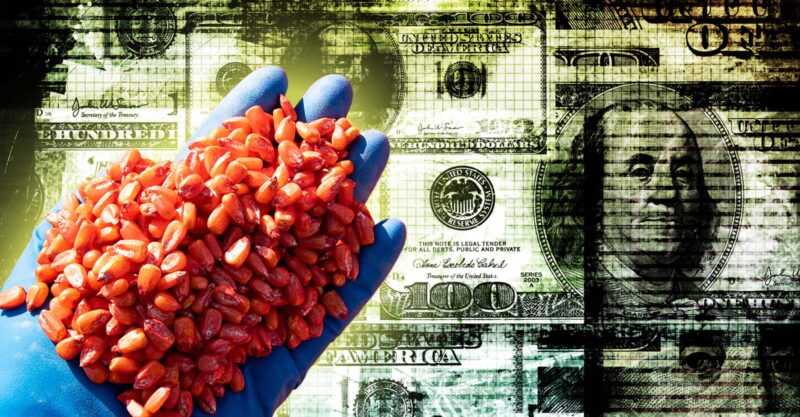


As the number of seed companies, which are also pesticide companies, consolidates through mergers, farmers face challenges associated with fewer seed choices, higher prices, less diversity and proprietary genetically engineered (GE) organisms.
To combat these problems, a nationwide action has been launched to tell members of the U.S. Congress to cosponsor the Fair Seeds for Farmers Act (H.R. 9681 and S. 5104).
A contributor to the high cost of food, seeds as an input account for up to 25% of farmers’ operating budgets. Four companies, the “Big 4,” control 51% of the global seed market — and they are the same four companies that control 62.3% of the agricultural chemical market — Bayer, Corteva, Syngenta (owned by ChemChina) and BASF.
The top four companies selling genetically modified seeds are the same. This concentration in the industry leads to higher costs and less choice for farmers, and less research into varieties suitable for organic systems.
The Fair Seeds for Farmers Act attempts to reduce these impacts. A 2023 U.S. Department of Agriculture report (USDA), “More and Better Choices for Farmers: Promoting Fair Competition and Innovation in Seeds and Other Agricultural Inputs, summarizes many of the problems.”
Farmers in the U.S. have not always needed to buy seed. The federal government — through the Patent Office until 1862 and the USDA thereafter until 1924 — mailed seeds free of charge to farmers throughout the country.
USDA collected seeds (germplasm) from farmers who experimented with varieties to meet regional needs, saved the seeds and shared them. In 1924, responding to pressure from seed companies, the practice ended.
Further support for the commercialization of seed production came from the Plant Patent Act (PPA) of 1930, applying to asexual reproduction of plants (e.g., grafting scions, cuttings, and runners), and the Plant Variety Protection Act (PVPA) of 1970, applying to seeds.
Under the PVPA, plant breeders were granted an exclusive right to propagate and sell their new varieties for 20 years, but those varieties were available to researchers who could use them for breeding new varieties, and farmers could save seeds to replant (and, until 1994, sell).
A number of Supreme Court decisions from 1980 to 2001 resulted in utility patents being issued for seeds and plants. Utility patents (“patents for invention” or “patents”), which can be issued by the U.S. Patent and Trademark Office for inventions that are novel, nonobvious and useful, apply to all users and can restrict seed saving, research and breeding.
Thus, patents eliminate resources from the pool of genetics available to plant breeders for improving crops. If breeders are allowed to use patented plants for breeding, they are often subject to restrictive licensing agreements.
Organic farmers can lose certified crops when genes (pollen) drift from GE plants. But they and others are also subject to lawsuits for patent infringement from the large seed/pesticide/biotech companies.
The Fair Seeds for Farmers Act, introduced in the U.S. House by Representatives Jim McGovern (D-Mass.) and Greg Casar as H.R. 9681 and S. 5104 in the U.S. Senate by Senators Peter Welch (D-Vt.), Elizabeth Warren (D-Mass.) and Cory Booker (D-N.J.), is an attempt to reduce the impacts of intellectual property (IP) laws on farmers through provisions that:
- Clarify terms relating to IP protection for plants;
- Limit the application of federal statutes for plant IP protection to that contained in the PPA and PVPA — thus eliminating the abusive use of utility patents; and
- Protects the use of “a plant, plant variety, plant germplasm, or other biological material for research, breeding, experimentation, seed saving, or propagation” from being limited by contract or agreement.
(The legislation does not apply to existing patents.)


Plant breeding supports resiliency
The case for the legislation extends to plant resiliency. Independent, publicly accessible breeding generates the varieties that perform without heavy chemical inputs.
Research published in Horticultural Plant Journal, and reviewed by Beyond Pesticides, adds to the evidence that organically managed farmland is viable using tomatoes developed through traditional plant breeding — no genetic engineering required — with performance varying meaningfully by region.
Regional adaptation is precisely the work that consolidated breeding programs abandon when seeking high-volume markets, and precisely the work a breeder cannot do if high-yielding genetic material, the elite germplasm, is patented.
A second study reviewed by Beyond Pesticides finds that organic farming matches conventional yield under irrigation and enhances seed quality under drought — a direct food-security argument for organic systems as weather becomes less predictable.
Breeding for resilience under drought conditions requires breeders who have the legal freedom to operate.
Legislation needed
The Fair Seeds for Farmers Act does not eliminate all the barriers to breeding crops that are suited to geographically and climatically diverse growing environments, but it does break the stranglehold of the large seed/pesticide/biotech corporations on seeds, possibly lowering grocery bills and giving farmers more freedom over their crops.
The costs of corporate-controlled seeds
Farmers pay more and know less
Seed prices rose roughly 700% for GE crops and 218% for other field crops between 1990 and 2013, and farmers retain less than half the value those varieties generate.
A Farmers Business Network analysis finds that about half of corn and soybeans on the market are relabeled with the same genetics — and in the Farmers Business Network’s survey, 73% of member farmers had bought relabeled seed while only 31% believed they had, defeating the basic risk-management practice of planting genuinely distinct varieties.
Organic seed supply is stalled
In comments to the National Organic Standards Board [Docket Agricultural Marketing Service (AMS)-National Organic Program-25-0034, October 2025], the National Organic Coalition — whose members include Beyond Pesticides — reported stagnation in organic seed use and urged the Board to look past production capacity to other limiting factors, including genetic access.
Consumers expect ready access to organic seed due to their interest in organic products, given that organic seed production displaces the pesticides and synthetic fertilizers used in conventional seed growing, and it is a revenue stream for organic growers.
Public vegetable breeder Jim Myers told USDA that the third-party prior art (already public) review process is opaque and beyond the means of small seed companies and public institutions.
Off-patent seed is not commercially viable without legislative reform
Patent applicants deposit seed with private depositories that, unlike USDA’s National Plant Germplasm System, are not equipped to maintain viability. Breeders report receiving seeds that will not germinate.
Cape Law Firm, which represents clients in the input industry, described a strategy of letting licenses lapse and requiring disposal of unsold inventory so that no generic supply exists when a patent expires. The Breakthrough Institute documented reach-through clauses claiming rights in material even after the patent has expired.
Genetic diversity is shrinking and cannot be adequately measured
Research restrictions prevent analysis of the genetic composition of commercial corn hybrids. USDA’s AMS was told that essentially all the genetic diversity in the U.S. maize crop is already available in off-patent lines, meaning no new diversity has entered the largest companies’ germplasm pools in at least 20 years.
USDA’s own Maize Crop Germplasm Committee has listed an assessment of the genetic health of the U.S. maize crop as “a matter of national security” for years.
Seed concentration enables reliance on pesticides
The American Antitrust Institute describes a sector reorganized around control of vertically integrated “systems” rather than competition in seeds and traits, and Friends of the Earth describes tightly integrated platforms that lock farmers into a single supplier.
The Center for Food Safety argues that herbicide-resistant crop systems “are inherently anti-competitive, in that they force farmers to buy these crops, where available, in self-defense, or suffer the drift-damaging consequences.”
Independent dealers are squeezed
The Independent Professional Seed Association, which represents roughly 22% of U.S. corn and soybean retail market share, reports having to hand a multinational licensor its full customer list and company financials in order to license traits, then compete against that licensor’s own brands.
“After giving them all our company information, we need to try to compete against their company and owned brands.”
Public plant breeding has been hollowed out
In 1950, public agencies outspent the private sector on agricultural research by 34%; by 2011 the private sector outspent the public sector by 73%. One breeder told USDA that when they started in 1982 there were six or seven public pepper breeding programs in the U.S., and, as of 2022, there were “perhaps two.”
USDA’s National Genetic Resources Advisory Council found that the 1980 Bayh-Dole Act, which allows private and nonprofit commercialization of federal government research, may have unintentionally undercut “public sector capacity to serve all agriculture” with a program to “[e]nsure that a diverse and high quality commercial seed supply exists that meets the needs of all farmers.”
Fear of retaliation keeps the record incomplete
The Center for Food Safety submitted a 50-page record of harassment and intimidation by seed companies. The Independent Professional Seed Association filed on behalf of members who would not comment individually for fear of retaliation.
AMS said plainly that this fear leaves an incomplete picture, and that further scrutiny by the enforcement agencies is warranted. (All comments cited here are in Docket AMS-AMS-22-0025.)
Readers can join the nationwide campaign to protect access to seeds by asking members of Congress to cosponsor the Fair Seeds for Farmers Act (H.R. 9681 and S. 5104).
Letter to U.S. Congress
One of the contributors to the high cost of food is the cost of inputs for farmers, who spend up to 25% of their operating budgets on seeds. Four companies control 51% of the global seed market — and they are the same four companies that control 62.3% of the agricultural chemical market — Bayer, Corteva, ChemChina, and BASF.
Not surprisingly, the top four companies selling genetically modified seeds are the same. The result of this concentration is higher costs and less choice for farmers, and less research into varieties suitable for organic systems. The Fair Seeds for Farmers Act attempts to reduce these impacts.
Farmers in the U.S. have not always needed to buy seed. The federal government — through the Patent Office until 1862 and the U.S. Department of Agriculture (USDA) thereafter until 1924 — mailed seeds free of charge to farmers throughout the country. USDA collected seeds (germplasm) from farmers who experimented with varieties to meet regional needs, saved the seeds, and shared them.
In 1924, responding to pressure from seed companies, the practice ended. Further support for the commercialization of seed production came from the Plant Patent Act (PPA) of 1930, applying to asexual reproduction of plants (e.g., grafting scions, cuttings, and runners) and the Plant Variety Protection Act (PVPA) of 1970, applying to seeds. Under the PVPA, plant breeders were granted an exclusive right to propagate and sell their new varieties for 20 years, but those varieties were available to researchers who could use them for breeding new varieties, and farmers could save seeds to replant (and, until 1994, sell).
A number of Supreme Court decisions from 1980 to 2001 resulted in utility patents being issued for seeds and plants. Utility patents (“patents for invention” or “patents”), which can be issued by the U.S. Patent and Trademark Office for inventions that are novel, non-obvious, and useful, apply to all users and can restrict seed saving, research, and breeding. Thus, patents eliminate resources from the pool of genetics available to plant breeders for improving crops.
If breeders are allowed to use patented plants for breeding, they are often subject to restrictive licensing agreements.
Organic farmers can lose certified crops when genes (pollen) drift from genetically engineered plants. But they and others are also subject to lawsuits for patent infringement from the large seed/pesticide/biotech companies.
The Fair Seeds for Farmers Act, introduced in the U.S. House by Representatives McGovern and Casar as H.R. 9681 and S. 5104 in the U.S. Senate by Senators Welch, Warren, and Booker, is an attempt to reduce the impacts of intellectual property (IP) laws on farmers through provisions that:
-
- Clarify terms relating to IP protection for plants;
- Limit the application of federal statutes for plant IP protection to that contained in the PPA and PVPA—thus eliminating the abusive use of utility patents; and
- Protects the use of “a plant, plant variety, plant germplasm, or other biological material for research, breeding, experimentation, seed saving, or propagation” from being limited by contract or agreement.
[The legislation does not apply to existing patents.]
The Fair Seeds for Farmers Act does not eliminate all the barriers to breeding crops that are suited to geographically and climatically diverse growing environments, but it does break the stranglehold of the large seed/pesticide/biotech corporations on seeds, possibly lowering grocery bills and giving farmers more freedom over their crops.
Please co-sponsor the Fair Seeds for Farmers Act.
Thank you.
Originally published by Beyond Pesticides.