Login
Login
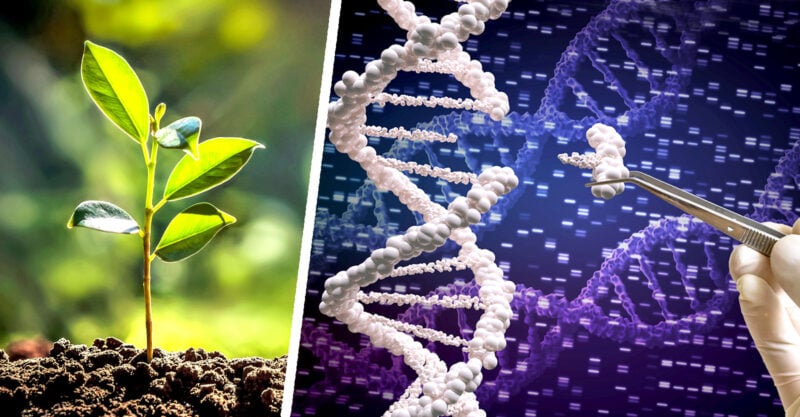


A recently published study in Nature Genetics shows that the use of CRISPR/Cas “gene scissors” causes unintended genetic changes that are different from random mutations.
According to the study, major structural changes in chromosomes occur much more frequently in the genomic regions targeted by the “gene scissors” than would otherwise be the case.
These results also have implications for the risk assessment of plants obtained from new genetic engineering, TestBiotech reported.
According to the European Union Commission and the European Food Safety Authority, unintentional genetic changes resulting from the use of CRISPR/Cas “gene scissors” are no different from random mutations.
However, a new method of data evaluation shows that this assumption is wrong.
The use of CRISPR/Cas completely interrupts the double DNA strand, thus causing some of the chromosomes to be temporarily separated from the main section.
In the separated (distal) section, the chromosomes can restructure and larger sequences of DNA can be lost (deletions), reversed (inversions) or inserted in the wrong place (insertions).


Studies on human, animal and plant cells have all shown that these restructurings occur.
However, the study recently published in Nature Genetics is the first to use large data sets to demonstrate a statistically highly significant dependence of the occurrence of these unwanted changes on the use of “gene scissors.”
A special program with artificial intelligence was used to evaluate the large amounts of data. This revealed that the location and frequency of the unintended genetic changes cannot in any way be equated to the occurrence of random mutations.
Although the data sets originate from human cells engineered with the “gene scissors,” it must be assumed that similar effects also occur in animal and plant cells.
However, the consequences are different: In humans and animals, these kinds of changes are particularly associated with the risk of cancer.
As far as plants are concerned, the risks are different and principally include, e.g. negative environmental effects and a change in the composition of food derived from these plants.
Breeding can also be affected: if the unintended changes go unnoticed, they can accumulate in the genetic material of plants, and thus impair both the genetic stability of future plant varieties and their suitability for use in agriculture.
Originally published by Sustainable Pulse.