Login
Login


By Pamela Ferdinand
Chemicals found in everyday products — from plastics and pesticides to cosmetics and nonstick cookware — interfere with the body’s hormone systems in ways that may increase the risk and severity of prostate cancer, according to a new report.
Data from a review of nearly 500 studies, published in September in Nature Reviews Urology, shows that these endocrine-disrupting chemicals (EDCs) may act as potential prostate carcinogens.
“EDCs affect the development of prostate cancer and aggressiveness of disease by a panoply of mechanisms that disrupt prostate cell fate,” the research team says.
Prostate especially vulnerable to hormone disruption
Prostate cancer is the second most common cancer among men worldwide and a leading cause of cancer-related deaths. About one in eight men in the US will be diagnosed during their lifetime, most often after age 65.
While genetics and age are key risk factors, research increasingly indicates that environmental and occupational exposures to endocrine disruptors are significant contributors.
Because the prostate relies on hormones to develop and function properly, it is particularly vulnerable to hormone-disrupting chemicals, such as bisphenol A (BPA), phthalates, parabens and per- and polyfluoroalkyl substances (PFAS).
Entering the body through food, air or skin contact, EDCs can mimic or block the body’s natural hormones, disrupting their production, breakdown or storage in the body — and increasing the risk of disease.
They have been linked to numerous health problems, including developmental problems, cognitive decline and reproductive issues.
The chemicals may also increase lifelong risks of chronic conditions such as obesity, asthma, diabetes and cancer, as well as heart disease and deaths.
Studies on prostate cancer have looked at work-related and environmental chemical exposures, as well as higher prostate cancer risks reported among people living near industrial plants or contaminated water sources.
For instance, in an early 2013 study, residents near a Teflon manufacturing site in West Virginia, where PFOA was used, showed increased rates of prostate and other cancers.
The latest review highlights a growing body of research that supports a connection between specific EDCs and increased prostate cancer risk, though direct links have not been clearly identified.
It cites a wide range of studies, such as:
- A 2024 study in Spain, using long-term data, found that men with higher levels in their blood of certain parabens — used as preservatives in packaged foods, pharmaceuticals, cosmetics and personal care products — had a greater risk of prostate cancer. Scientists also found that higher blood levels of BPA were associated with an increased risk of prostate cancer, with risk rising as those levels increased.
- Another study in Spain showed a positive association between living near specific industrial sites — such as ceramic, food/beverage and animal waste recycling plants — and higher rates of prostate cancer, among other cancers.
- Farmers in British Columbia exposed over nearly 40 years to the herbicide simazine and lindane, a pharmaceutical treatment for scabies and lice, were almost twice as likely to develop prostate cancer. The risk was 1.3 times higher for those exposed to the pesticide malathion.
- Residents of Merrimack, New Hampshire, where PFAS contaminated local drinking water, were found in a 2022 study to have a 36% higher risk of prostate cancer compared to people without such exposure.
How hormone-disrupting chemicals may harm the prostate
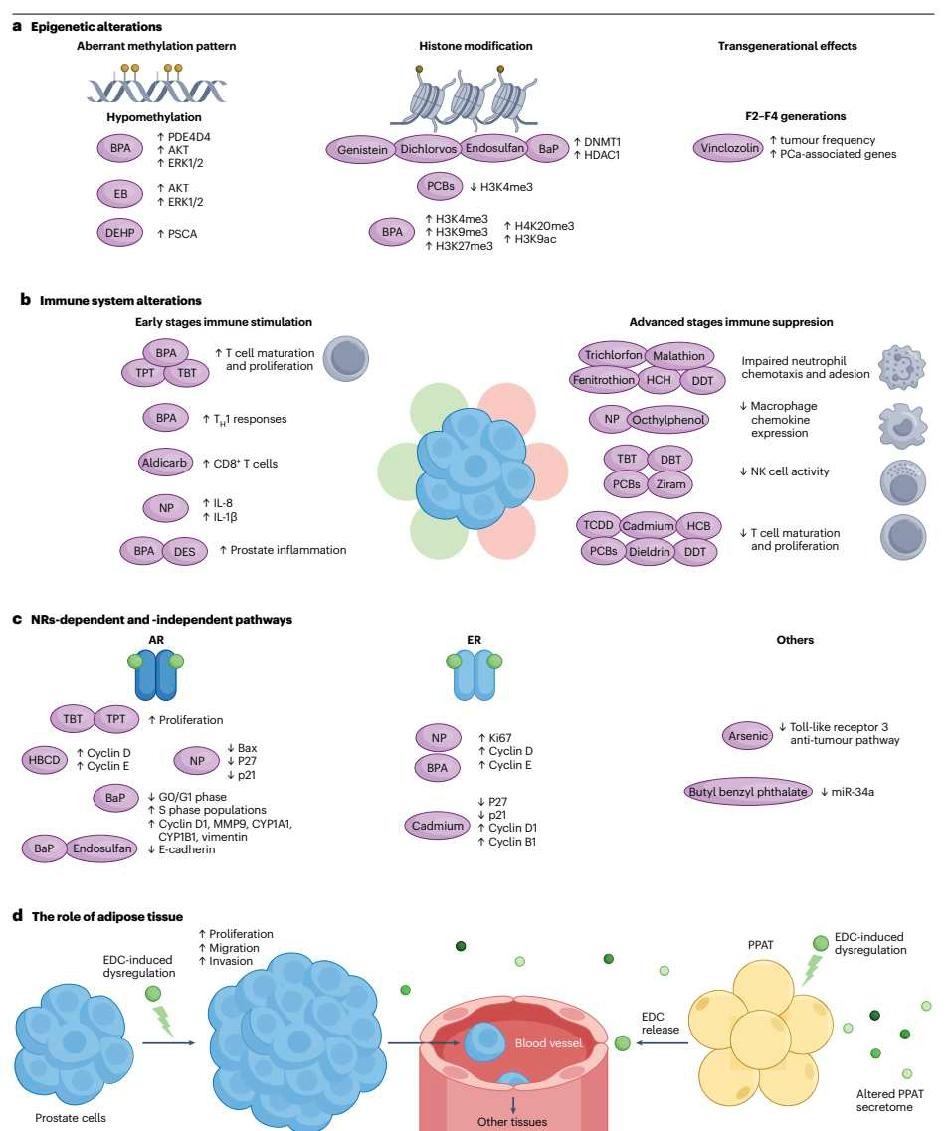
The mechanisms behind the effects of EDCs on prostate cancer risk are complex, scientists say. Certain chemicals disrupt the delicate balance of hormones such as testosterone and estrogen, which regulate prostate growth and function.
They may also:
- Affect gene expression through changes in how genes are turned on and off (epigenetics), increasing the risk of prostate cancer later in life — and potentially passing that risk to future generations.
- Interfere with enzymes that maintain proper hormone ratios, triggering faster cell growth and reducing natural cell death, which prevents tumors from forming.
- Disrupt the immune system, with some EDCs weakening it, while others overstimulate it. Even though these effects are opposite, both types can still contribute to cancer development by reducing its ability to detect and destroy cancer cells while fueling chronic inflammation.
Body fat (adipose tissue), which stores many of these chemicals, may also play a role, studies show. EDCs in fat cells can gradually enter the bloodstream and harm other organs, including the prostate.
Fat tissue near the prostate, specifically, has been linked to more aggressive forms of prostate cancer. In people with obesity, the buildup of these chemicals in fat stores can release larger quantities of harmful substances, potentially fueling cancer growth.
Scientists push for stricter controls and long-term studies
The researchers say a “crucial” need exists for larger, long-term studies to examine how, when, and why exposure to these chemicals increases prostate cancer risk and the specific biological mechanisms involved.
Further study could help inform public health strategies and regulatory measures aimed at reducing exposure to harmful chemicals produced by industry, they say.
But challenges remain: People are rarely exposed to a single chemical and usually encounter mixtures whose combined effects are difficult to predict. Some substances may cause harm at very low doses, and their effects can take decades to become apparent.
Prevention will require action on several fronts, the researchers say. This includes tighter regulation of chemicals used in plastics, cosmetics and pesticides, as well as improved working conditions for individuals in high-risk industries.
They also call for public education campaigns to help people limit their exposure in daily life, such as by reducing the consumption of ultraprocessed foods and avoiding products containing known endocrine disruptors.
“[Thresholds] of exposure related to the carcinogenic potential of EDCs must be established, in order to limit exposure to harmful compounds and provide awareness of their potential effects,” they say.
To reduce your exposure to EDCs, use glass, stainless steel or ceramic instead of plastic for food and drinks, and avoid nonstick cookware.
Choose organic food whenever possible, and opt for non-toxic personal care and cleaning products that are unscented and natural.
Originally published by U.S. Right to Know.
Pamela Ferdinand is an award-winning journalist and former Massachusetts Institute of Technology Knight Science Journalism fellow who covers the commercial determinants of public health.