Login
Login
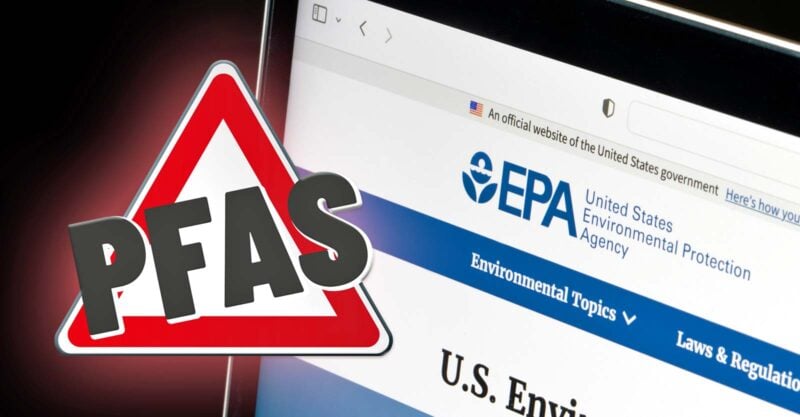


U.S. Environmental Protection Agency (EPA) Administrator Lee Zeldin and other top Trump administration EPA officials overhauled a webpage explaining the pesticide office’s decision not to classify many pesticides as “forever chemicals” — often called PFAS, or per- and polyfluoroalkyl substances.
The timing of the website’s controversial revisions corresponds with the date that pesticide industry lobbying giant CropLife America submitted a paper arguing against further regulating these chemicals.
The paper cited EPA’s revised website as support in multiple places and was submitted to the Journal of Toxicology and Regulatory Policy for review on Nov. 26, 2025, the same day the EPA’s website was revised.
“Donald Trump’s PFAS presidency is being orchestrated by former industry lobbyists and Lee Zeldin, the one cabinet member who claims to care about PFAS pollution,” said Nathan Donley, environmental health science director at the Center for Biological Diversity.
“To have the EPA administrator and his handlers directly involved in revising a single webpage is absolutely bonkers and exposes how desperately Zeldin and his industry cronies are working to hide the dangers of the ongoing parade of harmful pesticides this administration is approving.”
By the widely accepted scientific definition of what constitutes a “forever chemical,” the Trump administration has approved five new PFAS pesticides in just under two years.
But the Trump EPA insists that when measured by its unilateral, less-protective definition outlined on the revised webpage, none of the five newly approved pesticides are forever chemicals.
The original fluorinated pesticides webpage, captured by the Wayback Machine, was created on Nov. 3, 2025 — the same day the Trump administration approved its first PFAS pesticide, cyclobutrifluram.
This original webpage explained that PFAS “are defined in certain contexts as substances containing two or more fluorinated carbons, and in others as substances containing one or more fluorinated carbons. However, to date, EPA has not adopted a particular definition for its Office of Pesticide Programs (OPP) because each substance is evaluated on a chemical-specific basis regardless of classification.”
About three weeks later, on Nov. 26, 2025, the webpage was revised to the current-day version, removing any mention of other PFAS definitions used in the U.S. and around the world.
The website no longer mentions that the pesticide office has not adopted a PFAS definition, but points to the Office of Pollution Prevention and Toxics’ definition as the only definition the agency recognizes.
Freedom of Information Act documents obtained by the center show that Zeldin, EPA Office of Chemical Safety and Pollution Prevention (OCSPP) Assistant Administrator Douglas Troutman, OCSPP Principal Deputy Assistant Administrator Nancy Beck, and OCSPP Deputy Assistant Administrator Kyle Kunkler all reviewed and commented on or edited drafts of the revised website sent around by the Office of External Affairs.
Kunkler, a former lobbyist for the American Soybean Association, works under two former lobbyists for the American Chemistry Council, Beck and Lynn Dekleva, who are overseen by a fourth industry lobbyist, Doug Troutman, who was recently confirmed to lead the chemicals office following endorsement by the chemical council.
Are these pesticides really PFAS?
The EPA has stated in press materials that these new fluorinated pesticides are not PFAS. That assertion is based solely on the fact that they do not meet the chemicals office’s unilateral regulatory PFAS definition.
But the new pesticides do meet the much more widely accepted PFAS definition that was developed transparently by dozens of scientists around the world.
That definition has subsequently been endorsed by more than 150 leading PFAS researchers, is used by nearly every U.S. state for regulating PFAS, and was specifically written into past versions of the National Defense Authorization Act.
Using the scientific definition of a PFAS that is widely accepted in this country and around the world, these pesticides are all PFAS.
The EPA has also stated that its PFAS definition specifically excluded chemicals that had a single fully fluorinated carbon because they do not display the persistence properties commonly associated with forever chemicals.
The EPA’s final rule for its PFAS definition cites a single study to support this assertion: Gaines et al., 2023.
But the only instance where this study mentions the lack of persistence of chemicals with one fully fluorinated carbon is when it directly quotes the EPA’s response to a petition from communities seeking greater PFAS oversight by the EPA. Thus, the agency is essentially citing its own position as evidence to support its position.
In fact, many fluorinated chemicals that meet the widely accepted PFAS definition but not the EPA’s PFAS definition are incredibly persistent.
To name just a few: Carbon tetrafluoride is thought to have an atmospheric half-life of 50,000 years. Scientists have been unable to accurately identify an environmental half-life for trifluoroacetic acid (TFA), trifluoromethanesulfonic acid and bistriflimide because they are too persistent. Half-lives are estimated in centuries or millennia.
Chemicals with single fully fluorinated carbons can stick around for generations or longer, which was the basis for their inclusion in the widely accepted PFAS definition.
Most PFAS pesticides, which could linger in the environment at harmful levels anywhere from months to decades, depending on the chemical properties of the individual pesticide, are expected to eventually degrade into the forever chemical TFA and persist for centuries or millennia.
Originally published by the Center for Biological Diversity.