

 Login
Login
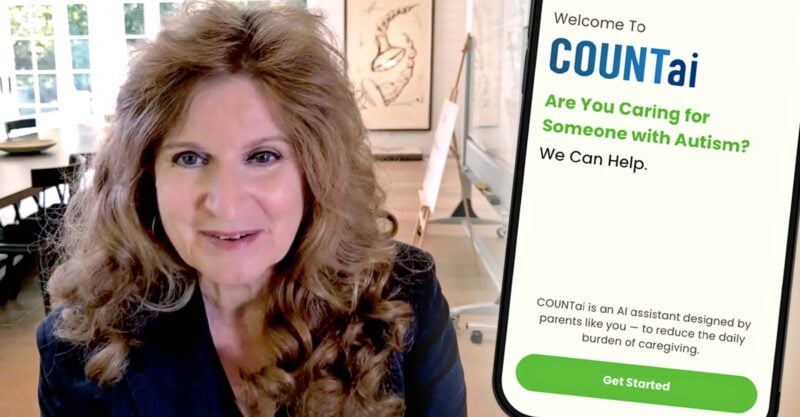


Families of children with autism can spend years collecting medical records, lab results and daily observations about their children — but they often have no easy way to make sense of all that information. Elizabeth Horn wants to change that.
Horn, founder of the Two Mothers (2m) Foundation, knows that challenge firsthand. Her autistic daughter, Sophia, is now in her 30s. Horn spent years piecing together Sophia’s complex health history and trying to figure out whether different interventions were helping.
She eventually built a dashboard for Sophia. That project grew into COUNTai, a free artificial intelligence (AI) tool designed to help families bring their children’s health information together, search through it and look for patterns.
COUNTai is in beta testing, and Horn is inviting families to help shape the platform as it develops.
The goal, she told Children’s Health Defense Chief Scientific Officer Brian Hooker, is to “empower families with … real-world data.”
“It’s creating something that’s meant to actually help us figure out autism. Finally,” she said.
The need is enormous. In 2025, the Centers for Disease Control and Prevention reported that about 1 in 31 U.S. children had an autism diagnosis, based on 2022 data.
Yet despite the number of children affected, autism remains poorly understood.
“Never before have we known so little about a condition that affects so many,” the 2m website says.
COUNTai is Horn’s attempt to close that information gap by helping families get more out of the information they already have about their children.


‘It learns from everything that it does’
Horn described COUNTai as an agentic AI platform — a type of AI designed to gather information, analyze it, then “mimic human decision-making to solve problems in real time,” according to IBM.
For Horn, the appeal was the ability to build an AI system around one child’s whole-body health history.
“What that meant to me, as a mom, is it can be me,” Horn said. “It learns from everything that it does. It remembers where it put every one of your lab tests, and it goes out and looks across all of the existing data, not only about autism, but about your child’s unique comorbid conditions.”
In Sophia’s case, that includes seizures, dysregulation and meltdowns.
Horn said she wanted something much simpler than sorting through binders or navigating complicated databases.
“I wanted something you could literally just talk to that was extraordinarily simple, easy to use, and that would remember everything that I said when I said it, and add that to my own daughter’s dataset,” she said.
The project began with a dashboard Horn’s team built for Sophia. They took years of information Horn had kept in binders and put it into a searchable dataset.
When Horn showed the dashboard to clinicians and researchers, their reactions convinced her the idea could help other families, too.
“They immediately said, ‘We need that. That’s the kind of tracking that will definitely help us … better understand the basic nature of the human body, the systems biology of our kids,’” she said.
COUNTai can scan ‘decades of data and identify changes … literally in seconds’
COUNTai is designed to let families interact with their information through voice, text and pictures. According to the COUNTai website, the system analyzes personal health data and uploads documents in real time to answer questions.
For example, when Sophia has a seizure, Horn can tell COUNTai what happened. The system records the event and can later answer questions such as when Sophia’s last seizure occurred.
It can also connect that event with other information.
Horn said COUNTai can recall weather conditions around the time of a seizure or meltdown, allowing families to look at factors such as humidity, barometric pressure or other environmental conditions alongside symptoms.
“Agentic AI has enabled us to look across decades of data and identify changes in things as specific as short-chain fatty acid levels and the diet,” she said. “It does it literally in seconds. And it brings up a graph if you want to see a graph that you could share with your clinician.”
The ability to search through years of information quickly is one of the platform’s biggest advantages. “It is astoundingly fast and extraordinarily helpful for families that have as much data as we do,” she said.
When clinicians asked about Sophia’s previous immune and aluminum test results, Horn said she consulted COUNTai. It found a 20-year-old lab result in less than 10 seconds.
“If I didn’t have an AI, I would have had to go to the closet, try to find the binder, try to find the test,” she said.
‘This is the best way forward to actually finding the answers for our kids’
Horn is also using COUNTai to track whether interventions appear to make a difference for Sophia.
For example, Horn introduced an exercise program that combines weight-bearing and cardiovascular activity. Horn then tracked Sophia’s gait, balance and steps and used COUNTai to monitor her meltdowns.
Sophia’s meltdown count dropped dramatically, according to Horn.
“We essentially have brought her meltdowns from up to 12 a day to zero. With no meds, no diet change, literally just exercise.”
The point is not to assume the same intervention will work for every child, Horn said. Instead, she wants COUNTai to make it easier for families to track what happens with their own children and eventually compare those experiences across children.
“We can create a virtual camp of kids, and say, ‘Look, is this working for other kids in the same way?’” she said.
That could also give researchers access to more detailed information about children’s day-to-day health, Horn said.
“I just know this is the best way forward to actually finding the answers for our kids and absolutely want to put it in everyone’s hands as soon as possible so you can help us build what we need,” Horn said.
Horn is also testing wearable technology and sensors that could provide additional information, including devices that track brain activity, heart-rate variability and movement.
“We do that … to make sure that we can get back to the community and say, ‘Look, this is what this did for us,’” she said. “The entrepreneurs … building these things are eager to try to help the people in the autism community.”
Who controls the data?
Putting years of a child’s medical records into an AI system raises an obvious question: Who controls the data, and how is it protected?
Hooker knows firsthand why families may be worried about losing control of sensitive medical records. He recalled “being completely horrified” when medical information was made public during his family’s legal case involving his son, who has autism.
“Everybody wants their medical information for their child to be private,” Hooker said.
Horn said COUNTai software developers understand those concerns. They are experienced technology entrepreneurs and also have personal experience with disability through a son who has a traumatic brain injury.
The team is exploring different technical approaches to protecting users’ information.
“We’re also planning a hackathon,” Horn said. The team plans to invite 300 engineers to answer the question, “How can we ensure that the data you’re collecting on your child is kept private?”
Horn said she wants families to help determine what privacy protections they need.
“I want us to be first up … to say, ‘This is what we need to know. These are the checks and balances we, as families, need to be assured that this data is ours and ours alone,’” she said.
The team is also exploring a separate community-level system that could allow parents to voluntarily contribute anonymous records to larger research datasets.


This article was funded by critical thinkers like you.
The Defender is 100% reader-supported. No corporate sponsors. No paywalls. Our writers and editors rely on you to fund stories like this that mainstream media won’t write.
‘It’s all about activating the community’
COUNTai is currently seeking parents of autistic children who are at least 4 years old and have been diagnosed with at least one other serious condition — such as gastrointestinal disease, seizures, self-injury or motor issues — to participate in its beta pilot.
“It’s all about activating the community to become participants in the way that we do autism research,” she said.
Rather than being “passively pulled in,” Horn said, families could have a seat at the table when researchers decide what questions to ask and whether research produces meaningful changes for families.
“You’ll have a voice in … creating a new way to think about doing research and funding projects that involve our health history, our story of our kids, so that we can counter some of the existing ways that we think about doing research that haven’t really netted much for U.S. families over the years,” she said.
Watch Horn discuss COUNTai here:
Related articles in The Defender
- ‘It Was Not Fine’: CHD’s Brian Hooker Describes What Happened to His Son After a Nurse Said It Was ‘Fine’ to Give the Toddler Multiple Vaccines
- What Most Autism Research Gets Wrong — and Why That Might Change
- ‘Bizarre, Creepy’: Kennedy Critics Form Shadow Autism Research Panel
- Wearables: Cassidy Introduces Bill to Require Clear Consent Before Companies Share Users’ Health Data
- AI-Powered Headsets for Kids With Autism: A Promising Therapy — or a Risky Gamble?
- 1 in 31 Kids Had Autism in 2022 — Up From 1 in 36 in 2020
