Login
Login


The University of Pennsylvania’s Annenberg Public Policy Center released results from a recent survey of the American public on April 27. They summarized their findings in this article: “Scientists Esteemed by Public, with Vaccine Scientists Seen as Similar to Scientists in General.”
The article begins:
“Vaccines and scientists who work on them have been embroiled in controversy and subject to unfounded attacks over the past half-dozen years.
“The litany of attacks has included both debunked claims and claims that lack evidence – for instance, that vaccines using mRNA technology such as Covid-19 vaccines alter people’s DNA (no evidence), that some vaccines contain tracking microchips (false), that vaccines cause autism (no evidence), and that scientists working on childhood vaccines are motivated by profit (no evidence).”
But be assured, everyone. Smart people know better. They continue:
“Despite these repeated attacks, a nationally representative survey by the Annenberg Public Policy Center (APPC) of the University of Pennsylvania finds that the American public continues to see scientists working on vaccines in fundamentally similar ways to medical scientists and scientists in general.
“The Annenberg survey, conducted Feb. 3-17, 2026, among 1,650 U.S. adults, finds that nearly 7 in 10 people (69%) say they trust vaccine scientists a moderate or greater amount to act in the best interests of “people like you.” This finding is statistically no different than the percentage who have moderate or more trust in medical scientists (72%) and scientists in general (70%).”
My jaw dropped when I read their opening salvo against loony vaccine skeptics like me. Sixty-nine percent of people surveyed trust vaccine scientists a moderate or greater amount?
That means that just over three out of 10 people believe that vaccine scientists don’t act in the best interest of people. Is that supposed to be a vote of confidence for vaccine researchers? Does being considered “esteemed” require just a 69% approval rate these days?
Nevertheless, Scientific American picked up the article and ran their own with the subtitle, “Roughly seven in 10 people still trust vaccine researchers, a new poll finds. The number is in line with trust for other scientists.”
What do they mean, “still trust vaccine researchers”? How much were they trusted in the past?
To my knowledge (and according to ChatGPT), this is the first survey that polled Americans’ trust in vaccine researchers specifically. They are alluding to the apparently failed “disinformation” campaign launched against vaccines since U.S. Health Secretary Robert F. Kennedy has held the top spot in the U.S. Department of Health and Human Services (HHS). Their piece begins:
“Americans trust vaccines scientists as much as they do other scientists, a new U.S. survey finds, despite a decline in vaccination rates and a proliferation of attacks on vaccines in both the wake of the COVID pandemic and the rise of figures such as Robert F. Kennedy, Jr., a noted vaccine skeptic.”
A closer look at the survey conducted by the “esteemed” Annenberg Public Policy Center (which touts Factcheck.org as one of its major projects, by the way) reveals something different. Here is the result they are quoting:
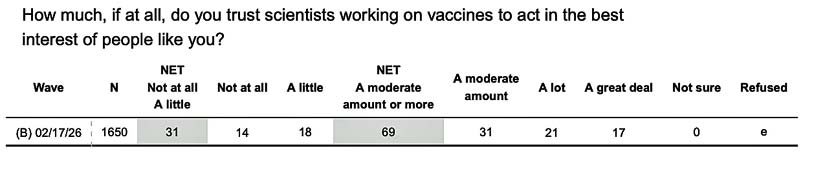
Responders were given five choices:
- Not at all (14%)
- A little (18%)
- A moderate amount (31%)
- A lot (21%)
- A great deal (17%)
The most frequent response was right in the middle, “A moderate amount.” What does “A moderate amount” really mean to the person who responded that way? Some but not a lot? Or a tad more than a little?
I’d say that this group in the middle still trusts vaccine researchers but wouldn’t consider them to be infallible. They are the folks who are on the sidelines, unwilling to take a stand against the “provax” or the “antivax” community.
Though they are unlikely to participate in public exchanges around this contentious topic, they represent a large group of people who are open to changing their minds. In my experience working with medical professionals on a daily basis, there aren’t any who have growing confidence in the utility and safety of vaccines as time goes by. If there is any movement, it’s in the opposite direction.
This is also true of the patients I see every day before their surgery. While the topic of vaccines isn’t part of my pre-operative interview, at least once a month, I meet someone whose health took a turn for the worse during the pandemic and blames it on the COVID-19 shots.
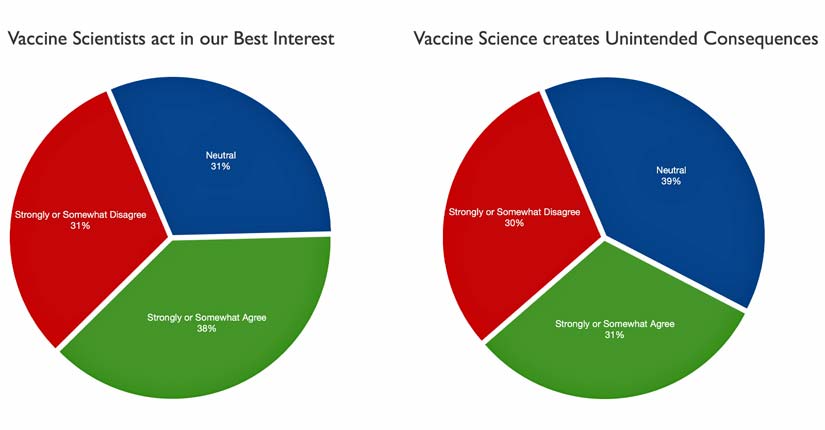
Taking out the 31% who are on the fence, this leaves two groups who are diametrically opposed. They are roughly the same size (31 vs. 38%). This means for every person who implicitly trusts vaccine researchers, there is another who is deeply skeptical of them.
And how about the responses to this question about accountability when fraud in vaccine research is uncovered. How often do the researchers take action?
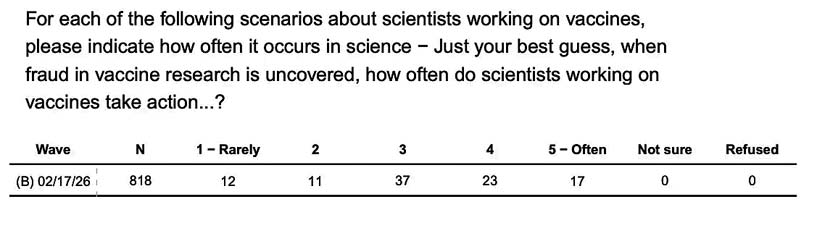
A whopping 1 out of 4 surveyed believe that action is taken infrequently when fraud in vaccine research is uncovered, compared to less than half who believe that accountability happens more often than not.
If we used Annenberg’s strategy to distort findings, we might say that 60% of people think that vaccine scientists ignore fraud in their own field.
And this question about vaccines themselves. Do vaccine scientists create unintended consequences that replace old problems with new ones?
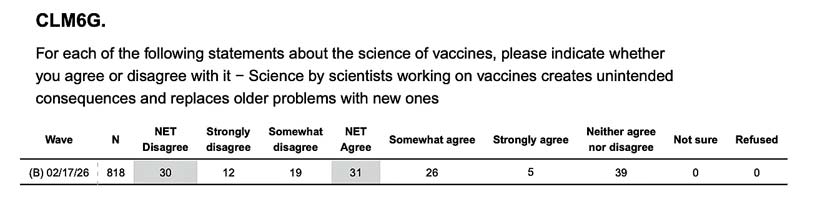
The population is split down the middle!
So to all those who have been smugly attacking vaccine safety advocates for our cautionary stand, I suggest taking caution yourselves. You may very well find yourself in the minority very soon.
You may have to resort to what we have been trying to do: have an honest and open discussion about what is and what can be known. It may not turn out the way you have anticipated.
I see this as a death knell for the vaccine industry and the status quo around vaccine research. Dr. Paul Offit, who is quoted in the Scientific American article, disagrees with me:
“‘I don’t think the results of the survey are surprising; [Kennedy] does not represent the views of most people,’ says vaccine expert Paul Offit of the Children’s Hospital of Philadelphia. ‘Most people get their children vaccinated because they want them to be safe, despite the loud voices.’”
The survey results should be surprising to Offit, who, of course, has never accurately conveyed what Kennedy’s views actually are. He has spent the last two years grotesquely misrepresenting Kennedy to the public.
Offit even declined to accept an invitation to appear at a Centers for Disease Control and Prevention Advisory Committee on Immunization Practices (ACIP) meeting in December 2025 to argue for the continuation of the Hepatitis B vaccine recommendation for newborns.
He doesn’t want to be questioned by highly informed and qualified scientists who disagree with him. He knows that relentlessly smearing vaccine skeptics holds the least risk. Unfortunately for him and the pharma-complex juggernaut which he fronts, it’s no longer working. That’s what the polling results actually demonstrate.
Perhaps Big Pharma’s go-to guy will finally be compelled to stoop to having a public conversation with the HHS Secretary of the United States of America in the interest of public health.


Public opinion is everything
While the Make America Healthy Again (MAHA) movement and vaccine safety advocates are understandably aggrieved at the heretofore anemic actions taken by the Kennedy HHS, I was very skeptical that anything could be done from the top down.
Doctors and medical organizations won’t change their opinion overnight, especially if change is driven from this administration in particular.
In order for real reform to occur, individual medical professionals will have to signal their disapproval around the present recommendations and vaccine safety testing. There is simply no way around it.
This means they have to wake up from their slumber and confront the reality that they have been misled for decades. This means that they will have to actually look beyond headlines, conclusions published in their trusted medical journals and summary statements coming from their medical organizations.
In my opinion, this can only happen one way: their own patients have to challenge them to defend their sanguine attitude around the mounting evidence for vaccine harm and their opinion that the small and short vaccine pre-licensure safety testing studies are sufficient to declare them “rigorously tested.”
In other words, the public must wake up first. The Annenberg poll is clear evidence that this is happening.
How long is the medical establishment going to be able to impose a childhood vaccination schedule upon a public in which 31% of people feel that “Science by scientists working on vaccines creates unintended consequences and replaces older problems with new ones?”
How long is the orthodoxy going to insist that the explosion of childhood chronic diseases has nothing to do with the spectacular increase in vaccine load, without a single study that supports their opinion?
How long before the American public realizes that they have paid over $5,000,000,000 to families of vaccine-injured children over the 40 years since the inception of the National Vaccine Injury Compensation Fund, while vaccine manufacturers generate over $20 billion in revenue from vaccine sales per year, yet remain immune from any liability their products cause?
If revenue far exceeds liability costs, why is the public still paying for their protection?
The pharma industry has been able to secure its stranglehold on public opinion regarding vaccines not only through their influence over legacy media, medical journal editorial boards and public messaging coming from mouthpieces like Offit.
They have worked very hard to create the illusion that advocates for vaccine safety are an inconsequentially small group of uninformed people who are seduced by a handful of people like Kennedy. They have sought to marginalize those of us who have legitimate questions that cannot be answered.
It’s not working anymore. They are getting desperate, and it is becoming more and more obvious. This is apparent when you notice that they include, for no good reason, people in the middle on their side.
Amusingly, the Annenberg poll also asked about trust in other institutions, like the military, police officers and politicians. Journalists were among the least trusted.
Fifty-one percent of responders had little or no trust in them. The other 49%, once again, included those in the middle. Only a scant 16% expressed “a lot” or a “great deal” of trust.
If it isn’t immediately obvious, the Scientific American article was written and edited by people who have no medical training. Dan Vergano and Claire Cameron are journalists, telling their scientifically minded readership what to think. As the public has finally come to realize, they are spin doctors. Their article is evidence of it.
On May 1, Katy Talento, former special assistant to President Donald Trump and the lead health advisor on the White House Domestic Policy Council from 2017 to 2019, published this tell-all confession of her decades-long evolution from staunch vaccine advocate to critic.
Talento is contrite for wrongly sidelining Kennedy when he pushed for a Vaccine Safety Commission at the start of the first Trump administration.
The overwhelming majority of “anti-vaxxers” weren’t born anti-vaxxers. They are like Katy Talento and me. They are like parents who wanted to protect their children, like Offit says, but then witnessed a precipitous and permanent decline in the health of their perfect infants or toddlers immediately following a series of vaccinations.
We are people who changed our minds at some point. You don’t have to agree with us.
However, when someone radically shifts their opinion about something, anything, I suggest listening in. You may come to realize that you, too, have been missing something very big for a very long time.
Originally published on Madhava Setty, M.D.’s An Insult to Intuition Substack.