Login
Login


By Nathan Donley, Ph.D.
Millions of American users of glyphosate-based Roundup have likely assumed the U.S. Environmental Protection Agency (EPA) would never have approved the pesticide unless it was safe.
But the science-based truth has never been as cut and dried as the EPA and Bayer, which bought Roundup maker Monsanto in 2018, have made it sound.
In a series of trials across the country, juries — and the public –— have learned that despite the safety claims by Bayer and the EPA, hundreds of studies by independent scientists link glyphosate herbicides to serious health harms, including cancer.
Even though Bayer maintains that its glyphosate products are safe and not carcinogenic, the company has thus far agreed to pay out more than $10 billion in settlement costs to tens of thousands of glyphosate users suffering from non-Hodgkin lymphoma and thousands of lawsuits remain.
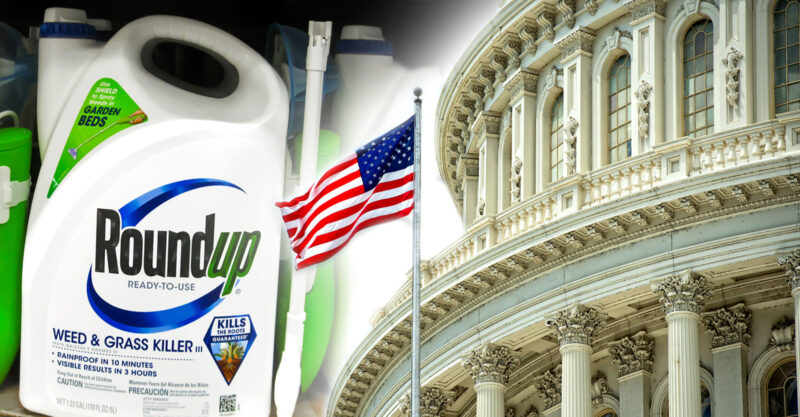
In an effort to block further litigation, the chemical giant has turned its focus to getting federal and state legislation passed to block Roundup users from suing the company for damages.
According to a recent Washington Post article, Bayer helped draft language for a legislative measure that would limit the types of lawsuits brought by Roundup users.
That measure is included in the U.S. House of Representatives version of the 2024 Farm Bill, which is slated to be finalized later this year. The company has also been pushing lawmakers in several states to pass similar measures.
Key to Bayer’s messaging to legislators is that, because glyphosate is EPA-approved, research showing its harms should be rejected. But the process by which the EPA approved glyphosate decades ago has never been reassuring to independent scientists such as myself.
EPA scientists conducting initial assessments of glyphosate in the 1980s discovered several mice dosed with the pesticide developed rare kidney tumors, prompting the scientists to confirm the pesticide’s link to cancer.
Then the EPA’s pesticides office did what it often does: It ignored the troubling research and the recommendation of its own scientists and approved the pesticide without acknowledging its documented link to cancer.
Even the EPA’s subsequent assessments and reapprovals of the pesticide, required every 15 years, have been plagued by questionable science. In 2022 a federal appeals court ruled that the agency’s finding that glyphosate has no link to cancer violated its own cancer guidelines and “was not supported by substantial evidence.”
Now it’s these problematic EPA endorsements that Bayer insists should be the basis for putting limits on the lawsuits glyphosate users can file.
Monsanto — and now Bayer — have tried to undermine independent scientific research by attacking any findings of glyphosate’s harm. The company even tried to covertly influence research that was then falsely presented as being independent of the chemical giant.
That attack campaign took on a new urgency in 2015 when the World Health Organization’s International Agency for Research on Cancer (IARC), often considered the gold standard in cancer research, found glyphosate to be a probable cause of cancer. Bayer’s response was to blast IARC for “cherry-picking” research.
In fact, IARC researchers upheld the highest standards by including only the findings of transparent research that could be reviewed for accuracy. That meant they could not include Monsanto’s claims of glyphosate’s safety because they could not review the company’s research data to verify those findings.


Conversely, the EPA has relied heavily on Monsanto’s studies of its own product in assessing glyphosate’s safety.
The EPA’s questionable process for assessing glyphosate’s cancer risk is hardly an isolated case.
That process was reflected in the EPA’s 2020 decision to reapprove the extremely toxic pesticide dicamba even though the drift-prone poison continued to damage more than a million acres of off-target crops and native plants the subsequent year.
And earlier this year the EPA released a report defending the safety of paraquat, signaling it was likely to reapprove the pesticide that’s banned in 58 countries and has been linked to Parkinson’s disease in hundreds of independent studies.
As with glyphosate, those actions reflect the agency’s culture of undervaluing compelling independent research on pesticides’ harms.
And that may be the most far-reaching verdict to come out of the glyphosate trials: The disturbing revelation that consumers simply cannot trust that a pesticide is safe simply because it gets the EPA’s stamp of approval.
That science-based reality should prompt legislators on both sides of the aisle in Congress and state legislatures to stand up for consumers and reject Bayer’s immoral push to block people suffering from cancer from suing the company.
Originally published by The New Lede.
Nathan Donley, Ph.D., is a former cancer researcher and environmental health science director at the Center for Biological Diversity.