Login
Login


By Jessica Corbett
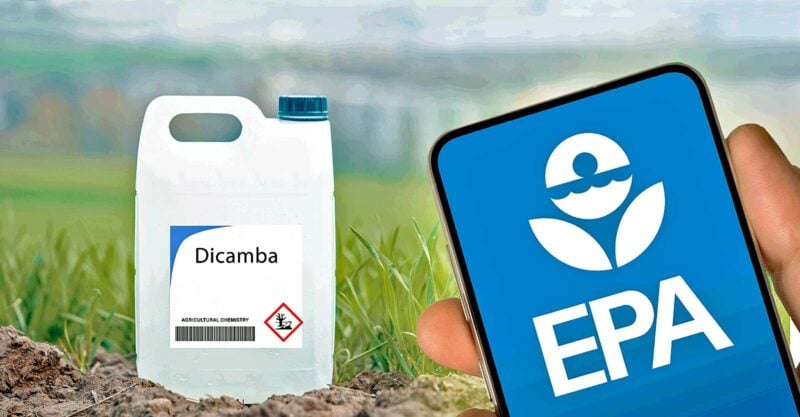
Despite U.S. President Donald Trump’s supposed goal to “Make America Healthy Again” (MAHA), his administration is moving to reregister dicamba, a pesticide twice banned by federal courts, for use on genetically engineered cotton and soybeans.
In response to legal challenges from the Center for Biological Diversity, Center for Food Safety, National Family Farm Coalition and the Pesticide Action Network, courts ruled against the herbicide’s registration in 2020 and again last year.
The U.S. Environmental Protection Agency (EPA) announced its latest push to allow the use of dicamba on July 23, detailing proposed mitigation efforts — including temperature restrictions and the use of drift reduction agents — that EPA spokesperson Molly Vaseliou told The Washington Post would “minimize impact to certain species and the environment.”
The EPA’s proposed registration is now open for public comment until Aug. 22, but supporters and critics are already weighing in. While the pesticide companies welcomed the agency‘s attempt to allow dicamba products from BASF, Bayer and Syngenta, the advocacy groups behind the court battles sharply called out the Trump administration.
“EPA has had seven long years of massive drift damage to learn that dicamba cannot be used safely with GE dicamba-resistant crops,” said Bill Freese, science director at the Center for Food Safety, in a statement.
“If we allow these proposed decisions to go through, farmers and residents throughout rural America will again see their crops, trees, and home gardens decimated by dicamba drift, and natural areas like wildlife refuges will also suffer,” he warned. “EPA must reverse course and withdraw its plans to reapprove this hazardous herbicide.”
Nathan Donley, environmental health science director at the Center for Biological Diversity, declared that “Trump’s EPA is hitting new heights of absurdity by planning to greenlight a pesticide that’s caused the most extensive drift damage in U.S. agricultural history and twice been thrown out by federal courts.”
“This is what happens when pesticide oversight is controlled by industry lobbyists,” he charged. “Corporate fat cats get their payday and everyone else suffers the consequences.”
Latest Trump administration big favor to the pesticide industry: EPA re-registers #dicamba, an herbicide that has twice been banned by federal courts.https://t.co/qPKwK0kKyb
Our fact sheet on dicamba:https://t.co/cEQu5DBb89— Gary Ruskin (@garyruskin) July 23, 2025
The centers pointed out that “the decision to seek reapproval comes less than a month after Kyle Kunkler, a former lobbyist for the American Soybean Association [ASA], was installed as the deputy assistant administrator for pesticides in the EPA’s Office of Chemical Safety and Pollution Prevention. The ASA has been a vocal cheerleader for dicamba since its initial approval for use on soybeans in 2016, despite the fact that soybeans have been the most widely damaged crop.”
The Post asked the EPA whether Kunkler’s recent appointment influenced the dicamba decision. In response, Vaseliou said that the “EPA follows the federal Insecticide, Fungicide, and Rodenticide Act when registering pesticides” and any insinuation otherwise was “further ‘journalism’ malpractice by The Washington Post.”
After Kunkler’s new job was made public last month, the Environmental Working Group (EWG) also flagged his “years of advocating against restrictions on farm chemicals such as glyphosate and atrazine,” and stressed that “these are the very pesticides singled out in Department of Health and Human Services Secretary Robert F. Kennedy Jr.’s ‘Make America Healthy Again’ report for their potential links to chronic illness in children.”
“The appointment of Kyle Kunkler sends a loud, clear message: Industry influence is back in charge at the EPA,” said EWG president Ken Cook at the time. “It’s a stunning reversal of the campaign promises Trump and RFK Jr. made to their MAHA followers — that they’d stand up to chemical giants and protect children from dangerous pesticides.”
“To those who genuinely believed the MAHA movement would lead to meaningful change on toxic exposures: We understand the hope,” he said. “But hope doesn’t regulate pesticides. People with power do. And this pick all but guarantees the status quo will remain untouched.”
Cook — whose group has also sounded the alarm about dicamba — concluded that Kunkler’s EPA post “is but the latest example of the Trump administration’s sweeping betrayal of environmental protection and public health.”
Originally published by Common Dreams.
Jessica Corbett is a senior editor and staff writer for Common Dreams.