Login
Login



By Melissa Smith and Rob Verkerk Ph.D.
Across much of the world, fewer babies are being born. Global fertility has fallen from 3.31 births per woman in 1990 to around 2.25 today, and more than 50% of countries and territories around the world are now below the approximate replacement level of 2.1.
What happens when the biological, social, relational and economic conditions that allow human beings to invest confidently in another generation all begin to weaken at the same time?
Fertility vs fecundity
Fertility is commonly used to mean our ability to reproduce. Strictly, demographic fertility describes actual births, while fecundity describes the potential biological capacity to reproduce.
Someone may be biologically capable of having children yet not have them because they lack a partner, suitable housing or security. Another may desperately want children but be unable to conceive.
The birth statistics record the same outcome — no baby — while concealing completely different stories.
That’s why falling birth rates need to be considered through a much wider lens. They sit at the intersection of biology, health, relationships, economics, culture, technology and confidence in the future.
Reproduction is a biological stress test
Reproduction is one of the most demanding biological processes humans undertake.
It requires far more than functioning reproductive organs.
Successful conception depends upon intricate communication between the brain, endocrine and immune systems, metabolism, cardiovascular system, microbiome and reproductive tissues and organs. Pregnancy then requires extraordinary adaptation across almost every physiological domain.
Around 1 in 6 people experiences infertility during their lifetime. Pregnancy loss remains heartbreakingly common.
At the same time, studies suggest sperm health has declined over recent decades, with evidence that the rate of decline may have accelerated after the turn of the century.
We cannot yet weigh these influences confidently in every case. But the global decline in fertility and reproductive success is clearly multifactorial.
Complex biological systems rarely lose resilience because of one factor.
Health is not simply the absence of diagnosed disease, but the continuing ability to respond, adapt and recover.
Declining reproductive function may therefore be worth considering not only as a problem of reproductive organs, but potentially as an early signal that resilience elsewhere in the system is being eroded.
Biology has a clock. Society has another
We’re having children later.
Across Organisation for Economic Co-operation and Development countries, the average age of women giving birth reached 30.9 years in 2021, compared with 28.6 in 2000.
But social time and biological time don’t necessarily run to the same clock.
If education, career establishment, financial security, finding a partner and securing a home take longer, the reproductive window available when people finally feel ready can become narrower.
Growing social isolation can make finding a partner with whom to have children harder still.
Hyperconnected. But are we becoming desocialized?
We live in the most technologically “connected” society in human history while loneliness and social isolation have become major public health concerns.
But has it played a part in disconnecting us from real-world social relationships that have been the bedrock of human reproductive success for almost the entirety of human evolution?
Put simply, digital connection is not equal to social connection.
Can a society become hyperconnected while simultaneously becoming desocialized?
If fewer stable relationships form, the effects eventually appear in birth statistics regardless of biological fecundity.
The missing ingredient may be security
Security is equally important, spanning economic, social, political and cultural life.
Having a child is an extraordinary investment in the future — biologically, emotionally, financially and temporally.
But reproduction requires more than resources. It requires sufficient confidence to commit those resources to another human being for close on two decades.
That makes findings from the U.N. Population Fund particularly revealing. Its 2025 research across 14 countries found that 1 in 5 people expected not to achieve the number of children they desired. Reported barriers included the cost of parenthood, housing, job insecurity, concerns about the future and not having a suitable partner.
Choosing to have fewer or no children from a position of genuine reproductive autonomy is very different from wanting children but finding the biological, relational or economic conditions increasingly stacked against you.
When fewer births create fewer parents
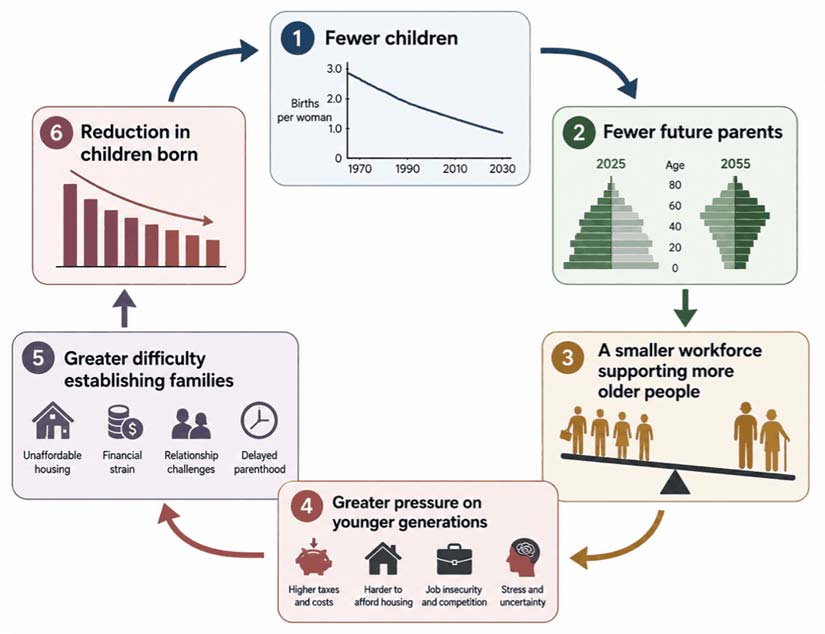
Persistently low fertility means fewer people entering reproductive age. Even if birth rates later recover, fewer potential parents still mean fewer births.
At the same time, smaller younger cohorts must support ageing populations, adding pressure to taxation, healthcare, pensions and social care.
All of this conspires to produce a potential vicious spiral:
Artificial intelligence and automation may replace some of the productivity lost from shrinking workforces.
Machines may replace labor, but they cannot replace generations.
What if resilience is the connecting thread?
- The body needs sufficient biological resilience to reproduce.
- People need sufficient relational resilience to form and maintain partnerships.
- Families and communities need sufficient social resilience to support parents and children.
- Young adults need sufficient economic resilience to contemplate supporting another human being.
If several foundations weaken together, declining births and top-heavy age structures follow — an unprecedented social dynamic that demands cultural transformation.
The answer does not lie simply in persuading people to have more babies.
Historically, falling fertility has accompanied some enormously positive changes: better child survival, female education and autonomy, access to contraception and greater reproductive choice. Those gains shouldn’t be reversed.
But there’s a profound difference between choosing a smaller family from a position of health, security and genuine agency and having fewer children because the family you wanted has become biologically, relationally or economically unattainable.
Rebuilding human resilience
The objective should not be to “fix” fertility, but to recreate the conditions in which humans flourish.
Biologically, that means treating reproductive and preconception health as something built across the life course, not something we suddenly become interested in when conception proves difficult.
Resilience is built on familiar foundations:
- Nutrient-dense food
- Healthy metabolism
- Restorative sleep
- Regular movement
- Healthy microbial ecosystems
- Meaningful relationships
- Finding higher purpose in life
- Reducing avoidable industrial chemical load wherever possible.
And health doesn’t just start at birth. The health of every human is predicated on the health of the biological mother and father during the preconception period.
We need communities in which people can meet and belong; relationships with the resilience to survive the pressures of modern life; families able to support one another across generations; economic systems that give younger adults realistic access to housing and security; and technology that enhances human connection rather than progressively replacing it.
Falling birth rates may ultimately be less interesting as a story about how many humans there will be tomorrow than as a signal of how well humans are flourishing today.
Perhaps that is where the conversation about falling birth rates needs to begin — recognizing that much of the needed transformation is already in our own hands, not those of governments or the medical-industrial complex.
Originally published by Alliance for Natural Health International.
Melissa Smith is an outreach and communication officer at Alliance for Natural Health International.
Rob Verkerk, Ph.D., is the founder and the executive & scientific director for the Alliance for Natural Health International.