Login
Login


By Mahelet G. Fikru and Jennifer Brodmann
How much pollution a facility engaged in production or resource extraction emits isn’t just based on its location, its industry or the type of work it does. That’s what our team of environmental and financial economists found when we examined how corporate characteristics shape pollution emissions.
Pollution emissions rates also vary with specific characteristics of the company that owns the facility — such as how many patents it holds, how profitable it is and how many employees it has, according to an analysis we have conducted of corporate pollution data.
We found that industrial and mining facilities owned by profitable companies with relatively few patents and fewer employees tend to release higher proportions of their toxic waste into the environment — into the air, into water or onto soil.
By contrast, industrial sites owned by unprofitable companies with higher levels of innovation and more personnel tend to handle higher proportions of their toxic waste in more environmentally responsible ways, such as processing it into nontoxic forms or recycling it or burning it to generate energy.
Corporations publish their pollution data
A 1986 federal law requires companies that are in certain industries, employ more than 10 people, and make, use or process significant amounts of certain toxic or dangerous chemicals to tell the government where those chemicals go after the company is done with them.
That data is collected by the U.S. Environmental Protection Agency (EPA) in a database called the Toxics Release Inventory. That data includes information about the companies, their facilities and locations and what they do with their waste chemicals.
The goal is not only to inform the public about which dangerous chemicals are being used in their communities, but also to encourage companies to use cleaner methods and handle their waste in ways that are more environmentally responsible.
Overall, U.S. companies reported releasing to the environment 3.3 billion pounds of toxic chemicals (1.5 billion kilograms) in 2023, a 21% decrease from 2014.
The decline reflects increased waste management, adoption of pollution prevention and cleaner technologies, in addition to the fact that disclosure requirements motivate companies to reduce releases.
The 2023 releases came from over 21,600 industrial facilities in all 50 states and various U.S. territories, including Puerto Rico, the U.S. Virgin Islands, Guam and American Samoa. One-fifth of the facilities reporting toxic releases in 2023 were in Texas, Ohio and California.
What kinds of businesses release toxic pollution?
Metal mining, chemical manufacturing, primary metals, natural gas processing and electric utilities represent the top five polluting industrial sectors in the U.S. Combined, businesses in those sectors accounted for 78% of the toxic chemicals released in 2023.
Research has found that, often, higher levels of toxic chemical releases come from industrial facilities in less populated, economically disadvantaged, rural or minority communities.
But geography and population are not the whole story. Even within the same area, some facilities pollute a lot less than others. Our inquiry into the differences between those facilities has found that corporate characteristics matter a lot — such as operational size, innovative capacity and financial strength.
In our analysis, we combined the data companies reported to the EPA about toxic chemical releases with financial information on those companies and ZIP-code-level geographic and demographic data.
We found that corporate characteristics like profitability, employment size and number of patents are more strongly connected with toxic chemical releases than a community’s population density, minority-group percentage or household income.
We looked at what percentage of its toxic chemical waste a facility or mine released to the environment versus how much it treated, recycled or incinerated.
The average facility in our sample, which included 1,976 facilities owned by companies for which financial data is available, released about 39% of its toxic chemical waste to the environment, whether to air, water or land — with the remaining 61% of it managed through recycling, treatment or energy recovery either on-site or off-site.
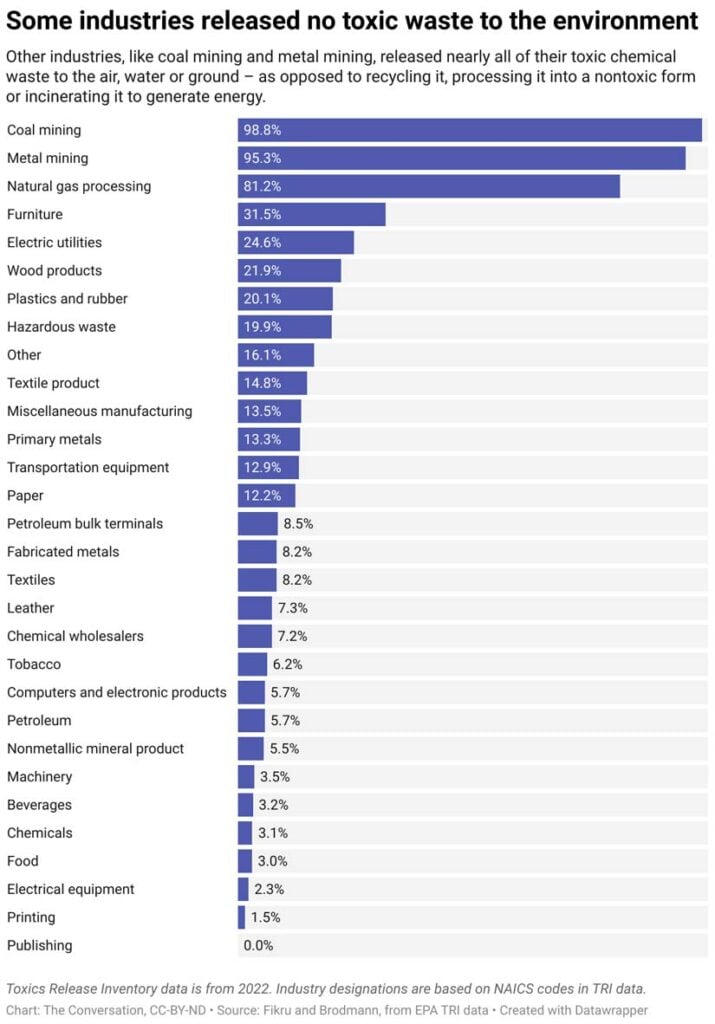
But facilities in different industries have different release rates. For example, about 99% of toxic chemicals from coal mines are released to the environment, compared with 81% for natural gas extraction, recovery and processing; 25% for power-generating electric utilities; and less than 3% for electrical equipment manufacturers.
The role of innovation
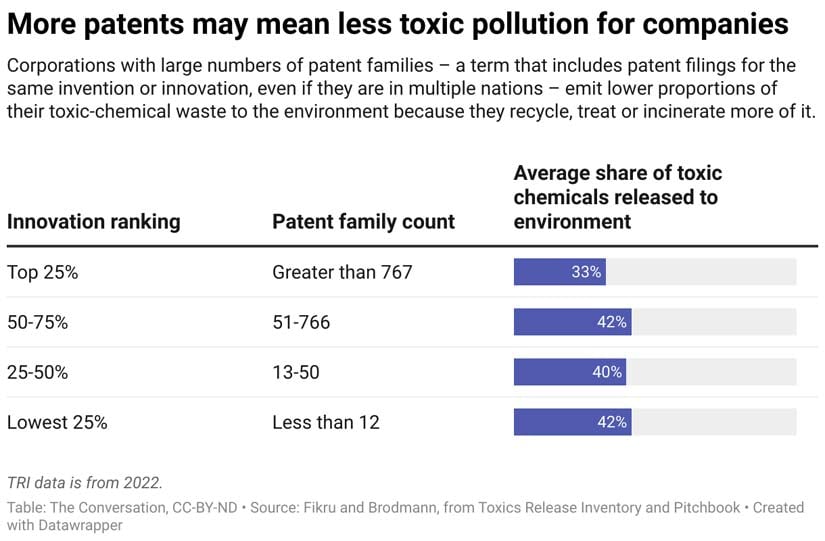
One corporate attribute we examined was innovation, which we measured by counting corporations’ patent families, which are groups of patent documents related to the same invention, even if they are filed in different countries. We found that companies with more patent families tend to release less of their toxic waste to the environment.
Specifically, facilities owned by the top 25% of companies, when rated by innovation, released an average of 32.5% of their toxic waste to the environment, which is eight percentage points lower than the average of facilities owned by the remaining companies in the sample.
We hypothesize that innovation may give firms a competitive advantage that also enables them to adopt cleaner production technologies or invest in more environmentally conscious methods of handling waste containing toxic chemicals, thereby preventing toxic chemicals from being directly released to the environment.
Size and profitability matter, too
We also looked at companies’ size — in terms of number of employees — and their profitability, to see how those connected with pollution rates at the facilities the company owns.
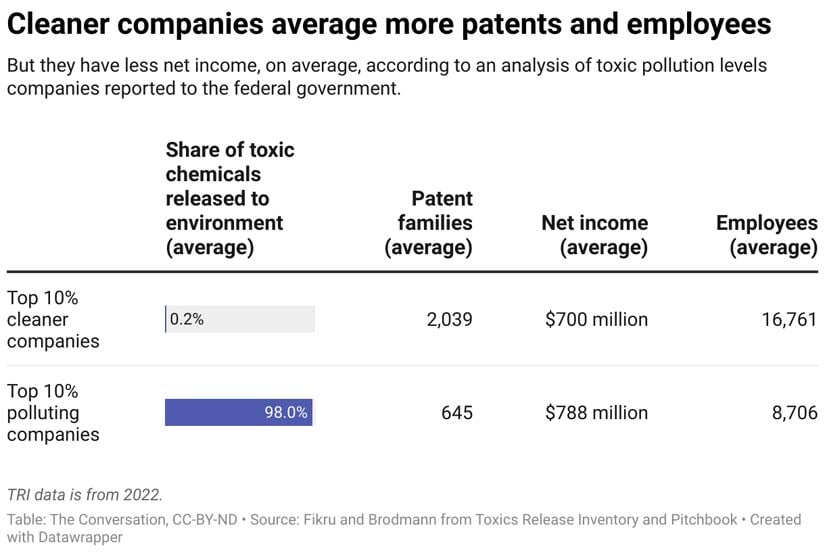
We found that larger companies, those with more than 19,000 employees, own facilities that release an average of 31% of their toxic chemical waste to the environment.
By contrast, facilities owned by midsized companies, from 1,000 to 19,000 workers, release 45%, on average. Those owned by smaller companies, with less than 1,000 employees, release an average of 42% of their toxic chemical waste to the environment.
An important note is that those larger companies, which are more likely to have multiple locations, often own facilities that handle larger volumes of chemicals. So even if they release smaller proportions of their toxic waste to the environment, that may still add up to larger quantities.
We also found that industrial facilities owned by profitable firms have higher average rates of releasing toxic chemicals to the environment than those owned by unprofitable companies.
Facilities owned by companies with positive net income, according to their income statements obtained from PitchBook, a company that collects data on corporations, released an average of 40% of their toxic-chemical-containing wastes to the environment.
Facilities owned by companies with negative net income released an average of 31% of their toxic chemical waste to the environment.
To us, that indicates that financially strong companies are not necessarily more environmentally responsible. That may be evidence that profitable firms make money in part by contaminating the environment rather than paying for pollution prevention or cleanup.
Our analysis shows that geography and demographics alone do not fully account for industries’ and facilities’ differing levels of pollution. Corporate characteristics are also key factors in how toxic waste is handled and disposed of.
Originally published by The Conversation.
Mahelet G. Fikru is a professor of Economics at Missouri University of Science and Technology.
Jennifer Brodmann is an associate professor of Accounting, Finance and Economics at California State University, Dominguez Hills.