Login
Login
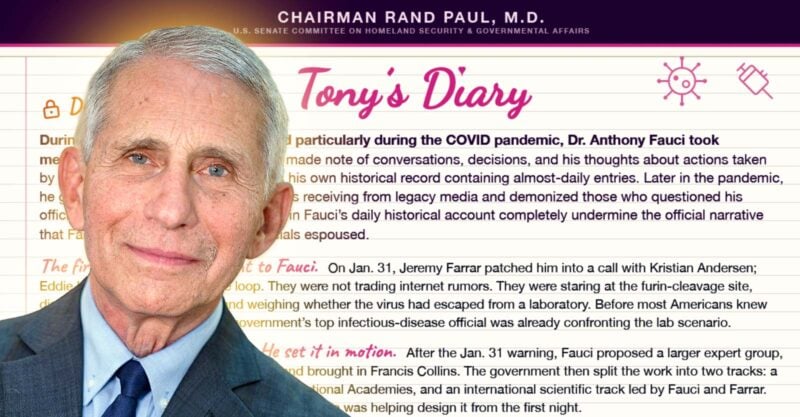


Former White House COVID-19 adviser Dr. Anthony Fauci is set to return to Capitol Hill Wednesday to answer new questions about the origins of the coronavirus pandemic and his role in the federal response.
Ahead of the July 29 hearing, Sen. Rand Paul (R-Ky.) released Fauci’s personal diary entries. The entries, spanning from December 2019 to the end of 2022, provide a behind-the-scenes glimpse into the virus’s source, public messaging, the government’s response to the pandemic and Fauci’s reaction to being thrust into the media spotlight.
Paul, who chairs the U.S. Senate Homeland Security and Governmental Affairs Committee, described the diaries as a contemporaneous record of Fauci’s meetings, phone calls, scientific discussions and observations during the pandemic.
The diaries will be presented as crucial evidence in the committee’s ongoing investigation.
For years, Paul has clashed with Fauci over whether the U.S. government funded research at the Chinese lab where U.S. and Chinese researchers were conducting gain-of-function experiments that may have been responsible for the pandemic.
Paul has repeatedly stated that Fauci denounced anyone who suggested COVID-19 could have originated in the lab, and that he never took accountability for funding hazardous research.
Fauci, who retired in 2022 after 54 years at the National Institute of Allergy and Infectious Diseases (NIAID), told lawmakers in June 2024 that lab-leak theories floated by Paul and other Republicans were “preposterous.”
“I’ve also been very, very clear, and said multiple times, that I don’t think the concept of there being a lab (leak) is inherently a conspiracy theory,” Fauci said. “What is conspiracy is the kind of distortions of that particular subject, like it was a lab leak, and I was parachuted into the CIA like Jason Bourne and told the CIA that they should really not be talking about a lab leak.”
During the same two-day hearing, Fauci told lawmakers, “I don’t recall” more than 100 times when asked about decisions he made during the early months of the outbreak.


Here are some key takeaways from Fauci’s diaries:
1. Fauci ruled out Wuhan wet market as the outbreak’s origin
Before most of the world would know about COVID-19, one of the earliest entries raises questions about the timeline surrounding the first known case.
With 1,400 cases and 42 recorded deaths, Fauci wrote on Jan. 26, 2020, that epidemiological and genomic information suggested infections occurred before the outbreak was linked publicly to Wuhan’s Huanan Seafood Market.
Fauci said the “first infection was in early December and was not connected to the market.”
“Now we know the market was not the source, it was the amplifier,” he added. “Having said that, somewhere the virus jumped from animals to humans.”
The entry challenged the early focus on the seafood market as the origin point of the outbreak and suggested the virus may have been circulating before cases connected to the market were identified.
2. Scientists privately raised the possibility of lab involvement
A consequential Jan. 31, 2020, diary entry describes a conversation with Jeremy Farrar, Ph.D., then-director of the Wellcome Trust, following discussions among scientists Kristian Andersen, Ph.D., Eddie Holmes, Ph.D., and Bob Garry, Ph.D., about a newly released SARS-CoV-2 genome sequence.
According to Fauci’s notes, the scientists discussed features of the virus that they believed were unusual and warranted additional scrutiny. Those features included the furin cleavage site, which helps the virus infect human cells.
“They bring up the possibility that this could have been deliberately inserted and either accidentally released or deliberately released by a crazy person in the lab,” Fauci wrote.
According to the diary, scientists disagreed on the likelihood of a laboratory origin, but agreed the issue warranted further investigation.
The pressure would mount in the coming months, prompting further inquiry.
“However, over the past couple of days given the amount of speculation about the possibility of a lab leak I have been saying that no one is 100% certain of the origin including me and so I am calling for a thorough investigation,” Fauci wrote May 26, 2021.
By July 8, he concluded that Andersen, Garry and other scientists strongly argued “with good evidence for a natural emergence” of COVID-19, rather than a lab leak.
3. ‘I am the most famous and talked about person in the country’
A surprising recurring theme throughout the diaries is Fauci’s growing awareness of his own public profile during the most intense months of the pandemic, which according to some reports claimed more than 7 million lives worldwide, including roughly 1.2 million in the U.S.
On April 7, 2020, his first entry — merely weeks after states began implementing mandatory shutdowns in New York and Ohio — refers to media coverage he’s featured in.
“Press still hot and heavy about me,” he wrote. “Multiple stories per day directly or indirectly involving me.”
A few weeks later, on May 21, Fauci mentions a “very flattering” front-page Washington Post article, adding “my national and international fame is explosive and really unimaginable.”
“I am the most famous and talked about person in the country and one of the most recognizable peson [sic] in the world,” he continued. “Countless profiles on me in multiple media. I cannot even read all the things that are written abuyt [sic] me since I am so busy….seriously. POTUS seems to be enamored of me even though I am taking the spotlight away from him.”
4. Fauci accuses Trump of ‘getting out of control’
The diaries also showcase Fauci’s rising frustration with the first Trump administration.
Throughout several journal entries, Fauci criticized White House communications liaisons for stemming his media appearances, raising concern over the administration’s public messaging and general irritation over misinformation.
On May 22, 2020, Fauci wrote: “Trump getting out of control in pushing to open up the country and get the economy back before election day. He is desparate [sic]. This is all about re-election.”
The next day he mentioned the media again.
“Apparently the WH is very upset that I am being profiled and it looks like I am putting down the POTUS and becoming a star that outshines him,” he wrote on May 23, 2020. “The press is playing into this as is the tweet storm. Very stressful!!”
On July 2, he added:
“I am concerned that we might be on ‘exponential’ increase as we enter into the 4th of July weekend. POTUS and his people have essentially dropped out and do not even recognize that an outbreak is ongoing on [sic]. They are denying all requests for me to appear on any major TV programs.”
5. Scientists questioned deleted NIH data records
Paul has previously called on Fauci to answer questions surrounding deleted COVID-19 files.
On June 18, 2021, Fauci’s diary recorded an “important e-mail” from Jesse Bloom, Ph.D., an associate professor at the Fred Hutchinson Cancer Center and an investigator with the Howard Hughes Medical Institute, regarding deleted early SARS-CoV-2 genetic sequences from the National Institutes of Health’s (NIH) Sequence Read Archive (SRA).
Bloom wrote to Fauci and other officials about missing early Wuhan SARS-CoV-2 data.
“I identified a data set of early Wuhan SARS-CoV-2 sequences that has been deleted from the NIH’s Sequence Read Archive,” Bloom wrote. “I was able to recover the deleted files from the Google Cloud and analyze the sequences.”
Bloom said he had submitted a preprint analyzing the recovered data and wanted to alert NIH officials because questions surrounding the origins and early spread of COVID-19 had become a major scientific and public issue.
While noting that the NIH’s SRA contains a large volume of data and is not responsible for independently reviewing every deletion, Bloom said the discovery warranted a broader examination.
“I think it would be highly worthwhile to do a comprehensive analysis of SRA (and other NIH) data that might be relevant to this topic that could have been deleted or otherwise overlooked,” he wrote.
Bloom said he was developing methods to identify additional deleted-sequence data and suggested the NIH could play a leading role in reviewing its own archives.
“I hope overall this can be a good opportunity for the NIH to take the lead by using its remarkable data archives to make progress in resolving some of the important questions about the virus’s origins,” Bloom wrote. Fauci disagreed.
“I believe that it was somewhat imprudent on the part of Jesse Bloom to make statements such as he has that indicate nefarious motives on the part of the Chinese when we have no idea why they deleted the sequences,” Fauci wrote of the e-mail.
The response stated that, after a Zoom discussion among scientists, several participants concluded Bloom had “jumped the gun” by suggesting the deleted sequences indicated Chinese officials were intentionally concealing information about the virus’s origins.
However, the response acknowledged that the deletion could fuel further suspicion among those who believed the data represented evidence of a possible laboratory-related origin of COVID-19.
Paul has stated he would grill Fauci about this at the hearing.
Venting frustration toward the CDC
Fauci’s diary records a disagreement with the Centers for Disease Control and Prevention (CDC) initially over how to characterize the severity of the 2019-2020 flu season.
Fauci wrote that CDC officials were upset with his assessment that the flu season was on track to be as severe as the 2017-2018 and 2014-2015 seasons. He noted that infection levels were similar to those years, but that hospitalizations and deaths were lower, which he attributed in part to the early predominance of influenza B, which tends to affect children more severely.
“Since the elderly account for most of the deaths and hospitalizations, the total of these are down,” Fauci wrote, while adding that “the number of pediatric deaths is way up.”
Fauci said the disagreement centered on how to define a “bad” flu season. “I say it is a bad season and CDC says no.”
He also expressed frustration that U.S. Health Secretary Alex Azar and CDC official Dr. Nancy Messonnier discussed his comments without including him.
“There was a discussion … about my statements, but no one thought of getting me on the conference call,” Fauci wrote. “Not good. Typical CDC!”
As the pandemic took shape, Fauci mentioned disagreements with CDC members like then-Director Robert Redfield, surrounding COVID-19 “containment” and “mitigation” tactics.
“Bob Redfield just does not come across very weel [sic],” he wrote. “He takes forever to say something and it is usually wondering. This drives the WH and HHS comms people crazy and so they are putting me out on all the requests.”
The CDC did not respond to requests for comment.


This article was funded by critical thinkers like you.
The Defender is 100% reader-supported. No corporate sponsors. No paywalls. Our writers and editors rely on you to fund stories like this that mainstream media won’t write.
Diaries end with Hollywood tribute to Fauci in Washington
Fauci’s diary ended in December 2022.
He describes attending the 2022 Kennedy Center Honors as a guest of Becerra, joining President Joe Biden at a White House reception before traveling to the awards ceremony.
Fauci wrote that he spoke with several celebrities, including Julia Roberts, Sean Penn and Matt Damon, and described the event as “a spectacular event mixing entertainment with honoring the honorees.”
He also reflected again on the public attention he received, writing that “hundreds of people” applauded and called out his name as he walked the red carpet.
“I was amazed how this recognition of me has reached such a height,” Fauci wrote, adding that he was “certainly not getting a big head about it,” but found the experience “rather weird and a little bit unnerving.”
The diary entry concludes with a brief exchange with Hunter Biden, whom Fauci said joked that if a photograph of the two together appeared online, “the internet ‘would explode,’” given that both were “being attacked by the far right GOP.”
Fauci did not respond to The Defender for comment.
Related articles in The Defender
- FBI Pressured U.S. Customs to Ditch Plan to Question Key Fauci Ally on Return Trip From Wuhan
- The Real Anthony Fauci: Bill Gates, Big Pharma, and the Global War on Democracy and Public Health
- Fauci Told Colleagues to Delete COVID-Related Communications, Emails Show
- Fauci’s Replacement at NIAID a Cheerleader for Gain-of-Function Research
- Fauci’s Self-proclaimed ‘DNA of Caring’: It Was All About Fast-tracking mRNA Vaccines