
 Login
Login


Tell the FCC How You’ve Been Impacted by Wireless Radiation
The Federal Communications Commission (FCC) is seeking public comments in ET Docket No. 13-84 as it responds to a federal court order requiring the agency to address evidence and concerns about the adverse health and environmental impacts of wireless radiation.
September 18, 2026
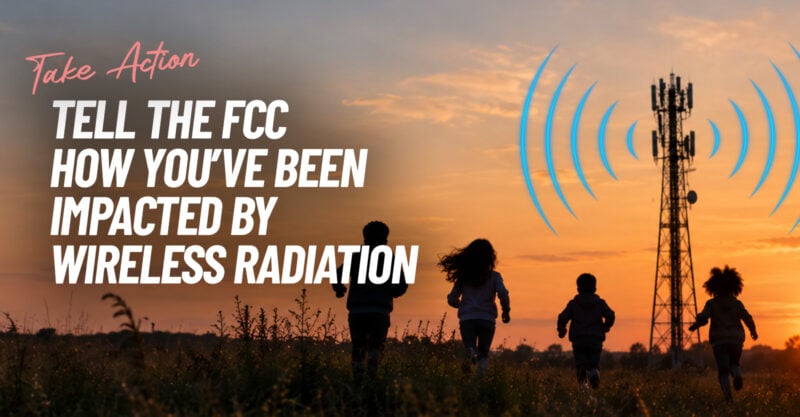
The Federal Communications Commission (FCC) is seeking public comments in ET Docket No. 13-84 as it responds to a federal court order requiring the agency to address evidence and concerns about the adverse health and environmental impacts of wireless radiation.
In 2021, the U.S. Court of Appeals for the D.C. Circuit ruled that the FCC’s decision to retain its decades-old radiofrequency (RF) radiation exposure guidelines was arbitrary and capricious because the FCC failed to consider a mountain of peer-reviewed scientific studies demonstrating serious biological harm. The court ordered the FCC to provide a reasoned explanation for its determination that its RF exposure guidelines adequately protect humans and the environment against the harmful effects of such exposure.
Specifically, the Court directed the FCC to address:
- The impacts of RF radiation on children.
- The health implications of long-term exposure to RF radiation.
- The ubiquity of wireless devices and technological developments since the FCC’s RF exposure guidelines were last updated in 1996.
- The impacts of RF radiation on the environment.
- The adequacy of the FCC’s RF radiation testing procedures for cell phones and other portable wireless devices.
For over five years, the FCC has ignored the court’s 2021 order. But after CHD dragged the FCC back into court earlier this year, the court issued an order on August 24, 2026 giving the FCC only 30 days to explain its years of inaction. And now, the FCC is reopening the record on the health and environmental impacts from RF radiation exposure. This is a critically important opportunity for all Americans experiencing negative health effects from RF radiation exposure to submit comments to the FCC and make your voices heard!
We must build a strong record in the FCC docket now! Tell the FCC why we need more stringent RF radiation exposure standards in the United States.
Take Action Now
We especially encourage you to personalize the sample message below with your own experience. You can describe RF radiation-related health effects experienced by you or your family, including cancer or non-cancerous effects; impacts on children; experiences with long-term or increasing RF radiation exposure; concerns involving cell phones, Wi-Fi, cell towers or other sources of RF radiation; and/or impacts you have observed on pets,wildlife, plants or the environment. You can also share with the FCC how many cell towers and other wireless telecommunications facilities are located near your home.
How to Submit Your Comment to the FCC
Make your voice part of the official record by submitting a public comment in ET Docket No. 13-84.
- Make your choice of what type of comment to file. The FCC prefers “standard filings” but does accept informal “express” submissions. Standard filings require that you upload a document in pdf or other acceptable format, whereas with express comments you can directly enter the text using your browser.
Enter your name, address and email address (optional) in the appropriate fields.
- Please submit a personalized comment about how wireless radiation exposure has impacted you and your family. You can start with the suggested text below and then personalize it. You may wish to write your comment in advance elsewhere.
- Check the box that says Note: By checking this box, I acknowledge that I am filing a document into an official FCC proceeding. All information submitted, including names and addresses, will be publicly available via the web. Privacy Act Statement.
- Select Continue to Review Screen.
- Check the box that says I’m not a robot.
- Click Submit.
Sample Text (please personalize)
I am writing regarding the FCC’s response to the D.C. Circuit Court of Appeals’ remand concerning its decades-old radiofrequency (RF) radiation exposure guidelines.
The Court directed the FCC to provide a reasoned explanation for its determination that its guidelines adequately protect humans against harmful effects of RF radiation unrelated to cancer. Specifically, the court required the FCC to address the impacts of RF radiation on children, the health implications of long-term exposure, the ubiquity of wireless devices and technological developments, impacts on the environment, and the adequacy of the FCC’s testing procedures for cell phones and other portable devices.
The FCC should fully consider evidence and real-world experiences concerning the health and environmental impacts of wireless radiation, including non-cancer health effects, impacts on children, long-term and cumulative exposure, cancer, and impacts on wildlife and the environment.
The FCC is not a health agency and does not have expertise in medicine, biology or public health. Yet, the agency continues to assert authority over RF exposure standards and is preparing to reach conclusions about whether its existing guidelines adequately protect the public.
I urge the FCC to recognize the critical role of federal health agencies, including the U.S. Department of Health and Human Services, and to rely on appropriate health and biological expertise when addressing the issues identified by the court.
This issue matters to me personally because:
[Please add your personal story here. You may wish to describe how wireless radiation has affected you, your child or family; health effects or cancer you have experienced; concerns about long-term exposure; experiences involving cell phones, Wi-Fi, cell towers or other wireless sources; or impacts you have observed on animals, wildlife, plants or the environment.]
I urge the FCC to give meaningful consideration to the experiences and evidence before it and to fully address each of the issues identified by the court.