
 Login
Login


Tell New Hampshire Lawmakers to Override Veto of ‘Lowering the Cost of Meat’ Bill
With only four USDA inspection facilities in the state, the system in place has extended wait times of 18 to 24 months, preventing farmers from being able to ensure their livestock will be processed at all. The current process has led to near-monopolies that have created bottlenecks and shortages, which have triggered enormous price increases.
August 11, 2026
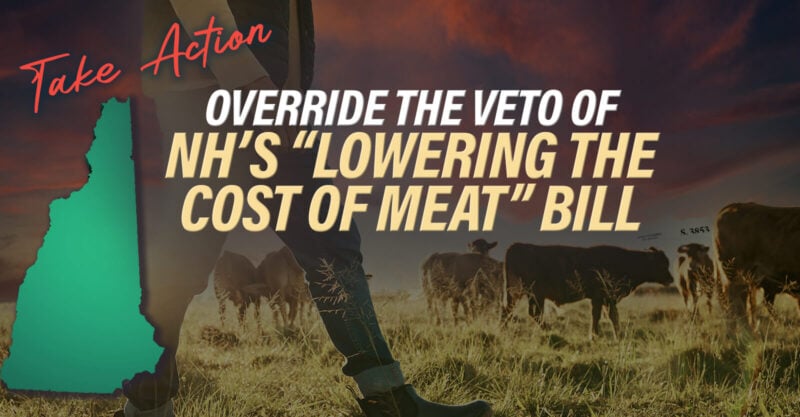
On May 21, HB 396 — which would have allowed New Hampshire’s livestock farmers to sell a limited amount of home-slaughtered and processed meat without going through the federal government’s USDA inspection process — was officially passed by both houses of the NH legislature.
However, the “Lowering the Cost of Meat” bill was vetoed by Governor Kelly Ayotte on July 10.
Between 2017 and 2022, the United States lost roughly 142,000 farms and about 20 million acres of farmland while meat processing became concentrated in the hands of Big Ag. Today, only four companies control 85% of beef processing in the US. Livestock farmers retain a shrinking portion of the retail price, and consumers pay more and more at grocery stores and restaurants.
Of great concern regarding quality and safety, USDA inspections have been recently degraded by increasing the speed with which inspectors must “inspect” animals, and by shifting some of their role to factory employees. These actions resulted in a reduction of animals flagged for problems by 3.5x, according to the Humane Farming Association.
With only four USDA inspection facilities in the state, the system in place has extended wait times of 18 to 24 months, preventing farmers from being able to ensure their livestock will be processed at all.
The current process has led to near-monopolies that have created bottlenecks and shortages, which have triggered enormous price increases.
HB 396 would have:
- Allowed New Hampshire’s farmers to slaughter and process their own livestock, enabling the sale of up to three cattle, or five swine or ten sheep or goats per month.
- Allowed livestock farmers to sell directly to consumers and restaurants.
- Required the meat to be labeled with its farm of origin, contact information for the farm, and date of slaughter, and, when served in restaurants or sold, labeled as being initially processed at the farm and exempt from state inspection.
- Required appropriate storage temperatures.
- Mandated testing of ground meat for E. coli and Salmonella.
- Established traceability and transparency to help guarantee quality while lowering consumer costs by eliminating middlemen.
- Allowed for the processing of livestock humanely and efficiently.
- Required yearly herd inspections.
- Challenged federal preemption of state authority for meat regulation.
On August 19, the state legislature will vote on overriding the Governor’s veto, with a two-thirds vote needed in each house for success.
It’s time to reclaim freedom from Big Ag tactics and federal restrictions placed upon New Hampshire’s livestock farmers. Contact your New Hampshire legislators today and urge them to override the Governor’s veto of HB 396!