
 Login
Login


Public Health Officials Never Engaged in ‘Good-faith Conversation’ About Risks, Benefits of COVID Shots for Kids
In “Within Reason: A Liberal Public Health for an Illiberal Time,” Boston University School of Public Health Dean Sandro Galea argues the U.S. public health establishment succumbed to political encampment, intellectual intolerance and a “retreat from the principles of free speech, open debate, and the pursuit of knowledge” during the pandemic.
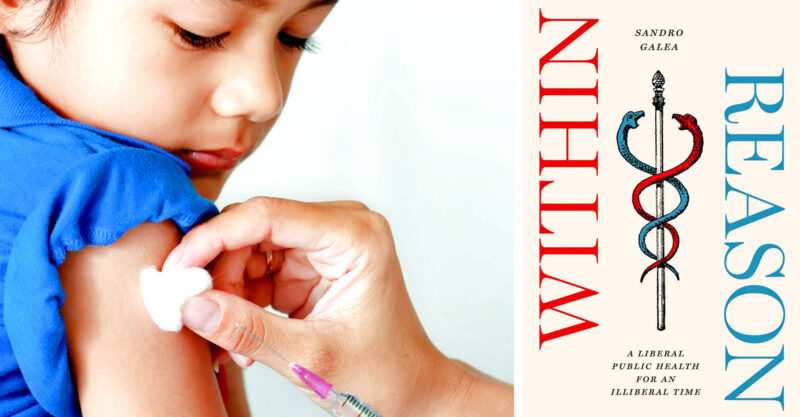
In his book, “Within Reason: A Liberal Public Health for an Illiberal Time,” author Sandro Galea, dean of the Boston University School of Public Health, chronicles how U.S. public health has strayed from its liberal roots in recent years, especially during the COVID-19 pandemic.
The book argues that the public health establishment became enmeshed in political encampment and intellectual intolerance as the pandemic response unfolded.
This represented “a retreat from the principles of free speech, open debate, and the pursuit of knowledge through reasoned inquiry that should inform the work of public health,” according to Galea.
Across 50 essays, Galea outlines five key areas where he believes the field has fallen short: the politicization of public health science, an unwillingness to weigh trade-offs, the influence of media bubbles and social media over peer review, valuing bureaucratic influence over truth-seeking and a forgetting of public health’s philosophical roots in the liberal tradition.
In a Substack post explaining his motivation for writing “Within Reason,” Galea said public health’s “partisan bias has become increasingly explicit and entrenched” in a manner that echoes “the influence trading engaged in by political advocacy organizations.”


He cited as an example the Centers for Disease Control and Prevention “working with teachers’ unions and the Biden administration to shape pandemic policies for schools.”
On the issue of childhood COVID-19 vaccinations, Galea contended that “public health has not engaged” in a “good-faith conversation” weighing the benefits against potential risks. “Instead, we have let those who express legitimate concerns about these tradeoffs be painted as ‘anti-vaxxers,’” he wrote.
He also lamented public health’s “unwillingness to fully address the tradeoffs involved in decisions about health,” such as lockdown policies. Support for anything short of indefinite closures was characterized by some “as a betrayal of our core mission,” Galea noted.
“In a historical moment characterized by increasing complexity, such zero-sum thinking will not serve us well in the long-term,” he wrote.
Galea argued the influence of social media has undermined scientific debate, as criticism of contrarian views like the Great Barrington Declaration “was overwhelmingly amplified by social media rather than by the empirically informed consensus that emerges from a process of peer review.”
The public health field’s association with progressive politics “became particularly significant as the 2020 election unfolded,” he wrote, creating opportunities to do good, but also necessitating “a level of deference to a party line.”
Above all, Galea argued, public health strayed from its Enlightenment values of “free inquiry and scientific reasoning” during the pandemic.


“Rather than fully engage with the substance of arguments that did not fit neatly in the mainstream of public health opinion, some in public health have attacked the motives of those making such arguments, shutting down debate,” he wrote.
Galea stressed his critiques emerge from his progressive values and desire to strengthen the field of public health. He continues to see himself siding with the political left, but this commitment is to “the liberal ideal, one where we build a better world based on reason, not ideology.”
Galea said he hopes the book will generate important conversations and self-reflection within public health.
“There are times when it is important to launch the self-reflection that can make us better,” he wrote. “And it is a sign of strength — not weakness.”
Spanning issues from race, class, politics and freedom of speech to the roles of bureaucracy, tradition, objectivity and history in shaping health, “Within Reason” offers a wide-ranging critique of how public health has strayed from its liberal roots across a mosaic of societal forces that influence the field.
Galea reads selections from his book on his website.
Do you have an article you’d like to share with the CHD Community? Here’s how to send it to us.
