
 Login
Login


‘Religion of Big Pharma’: Doctors, Citizens Face ‘Excommunication’ for Challenging COVID Narratives
Aaron Lewis, Ph.D., warns that a government-backed “religion of Big Pharma” has taken hold in America, rewarding obedience while punishing skepticism and debate. Citing censorship, vaccine mandates and disciplinary actions against physicians, he argues that the suppression of dissent threatens both scientific inquiry and constitutional freedoms.
By Aaron Lewis, Ph.D.
Faith. Obedience. Consequences for dissent. Throughout history, these have been pillars of religious communities, structures designed to foster unity, reverence and commitment to a shared truth. At their best, faith is a profound trust in God or a higher purpose, offering hope and meaning.
Yet, when faith becomes dogmatic, rooted in unquestioning allegiance to authority and rigid adherence to doctrine, it can sometimes lead to exclusion or punishment of those who challenge the prevailing narrative.
Today, these same dynamics extend beyond the boundaries of church, mosque or synagogue. In 21st-century America, we are witnessing the emergence of a new orthodoxy: the religion of Big Pharma, sanctified and enforced by the very government sworn to protect our freedoms.
Let’s call it what it is — a de facto state religion, forged not in the fires of spiritual salvation but in the laboratories of the medical-industrial complex (MIC). Here, white coats are the new vestments, “trust the science” has replaced “trust God,” and those who dare question the mandates are cast out, deplatformed, shunned and ridiculed with all the fervor of a modern-day witch hunt.
In its zeal, the government has done exactly what the framers of our Constitution forbade: it has established a new faith, and woe to those who refuse to kneel.
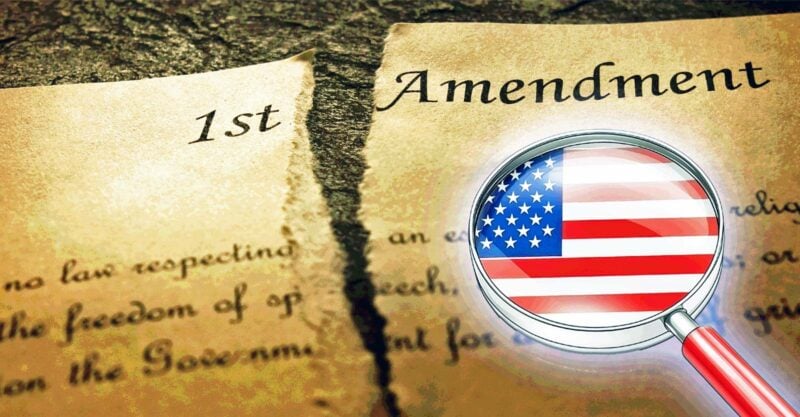
The Establishment Clause of the First Amendment is clear and uncompromising: “Congress shall make no law respecting an establishment of religion, or prohibiting the free exercise thereof.”
The founders wrote this to protect the American people from the tyranny of state-sanctioned faith, ensuring no government could dictate belief, demand ritual or punish dissent. This is the bedrock of religious freedom, a firewall between personal conscience and official decree.
Yet, what happens when the government bypasses tradition and establishes a new kind of religion? One built not on ancient texts but on scientific mandates, enforced by the MIC and Big Pharma?
When obedience is demanded and dissent is punished, the spirit of the Establishment Clause is not just ignored — it is trampled. In forging this modern orthodoxy, our leaders have violated the very constitutional principle meant to shield us from such dogma.
Look closer, and the parallels between organized religion and the medical establishment are impossible to ignore. The symbols, the rituals, the reverence for authority — all the hallmarks of faith transplanted seamlessly into the world of modern medicine.
Clergy and vestments
In traditional religion, particularly in the Christian tradition, clergy don robes, collars and garments signifying their authority, rank and spiritual purity.
The medical establishment has its own vestments: the white coat. This isn’t just a uniform. It is a symbol, a visual cue that signals trust, expertise and unquestionable authority.
The “priesthood” of science is populated by doctors, researchers and public health officials, elevated to near-sacred status. Their word is doctrine; their guidance is gospel. Questioning them is not merely discouraged. Questioning is treated as heresy, as if challenging the divine order.
Rituals and sacraments
Religion’s power is rooted in ritual: baptism, communion, prayer and fasting. These acts bind communities and reinforce beliefs.
Modern medicine has its own sacraments: vaccinations, annual checkups and prescribed treatments. Each is performed with ceremony, each accompanied by solemn assurances of their necessity and sanctity.
The language of medicine, dense with jargon and acronyms, serves as a sacred tongue accessible only to the initiated. Like Latin Mass or Hebrew prayers, it excludes outsiders and reinforces the authority of those who speak it.
Dogma and doctrine
Every religion has dogma, beliefs that must not be questioned, commandments to be obeyed.
Today, “trust the science” is the new catechism. Medical guidelines, advisories and mandates are issued as secular commandments.
The faith of the congregation is measured not by their knowledge, but by their willingness to accept these teachings without skepticism.
Dissent is branded as dangerous, misinformation or “anti-science,” echoing centuries of religious condemnation for blasphemy.
Promised salvation and eternal life
At the heart of many religions is the promise of salvation, healing or eternal life.
Big Pharma offers its own brand of deliverance: health, safety, longevity. The promise of “safe and effective” is uttered with a certainty reminiscent of religious assurances.
Obedience brings the hope of utopia, a sanitized, disease-free future for those who follow the rules. Those who resist are cast as threats to the collective salvation, held up as examples of what happens to the unfaithful.
The parallels are not only striking, but also indicting, revealing a system that demands belief, rewards obedience and punishes dissent with the zeal of any ecclesiastical order.
Methods of enforcement: obedience and excommunication
At the heart of every powerful religion lies a mechanism for enforcing obedience and punishing those who stray. In the age of Big Pharma, these ancient methods have simply been rebranded for modern times:
- Shunning and exile: Where religions excommunicate, the medical establishment deplatforms. The heretic of old was cast from the church, condemned to social and spiritual exile. Today, those who refuse to accept medical dogma, or, worse, publicly question it, are shunned with equal fervor. “Anti-vaxxer” has become a scarlet letter, used to shame and silence. Doctors who stray from the accepted narrative risk losing their licenses, their livelihoods and their reputations. Ordinary people have been denied services, jobs and even access to public spaces, all for refusing to bow at the altar of mandated medicine.
- Dissent is heresy: Religious orthodoxy has always guarded its doctrines with a jealous eye, punishing those who dare to question. The modern medical complex is no different. Whistleblowers, critics and advocates for informed consent are branded as heretics; spreaders of “misinformation.” The fate of those who resist is public humiliation, professional ruin and digital erasure. Dissent is not only discouraged — it is actively hunted and purged, as if the very act of questioning is a mortal sin.
- Mandated obedience: Throughout history, religious authorities have imposed mandates: attend church, confess sins, observe rituals. The medical establishment has its own mandates — vaccines, masks, compulsory treatments, enforced by law, media and social pressure alike. The government, once the protector of individual conscience, now acts as the high priest, issuing decrees and demanding sacrifice for the greater good.
Consider the story of Jim Jones, the infamous cult leader whose unchecked authority led to the Guyana Tragedy, 909 souls lost in a mass suicide and murder, including a sitting U.S. congressman.
The American government rightly condemned Jones’ tactics: the excommunication of dissenters, the ruthless enforcement of obedience, the absolute intolerance of questioning. Jones’ authority was total, his word unchallengeable, his system of control fatal.
Yet today, we see the same dynamics at play, an unquestionable authority, the shunning of nonbelievers and mandates enforced with the threat of exile. The tragedy of Jonestown stands as a warning: when obedience is demanded at all costs, when authority cannot be questioned, the price is always paid in human suffering.
Our government once denounced these cultic tactics — now, it seems to have adopted them, cloaked in the language of public health.
From separation to collaboration
The First Amendment was designed to keep government and religion at arm’s length, a constitutional firewall barring the state from establishing or endorsing any faith. Yet, in the era of Big Pharma, that separation has not merely eroded — it has been willfully dismantled.
The federal and state governments have become the chief enforcers of medical “doctrine,” wielding the power of law, regulation and relentless public messaging to demand obedience.
Through mandates for vaccines in schools and workplaces, the government has codified medical ritual into law. Public funding for pharmaceutical giants and the legal immunity granted to vaccine manufacturers represent a direct pipeline from the public treasury to the coffers of the new priesthood.
Public-private partnerships have blurred the lines between the state and the medical-industrial complex, creating an apparatus that operates above reproach or accountability.
But the state’s collusion doesn’t end there. Explicit government pressure on social media platforms to suppress “misinformation” has led to the systematic deplatforming and silencing of dissenters, a digital excommunication. The government has not only enforced its orthodoxy but has actively punished those who question it, in direct contradiction to the free speech guarantees of the Constitution.
As revealed by PBS News (Aug 27, 2024), Meta CEO Mark Zuckerberg admitted that senior Biden administration officials pressured Facebook to “censor” certain COVID-19 content during the pandemic. Zuckerberg even vowed that Facebook would push back if faced with such demands again, yet this stunning admission resulted in no reprimand or consequence.
The betrayal of the American people was met with indifference, and the machinery of censorship rolled on.
And perhaps most egregiously, the government has invaded the sanctuaries of churches, synagogues and mosques, institutions once protected by the Establishment Clause, and conscripted them as agents of its new faith. Houses of worship have been publicly praised and rewarded for hosting vaccine clinics, with clergy urged to preach the gospel of “trust the science.”
Rhetoric from officials has crossed the line into blasphemy, with claims that “God created vaccines,” and that taking the shot is a divine commandment. Dissenting congregations, those refusing to align their altars with the state’s mandates, have been demonized, shamed, some pastors arrested and imprisoned, and in some cases, denied access to grants or public platforms.
This is not mere collaboration — it is a usurpation of authority and an unconstitutional imposition of a new state religion. The government, by leveraging its power to favor, coerce and punish religious institutions based on their obedience to medical mandates, has violated the very principle it was designed to uphold.
The Establishment Clause was not written for times of comfort, but for moments exactly like this, when the state, cloaked in the guise of public welfare, dares to dictate faith, ritual and belief.
Evidence of a de facto state religion
The cumulative evidence is undeniable: America’s medical establishment, empowered by government authority, has become a secular state religion. The vestments have changed, but the machinery of faith remains. White coats and stethoscopes have replaced robes and collars; “trust the science” has become the new creed.
Like any religion, this system rewards the faithful — those who obey mandates, repeat the dogma and participate in the prescribed rituals. Rewards come in the form of social acceptance, employment and unrestricted public participation.
Dissent, however, is met with swift and ruthless punishment. Critics are cast out, deplatformed, shamed, stripped of professional credentials and rendered social pariahs. Even questioning the orthodoxy is enough to trigger excommunication, as seen in the silencing of prominent doctors, scientists and everyday citizens who dared to ask for evidence or advocate for informed consent.
The government, in partnership with its medical priesthood, has created a closed system where questioning is not tolerated, and deviation is crushed with religious zeal.
There is no shortage of examples. The American Board of Internal Medicine (ABIM) revoked Dr. Peter McCullough’s certifications in cardiovascular disease and internal medicine after he publicly questioned the safety and efficacy of mRNA vaccines and advocated for alternative COVID-19 treatments.
Dr. Pierre Kory and Dr. Paul Marik, co-founders of the Front Line COVID-19 Critical Care Alliance (FLCCC), faced similar professional excommunication for their promotion of ivermectin as a COVID-19 therapy — their board certifications were stripped for what was deemed the spread of “unproven treatments.”
Dr. Scott Atlas, a prominent physician and adviserr to President Donald Trump, was publicly vilified for suggesting a herd immunity approach and challenging mask and lockdown mandates, a stance that led to fierce backlash from the medical establishment and mainstream media. Even a sitting U.S. senator, Rand Paul, an ophthalmologist, has been relentlessly criticized and marginalized in public discourse, simply for demanding accountability, transparency and debate regarding pandemic policies.
By every rational measure, this is the very definition of an established religion, complete with doctrine, clergy, ritual, and enforced belief. In violating the Establishment Clause, our government has not merely blurred the line between church and state — it has redrawn it in the image of a new and powerful orthodoxy, where punishment for heresy is real, and faith in the system is non-negotiable.
Consequences and why this matters
The consequences of this de facto state religion are profound and far-reaching. First and foremost is the erosion of trust, not only in government, but in science itself.
When authorities demand uncritical obedience and punish dissent with excommunication, the public inevitably grows suspicious of both the message and the messenger. The sacred bond of informed consent, the right to weigh risks, ask hard questions and make personal medical choices, has been shattered.
Medical freedom, once a cornerstone of American liberty, is now subject to the whims of bureaucrats and unelected “clergy” in white coats.
Open debate, the lifeblood of scientific progress and democratic society, has been replaced by dogmatism and censorship. The chilling effect on physicians, researchers and ordinary citizens who fear professional or social ruin for speaking out cannot be overstated.
What began as a public health response has metastasized into a broader assault on constitutional rights and civil liberties. The Establishment Clause was designed to protect against precisely this kind of state-mandated orthodoxy, yet it has been systematically undermined.
Let’s be clear: just as government must never interfere with religion, never favoring one faith over another, including the state “pharma” religion, it must not coerce the medical profession. There are more than 1,025,104 board-certified physicians in the U.S., each trained, tested and sworn to serve the public in good faith.
Yet those most quickly deplatformed are not criminals or quacks — they are legitimate doctors who, by virtue of their experience, dare to question a protocol or suggest an alternative. That is terrifying. To be erased, not for malpractice, but for independent thought because you chose a different way than the government, the medical-industrial complex or the handful of doctors anointed as the “popes of healing” — is not just wrong, it is a grave violation of everything America is supposed to stand for.
If we allow any government, under the guise of science or security, to decide which beliefs are acceptable and which voices may be heard, we risk losing not just our freedoms, but the very soul of our republic; if we haven’t lost it already.
Galileo’s sentence: Are we next?
In 1633, Galileo Galilei stood before the Catholic Church, accused of heresy for daring to challenge dogma with science. He was forced to recant, silenced and sentenced to house arrest for the rest of his life — his punishment for independent thought and scientific inquiry.
Today, we face a new inversion of that tragedy. Now it is the government, armed with the machinery of Big Pharma, that seeks to suppress the church, the synagogue, the mosque — and all places of faith — demanding their allegiance and erasing the very notion of submission to God. The altar has shifted from the sacred to the secular, and the old guardians of conscience are being made obsolete.
If we do not re-examine the government’s role in enforcing medical orthodoxy, we risk trading the freedom to worship for the mandate to obey. Are we willing to let the soul of America, once grounded in faith, reason and liberty, be rewritten by edict, until even the act of questioning becomes a relic of the past?
The legacy of Galileo warns us: when debate is forbidden and authority reigns supreme, humanity always loses.
Aaron Lewis, Ph.D., is a humanitarian and religious liberty advocate. He is also the author of the forthcoming book, “The Point of No Return: An Examination of Irreversible Shifts in Society’s Core Institutions.”