 Login
Login


‘Honestly Not Sure What the Problem Is’: Mary Holland Tells Vermont Lawmakers That Changes to Federal Vaccine Policies Don’t Affect What States Can Do
All of the hullabaloo about new federal vaccine guidelines misses the fact that they don’t restrict states from adopting their own guidelines. That was part of the message Children’s Health Defense CEO Mary Holland brought to the Vermont State House on Feb. 3, when she testified to the House Committee on Health Care on the subject of “Prioritizing Children’s Health & Health Choice in Vermont.”
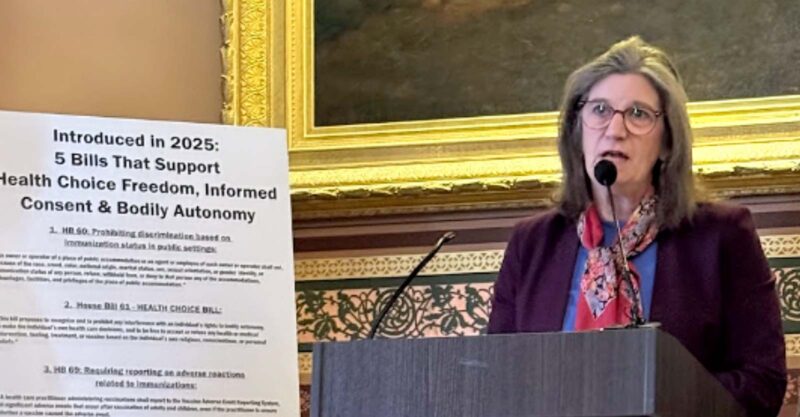
Photo credit: Vermont Daily Chronicle.
By Vermont Daily Chronicle
By Paul Bean
All of the hullabaloo about new federal vaccine guidelines misses the fact that they don’t restrict states from adopting their own guidelines.
That was part of the message Children’s Health Defense CEO Mary Holland brought to the Vermont State House on Feb. 3.
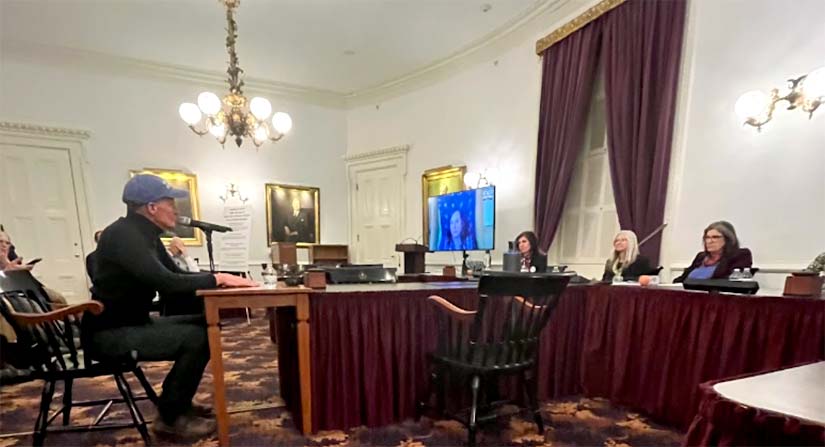
Holland testified to the House Committee on Health Care on the subject of “Prioritizing Children’s Health & Health Choice in Vermont.”
The visit aligned with “Children’s Health Day,” an advocacy event at the Statehouse promoting health policy choices, including vaccine-related issues. This event was organized by Amy Hornblas with Vermont Stands Up, Vicki Dubin Master with MAHA-Vermont and Alison Despathy.
Children’s Health Day kicked off with a press conference in the Cedar Creek Room prior to her committee testimony. Speakers included Rep. Gregg Burt (R-Cabot), who is responsible for introducing a handful of health freedom bills, including House Bill 60: An act relating to prohibiting discrimination based on immunization status.
Holland told the committee some of the emerging data on childhood chronic disease, obesity and vaccine safety in reference to H.545, a bill that would allow the “Commissioner of Health to issue immunization recommendations for children and adults as part of the Department’s immunization program.”
H.545 was introduced as a response to a presidential memorandum and under the direction of HHS leadership, including U.S. Health Secretary Robert F. Kennedy Jr., which significantly overhauled the U.S. childhood immunization schedule by reducing the number of diseases with routine, universal vaccine recommendations for all children from 17 to 11, aligning with schedules in many peer-developed nations, specifically in Europe.
Vaccines previously recommended routinely — such as those for COVID-19, influenza, rotavirus, hepatitis A and B, meningococcal disease and RSV — were reclassified to either high-risk groups only or subject to shared clinical decision-making between providers and parents, while preserving access to them through healthcare.
“All vaccines are still available,” Holland told the committee.
“All vaccines are still covered by insurance. All vaccines are still covered by the injury compensation program that was set up by the 1986 National Childhood Vaccine Injury Act. So I’m not honestly sure what the problem is that Vermont and 18 other states believe that they’re fixing that exists right now. Because, really, federal policies has not changed anything that the states can do in terms of vaccines.”
Holland also explained that while Vermont is one of the healthier states in the country, we are not excluded from some of the broader health concerns affecting the nation.
“Over 77 percent of young adults, 18-year-olds, are ineligible for military service, meaning that they don’t have the mental health or the physical health to allow them to serve in the military. So obesity, poor physical fitness, mental health challenges. So we have sick kids,” said Holland to the committee.
“I think we have to acknowledge that we have a chronic disease epidemic. And the Make America Healthy Again report that was commissioned by the president last year, about a year ago, starts to address that.”
“I know that one of the bills here, 61, is really to say anything that interferes with bodily autonomy and discriminates against people who are not in compliance with a violation of bodily autonomy should not be the case, that there should be full choice,” said Holland in reference to a bill introduced by Rep. Mark Higley, titled H.61 An act relating to bodily autonomy and health care decision making.
Holland also referenced in testimony what she considers the best health freedom bill in the country, which was introduced and passed in Idaho, called “The Idaho Medical Freedom Act.”
“Idaho is the first state that has passed a true health freedom bill, basically saying that nobody can be deprived of schooling or be deprived of a job based on their vaccination status or any other they can’t be mandated to wear a mask and so forth, any other medical intervention. So basic ideas here really should be prior free and informed consent.
“That’s the modern standard for medicine. That should be the case for you and your minor children. We shouldn’t be allowing nine-year-olds to make vaccine decisions, as is the case in several states in the country.”
Later in the day, the crowd that had gathered for Holland’s visit met for a panel in room 11 to discuss what was said during the testimony and how everyone thought it went. To the surprise of none of us, the committee did not ask any questions or even comment on Holland’s presentation.
That being said, the testimony was a huge step in the right direction because last year Holland was given a time to speak to only have her name removed from the schedule an hour before she was supposed to speak.
Vicki Dubin-Master with MAHA-Vermont also shared with us all some of the major wins that have happened for MAHA since RFK Jr.’s appointment. These include the changes in vaccine recommendations, removing food dyes, increased research on what’s actually causing autism, changes in the recommended diet and food pyramid and so much more.
The day finished with a gathering for dinner at the Capital Plaza hotel, where attendees shared stories, experiences and prayers.
Prayers were offered for the health of our nation, our state, our community members and our families. Many of us shared our thanks to be together amongst friends and for Holland’s visit.
“We might have to make this an annual thing,” I overheard Holland say as people started gathering their things to say goodbye.
Vermont House Bill H.545, titled “An act relating to issuing immunization recommendations,” passed the House on Jan. 23, by a vote of 127 yeas to 9 nays.
It was sent to the Senate, read for the first time on Jan. 28, and referred to the Senate Committee on Health and Welfare. As of early February, the bill remains in the Senate Committee on Health and Welfare.
Watch the press conference here.
Watch Mary Holland’s testimony here:
Originally published by the Vermont Daily Chronicle.
Paul Bean is the social media director for the Vermont Daily Chronicle.
The views and opinions expressed in this article are those of the authors and do not necessarily reflect the views of Children’s Health Defense.
Do you have a story you’d like to share with the CHD Community? Click here for details.