 Login
Login


Locking Pigs in Crates Isn’t a Recipe for Better Health
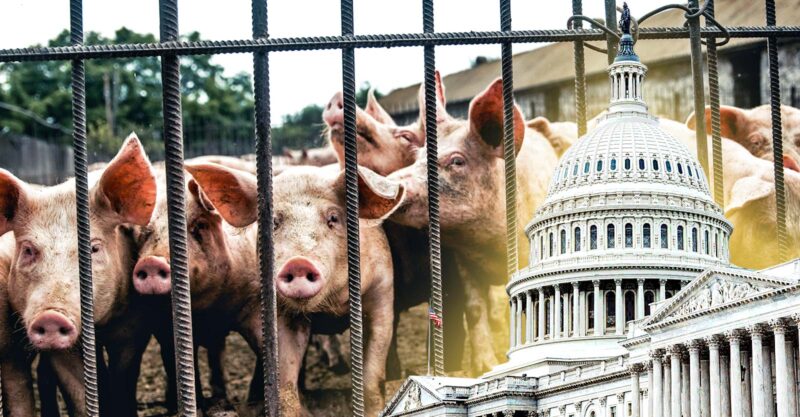
The Save Our Bacon Act belongs nowhere near the Farm Bill. It would block states from setting higher animal welfare standards — such as California’s voter-approved Proposition 12, which bans gestation crates for pigs — and reward large pork companies at the expense of farmers who invested to meet those requirements.
By Angela Huffman
People want healthier food, and voters have passed laws to require better standards for how that food is produced. American family farmers are meeting those standards.
But industrial pork producers, including foreign-owned Smithfield, are pressuring Congress to take those standards away.
That is the fight over the so-called Save Our Bacon Act, which lawmakers should keep out of the final Farm Bill.
The bill would strip states of the right to set higher standards for food sold within their own borders. Its main target is California’s Proposition 12, a voter-approved law that requires pork, eggs and veal sold in the state to meet stronger animal welfare standards.
For pork, Proposition 12 bans gestation crates by requiring breeding pigs to have enough space to stand up, lie down, turn around and extend their limbs. Gestation crates keep pregnant pigs in stalls so small they cannot turn around.
Many independent farmers have already adapted to meet those standards and sell into California’s Proposition 12 market.
Farmers who invested to meet the market should not have the rules changed after they’ve already made those investments. Congress should not punish them while rewarding the largest pork companies that want to preserve the old confinement model.
Sen. Roger Marshall of Kansas recently withdrew his support from the U.S. Senate version of this bill. Marshall is a physician and chairman of the Make America Healthy Again (MAHA) Caucus.
The U.S. Senate Committee on Agriculture, Nutrition and Forestry appears to have followed his lead by leaving the measure out of its Farm Bill draft. Lawmakers should keep it that way.


Pigs are rooting, foraging animals. They move, explore, nest and wallow. A system that locks them in place denies those basic behaviors and creates stress by design.
Intensive confinement systems concentrate animals in ways that can increase disease pressure and contribute to reliance on antibiotics. According to U.S. Food and Drug Administration data, swine accounted for about 44% of U.S. sales and distribution of medically important antibiotics approved for use in food-producing animals in 2023.
Antibiotic resistance does not stay on the farm. The Centers for Disease Control and Prevention says antimicrobial resistance can spread between people, animals and the environment, including water and soil.
The implications extend beyond pork.
A Harvard Law School analysis found the Save Our Bacon Act could jeopardize more than 600 state laws and regulations, including measures related to food safety, disease prevention and consumer protection.
At a time when states may need to respond quickly to animal-health threats like New World screwworm, lawmakers should think carefully before giving Congress the power to wipe out state food and agriculture protections nationwide.
The pork lobby already challenged Proposition 12 at the U.S. Supreme Court and lost. Now, corporate pork is asking Congress to do what the court did not do.
The Farm Bill should help farmers stay in business. It should support healthier food and fairer markets. It should not be used to strip states of the right to set basic standards for food sold within their borders.
The Senate should keep the Save Our Bacon Act out of the Farm Bill and reject any amendment that tries to add it back in.
Keeping pregnant pigs locked in crates will not make America healthier.
Protecting confinement-heavy production will not reduce disease pressure, antibiotic dependence or public concern about how food is raised.
Congress should support farmers who are building a healthier food system, not corporate pork companies trying to hold the old one in place.
Originally published in the Washington Examiner.
Angela Huffman is co-founder, president and CEO of Farm Action.
The views and opinions expressed in this article are those of the authors and do not necessarily reflect the views of Children’s Health Defense.
Do you have a story you’d like to share with the CHD Community? Click here for details.