 Login
Login


Colorado Abandons CDC Vaccine Guidance After Emergency Board Vote
Colorado health officials last month voted to drop CDC vaccine guidance and adopt immunization recommendations from the American Academy of Pediatrics through an emergency rule change. The move followed a recent federal advisory vote on hepatitis B vaccination and immediately altered how the state sets vaccine requirements for children and students.
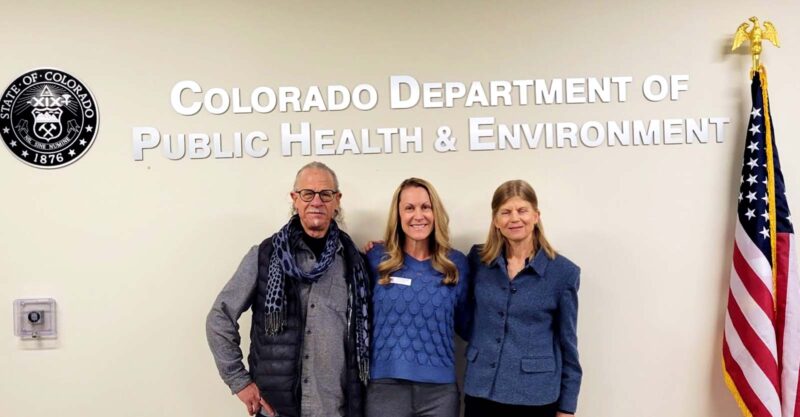
Left to right: Phil Silberman, Katy LeVasseur and Cynthia Nevison. Photo by CDPHE.
The Colorado Department of Public Health and Environment’s (CDPHE) Board of Health voted Dec. 17, 2025, to move away from vaccine recommendations issued by the Centers for Disease Control and Prevention’s (CDC) vaccine advisory board.
The state will defer to vaccine guidance from private trade associations, including the American Academy of Pediatrics (AAP), the American Academy of Family Physicians, the American College of Obstetricians and Gynecologists and the American College of Physicians.
The meeting had been planned for months. However, the CDPHE added an emergency rulemaking segment to the hearing in response to the Dec. 5, 2025, vote by the Advisory Committee on Immunization Practices (ACIP) to change the birth dose of the hepatitis B vaccine to shared clinical decision-making.
Colorado will implement the following changes immediately:
- Adopt the AAP’s 2025 Recommended Child and Adolescent Immunization Schedule.
- Add an appendix to define the immunization requirements for students ages 19 to 21 attending public, private or parochial schools through grade 12, since the AAP schedule applies only to children 18 and younger.
- Update language throughout the document to reflect the revised immunization schedule references.
I wasn’t sure what to expect as I walked into the CDPHE building for the hearing. I was used to fighting these vaccine policy battles at Colorado’s Capitol complex. This time, those of us testifying against the proposed rule changes had to appeal to unelected board members who were far less accountable to the public than state legislators.
It was not surprising to hear most board members assert — both in their commentary and through their votes — that they alone follow evidence-based science, while the current ACIP committee does not.
Still, it was deeply disappointing to see their unwillingness to acknowledge that our side also presented data and evidence. Rather than engaging with that information, they dismissed it, while failing to offer substantive scientific evidence of their own.
That said, there were some genuinely refreshing moments. The votes were not unanimous, and a few board members brought thoughtful dissent to the discussion.
Commissioner Stan VanderWerf, in particular, did not back down. He pressed key issues, including the coercion families face when attempting to opt out of mandated vaccines. VanderWerf emphasized the need for transparency around exemption options for Coloradans.
It was great to see a board member openly champion parental rights at CDPHE.
With more vaccines shifting to a shared decision-making model, CDPHE has adopted rules to preserve Colorado’s existing requirements. It will be interesting to watch how this approach affects state liability, especially as a growing number of states move further away from the federally recommended schedule.
These states include California, Hawaii, Illinois, Minnesota, New Hampshire, New Jersey (pending), New Mexico, New York, North Carolina, Oregon, Washington and Wisconsin.
Now is the moment for communities nationwide to contact their local elected officials and speak out in support of the efforts by the U.S. Department of Health and Human Services to restore transparency, accountability and honest scientific debate in public health policy.
What’s happening in Colorado isn’t an isolated case. It reflects a broader, coordinated push in multiple states to sidestep federal reforms and maintain business as usual — often behind closed doors and with little public accountability.
Real science thrives on debate, not decrees. Yet too often, policies affecting children are shaped by institutions and industries with enormous financial stakes, while parents and independent experts are brushed aside.
If children’s health were truly the priority, then open discussion, informed consent and rigorous scrutiny would be welcomed — not treated as threats.
Communities must demand policies that put people before profits and health before industry influence, because decisions made today will shape the well-being of families for generations to come.
Do you have a story you’d like to share with the CHD Community? Click here for details.