
 Login
Login


CHD Book Club: The Fight Against Monsanto’s Roundup: The Politics of Pesticides
When readers want to engage with books in greater depth, they form book clubs so they can explore the material with friends and like-minded folks. That’s the idea behind the CHD Book Club!
When readers want to engage with books in greater depth, they form book clubs so they can explore the material with friends and like-minded folks. That’s the idea behind the CHD Book Club!
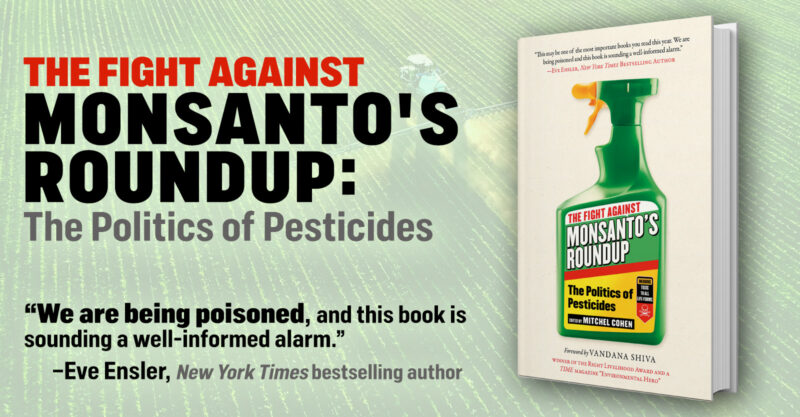
The second selection (February, 2023) in the CHD Book Club is “The Fight Against Monsanto’s Roundup: The Politics of Pesticides,” edited by Mitchel Cohen.
Chemical poisons have infiltrated all facets of our lives — housing, agriculture, work places, sidewalks, subways, schools, parks, even the air we breathe. More than half a century since Rachel Carson’s Silent Spring ignited the fight against environmental poisons, “The Fight Against Monsanto’s Roundup” takes a fresh look at the politics underlying the mass use of pesticides and the challenges people around the world are making against the purveyors of poison and the governments that enable them. The book takes lessons from activists who have come before and offers a radical approach that is essential for defending life on this planet and creating for our kids, and for ourselves, a future worth living in.
Here are some thought-provoking discussion questions to think about as you read “The Fight Against Monsanto’s Roundup.” In addition, we invite you to view the Friday Roundtable featuring editor Mitchel Cohen and Jonathan Latham, author of one of the book’s chapters, as well as our in-depth interview with the editor and chapter authors on Good Morning CHD on Saturday, February 18, 2023.
Questions for Discussion
- The book provides some chilling history: In 2018 Monsanto was bought by the German company Bayer, which most Americans associate with aspirin. But Bayer is a stepchild of the Nazi chemical cartel IG Farben that was seized by the Allies after World War II. The Nazis killed millions of innocent people by filling gas chambers with Zyklon B, a chemical made by Farben. Even before the Nazis made such horrific use of it, the U.S. government used the same Zyklon B in the 1930s to “decontaminate” Mexican migrant workers without their consent. How does this early history of corporate–government cooperation in toxic chemical use inform your understanding of more recent toxic assaults?
- Zyklon B was used extensively during World War II, as was DDT, the insecticide that the FDA banned in 1972, long after Rachel Carson’s “Silent Spring” made the public aware of just how poisonous it was. Agent Orange, another extremely toxic chemical made by Monsanto and other chemical companies, was used to defoliate the jungles of Vietnam during the Vietnam War. What role do you think the military plays in the development of toxic chemicals and their use in the civilian population?
- In 2007 the U.S. Ambassador to France, advised the U.S. to “prepare for economic war” with countries that were not interested in Monsanto’s genetically modified corn. Secretary of State Hillary Clinton, among others, pressured these countries into buying Monsanto’s products. How does U.S. foreign policy further the goals of chemical companies like Monsanto? Why would the government adopt policies that do so?
- The director of the Department of Agriculture asked for money to “combat resistance” to GMO foods and make it much harder to require GMO labeling. How does U.S. domestic policy further the goals of chemical companies like Monsanto?
- The book argues that new chemicals are presumed harmless until proven otherwise, providing a low threshold for approval. On the other hand, getting chemicals taken off the market requires a high burden of proof of toxicity. How does this imbalance affect corporate profits? How does it affect the consumer?
- We know from works like Stephanie Seneff’s “Toxic Legacy” that glyphosate, Roundup’s main ingredient, is highly toxic on its own. But this book emphasizes the fact that Roundup isn’t “just” glyphosate, the only “active ingredient” listed. Monsanto considers the rest of the formulation a “trade secret.” How do the other ingredients affect Roundup’s toxicity? Should Monsanto (now Bayer) be allowed to keep these ingredients secret?
- In chapter 12, “Unsafe at any Dose? Glyphosate in the Context of Multiple Chemical Safety Failures,” Jonathan Latham, PhD, points out that doing the studies required to establish true safety before approving each new chemical is impossible. That implies that arguments citing inadequate testing for safety are misguided and can backfire. Latham also argues that efforts to ban specific chemicals are wrong-headed and likely to backfire as well. Do you agree with him? Why or why not?
- In the book’s first chapter, “Roundup the Usual Suspects,” New York City officials, trying to combat West Nile virus by killing the mosquitos that carry it, ask Mitchel Cohen and Cathryn Swan, “Which less toxic chemical sprays should we use?” Cohen and Swan answer, “None! Bring in goats, dragonflies, bats!” The city officials see that as absurd. How does this conversation encapsulate the problem for activists who wish to live in a less-toxic world? And does it imply a solution?
- Chapters 16 — “Big Science and the Curious Notion of ‘Progress,’” by Mitchel Cohen — and 17 — “When Rights Collide: Genetic Engineering & Preserving Biocultural Integrity,” by Dr. Martha Herbert — argue for a radically different way of looking at science and the scientific method. “It is a way of finding out about the world that entails cutting it up into bits and pieces (conceptually, as well as in actuality),” says Cohen, “and attempts to reconstruct the properties of the system from the ‘parts of the parts’ so produced, as they futilely try to put Humpty Dumpty together again by piecing together the individual fragments.” Do you agree with this assessment? Why or why not? If you agree, do you see this as a problem? If so, is it a problem that can be solved?
- “I — and others — have been saying for years that destruction of the environment is based on contempt for everything outside the human skin,” Alan Watts is quoted as saying in 1974. “We are not in nature; we are nature. But as masters of technical weapons we are fighting the environment as if we still believed ourselves to be strangers on the earth, sent down into this world from a purely abstract, ideational, and spiritual heaven.” Do you agree with Watts? Why or why not? What would happen if all humankind saw itself as part of nature rather than the master of nature?
- In her chapter (17), Dr. Herbert says, “The patenting of altered genes and seeds turns living beings into intellectual property and profit-generating biomachines. This occurs in an economic system where the overall goal is accumulation of profit. Getting rich means having more money, and ‘money’ itself is an abstraction dissociated from the particular qualities of the commodities that are produced and sold. One can get rich from selling corn flakes or nerve gas — it doesn’t really matter. The compulsion to implement a more efficient means of capital accumulation overwhelms all other considerations.”Similarly, Cohen quotes an article by Kurtis Bright, “. . . the next time you hear some defender of GMOs talk about how companies like Monsanto are just benevolent corporations looking to feed the hungry people of the world, remind them that Monsanto is a chemical company first, and a seed company second. And that they have only one motive: profit. And if the death and maiming of children and civilians is the path to profit, they will not hesitate to take it.”The “economic system” Herbert describes is clearly capitalism. Do you think capitalism itself is what enables companies like Monsanto to poison the world with impunity? Why or why not? If so, what do you see as the solution?
- In the book’s introduction, Cohen asks, “Will the growing awareness of pesticides and their effects on our lives broaden into critical challenges on related issues such as habitat fragmentation and destruction, climate chaos, agribusiness based on monocropping, genetic engineering, patenting of seeds, and the loss of biodiversity? Will activists in the United States and other industrial countries be able to force their governments to reverse course? Will they succeed in challenging the corporate quest for ever-increasing profits and control? To do so requires those reading this book to be reborn as ecology activists who strive to win society to a different way of looking at human interactions with nature — no easy task, in current circumstances — and to take action based on that transformed consciousness.”